The shake you drink at the finish line decides less about your recovery than the time of your next start. Race again the same afternoon and carbohydrate in the first four hours becomes the priority. Race again the next morning and the day's carbohydrate total counts for more than any single meal. With two or three days to go, ordinary meals do the refuelling, and soreness keeps its own schedule whatever you eat.
The 20 sources reviewed here include no published study that tested a feeding or drinking plan after HYROX or measured glycogen, muscle damage, soreness, or repeat performance after a race. The HYROX evidence describes the race itself. It is eight 1 km runs, each followed by a fixed station, from the SkiErg to 100 wall balls.1 The rulebook lets a doubles team race twice in the same division at one event, and lets World Championship qualifiers enter more than one division when start times do not clash.2 Brandt and colleagues timed 11 recreational athletes through a simulated Open race and recorded a median of 86.5 minutes, with about 80 percent of it in the very hard heart rate zone and peak lactate of 8.5 mmol/L.3 Elite medians in season 7 were about 57 minutes for men and 63 for women.4 Those numbers describe the effort, and none of them says how empty your muscles are at the finish or how fast they refill.
The recovery numbers below come from general sports-nutrition consensus and studies of cycling, running, resistance exercise, and functional fitness. Many trial samples were small and made up of young men. Treat the ranges as starting points to adjust to the race you just finished and the effort still ahead.
01How the next start time changes post-race carbohydrate
Muscle rebuilds glycogen slowly. The ACSM joint position statement puts resynthesis at roughly 5 percent per hour,5 so a few hours can restore only part of a large deficit however well you eat. Timing matters when the hours are scarce. Burke, van Loon, and Hawley's 2017 review concluded that eating immediately matters when 4 to 8 hours separate two sessions, and that from about 4 to 24 hours the total carbohydrate eaten matters more than its type, form, or meal pattern.6 In Ivy's 1988 trial of 12 male cyclists, delaying the same carbohydrate dose by 2 hours slowed storage by 45 percent.7 In Parkin's 1997 trial of 6 trained men, a 2 hour delay made no difference to glycogen at 8 or 24 hours, provided enough carbohydrate came in across the recovery period.8
Muscle damage slows the refill. Burke's review describes eccentric and damaging exercise reducing glycogen restoration over 24 to 72 hours. After soccer matches, glycogen stayed below resting levels at 24 hours despite high carbohydrate intake, and at 48 hours in type II fibers.6 HYROX packs sandbag lunges, burpee broad jumps, wall balls, and 8 km of running into one effort.1 Nobody has measured damage after a HYROX, so applying that slowdown here is an inference. It is a reasonable one.
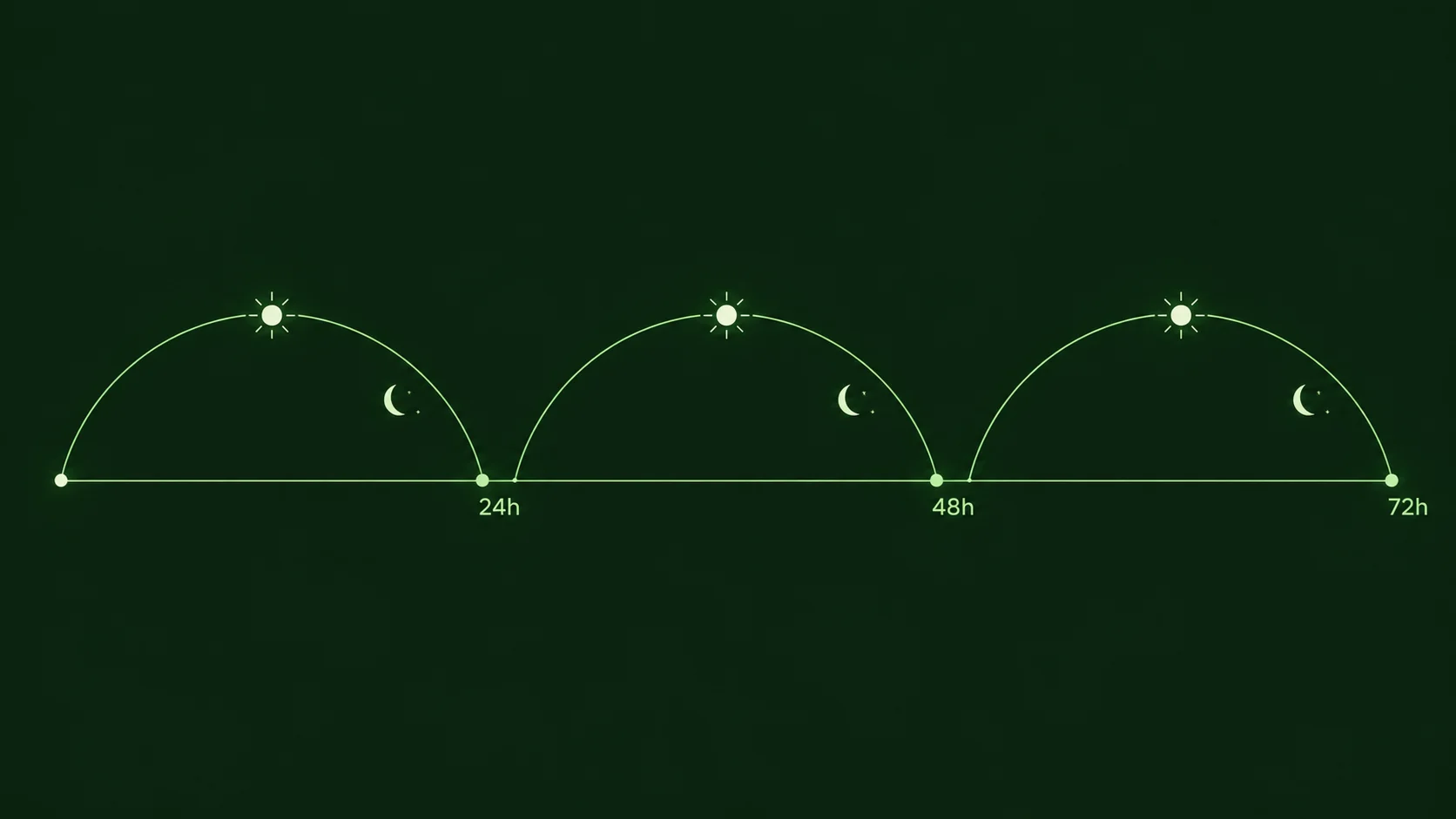
Under about 8 hours, the first 4 hours of eating earn careful planning. Overnight, the day's total carries the load. From 24 to 72 hours, meals matched to the next workload do the job, and a big recovery push adds little.
| Time to next hard effort | Main job | Carbohydrate | Protein | Fluid |
|---|---|---|---|---|
| Under 8 hours | Restart glycogen storage fast | About 1.0 to 1.2 g/kg per hour for 4 hours in small repeated feeds | 0.25 to 0.4 g/kg per feeding; add hourly protein only if carbohydrate is capped | If rapid rehydration matters, 125 to 150 percent of measured loss with sodium |
| 8 to 24 hours | Hit a daily total | Workload-matched; 7 to 10 g/kg only after substantial depletion and before another full race | 0.25 to 0.4 g/kg every 3 to 5 hours | If rapid rehydration matters, 125 to 150 percent of measured loss with sodium |
| 24 to 48 hours | Match food to tomorrow's load | ACSM daily band for the planned session | 0.25 to 0.4 g/kg every 3 to 5 hours | Replace any measured loss, then drink normally |
| 48 to 72 hours | Eat enough while soreness resolves | Workload-matched, with no automatic carb load | 1.2 to 2.0 g/kg across the day | Normal drinking |
02When you race again within 24 hours
This is the one window where the minutes after the finish carry real weight, and the HYROX rules make a repeat start possible. A doubles pair can race twice in one division and keep the faster time, and a World Championship qualifier can enter more than one division when start times do not clash.2 The same rulebook says racers must carry their own food and take drinks from aid stations,2 so an athlete can cross the line having eaten little. The HYROX race nutrition guide covers what to carry during the race.
Same-day restart under about 8 hours
ACSM gives 1.0 to 1.2 g/kg of carbohydrate per hour for the first 4 hours when less than 8 hours separate two fuel-demanding sessions, followed by a return to normal daily intake. Small regular snacks may help.5 The ISSN nutrient timing stand sets 1.2 g/kg per hour for recoveries shorter than 4 hours.9 Both are general consensus built largely on cycling and running lab work, and neither has been tested between two HYROX starts. For a 70 kg racer the ACSM range works out to 70 to 84 g an hour, which is a lot of food for a stomach that just finished 100 wall balls.

Burke's review found that intakes above 1 g/kg per hour taken as repeated small feedings raised early storage rates by 30 to 50 percent, and that solid and liquid carbohydrate work equally well over 2 to 24 hours.6 So graze. Sports drink, juice, white bread, rice cakes, and sweets every so often will go down easier than a single plate, and all of it counts.
If you cannot face that much carbohydrate, ISSN lists 0.8 g/kg carbohydrate per hour plus 0.2 to 0.4 g/kg protein per hour as an alternative.9 ACSM reports that 0.8 g/kg carbohydrate with 0.4 g/kg protein restored glycogen about as well as 1.2 g/kg carbohydrate alone.5 Burke's review sets the limit. Added protein improves glycogen storage only when carbohydrate sits below about 0.5 to 0.8 g/kg per hour.6 Protein is the fallback for a racer who is undereating carbohydrate, and it adds nothing to glycogen once carbohydrate is at the full rate.
ISSN also lists caffeine at 3 to 8 mg/kg as a refuelling aid.9 Burke's review calls the caffeine findings mixed and flags the sleep cost,6 which matters when the second race is tomorrow. For a same-day restart, fold caffeine into the pre-race dose you already rehearse. Before an overnight gap, leave it out.
Overnight turnaround
With about 20 to 24 hours between starts, the first meal can wait for the awards, the drive, or the queue at the food truck. Parkin's delay trial supports that as long as the day's carbohydrate adds up.8 Burke's review places the 24 hour glycogen storage threshold at about 7 to 10 g/kg per day.6 Nicholas and colleagues ran 6 men to exhaustion in an intermittent shuttle test twice, 22 hours apart. Raising carbohydrate to 10 g/kg during the recovery improved running capacity, and an equal-calorie diet with extra protein and fat did not.10 That trial is the closest performance evidence for a next-day repeat of a mixed high-intensity effort, and it points at carbohydrate specifically, with calories alone falling short.
Those protocols were built to empty muscle. A 60 to 90 minute HYROX may not drain glycogen that far, which is an inference, and 7 to 10 g/kg means 490 to 700 g of carbohydrate for a 70 kg racer. Move toward that range when the finish felt empty and tomorrow is another full race. If tomorrow is a relay leg or an easy session, the lower daily bands in the next section fit better.
Tibana and colleagues found no loss of back squat power in 9 trained men 24 hours after a session of Olympic lifting and 10 to 12 minutes of conditioning.11 Barboza and colleagues put 15 experienced men through four workouts over two days. Jump height barely changed, and 24 hours after the competition somatic complaints were up 28.5 percent and sleep quality was down 13.7 percent.12 Both samples were small, neither study controlled diet, and neither workout resembled 86 minutes of running and stations. Nobody has compared a second HYROX with the first.
03When the next hard effort is 24 to 48 hours away
ACSM states that glycogen can be normalized with 24 hours of reduced training and adequate fuel, in the absence of severe muscle damage.5 Burke's soccer data show how damage can stretch that timeline,6 and HYROX stations are the kind of work that raises the concern. With a full day or more in hand, the job is a daily total matched to what you will do next.
ACSM sets daily carbohydrate at 3 to 5 g/kg for light training, 5 to 7 g/kg for moderate training of about an hour a day, 6 to 10 g/kg for 1 to 3 hours of endurance work a day, and 8 to 12 g/kg for more than 4 to 5 hours a day.5 Those bands were written for training days in general athletes. Which band a HYROX racer needs before a second race has never been tested. As a starting point, an easy day next sits in the lowest band, an hour of hard training in the moderate band, and another full race in the 6 to 10 g/kg band.
Barboza's competitors reported worse sleep and more somatic complaints while their jump height held.12 Performance can hold up while sleep and perceived recovery slip, so plan meals ahead of time and eat them on schedule, even when you do not feel hungry.
04When the next hard effort is 48 to 72 hours away
Two days out, refuelling mostly takes care of itself if you eat normally. Burke's review notes that low energy intake may limit glycogen storage,6 so the real risk is a skimpy Monday after a big Saturday. Carbohydrate matched to the week's training and protein spread across meals cover it.
Burke's review also describes glycogen supercompensation, probably reached within 36 to 48 hours of the last session with rest and adequate carbohydrate.6 That comes from endurance loading research, and nobody knows whether a second HYROX three days later benefits from a load. Top up modestly if you normally do before a race, and skip the full carb load by default.
Soreness runs on a longer clock. Owens and colleagues' 2019 review reports that signs of exercise-induced muscle damage can last up to 14 days, with lost muscle function and soreness as the main consequences.13 Day three can still feel heavy even when you have eaten well.
05Protein supports repair without shortening soreness
General athlete consensus puts protein at about 0.25 to 0.4 g/kg per meal, roughly 20 to 40 g, repeated every 3 to 5 hours, and 1.2 to 2.0 g/kg across the day.59 Areta and colleagues gave 24 trained men 80 g of whey over 12 hours after resistance exercise. Four 20 g doses every 3 hours stimulated myofibrillar protein synthesis more than eight 10 g doses or two 40 g doses.14 A post-race shake, lunch, dinner, and a protein-rich snack before bed will hit that pattern without any special product.

Extra protein has not delivered on soreness. Pasiakos and colleagues reviewed 27 studies and found no apparent relationship between protein supplements and recovery of muscle function, soreness, or damage markers after a single bout of endurance or resistance exercise.15 The strongest real-race test comes from ten Haaf and colleagues, who randomized 323 recreational runners after a 15 km road race. The protein group took 20 g of milk protein after the race and at breakfast for three days, plus 40 g before sleep on race day and the next two nights. Their usual protein intake was already about 1.1 to 1.2 g/kg per day. Soreness did not differ from an equal-calorie carbohydrate drink on days one to three in the main analysis.16 If your meals already cover the consensus range, another shake is unlikely to make your legs feel better.
Owens and colleagues note that many nutritional recovery fixes target oxidative stress and inflammation, which are also part of how training adapts, and they question long-term use of supplements aimed at reducing muscle damage.13
06Rehydrate against the scale if you weighed in
No study has measured sweat losses in HYROX. The race is indoors and runs about 1 to 2 hours, so losses may be modest for many racers, and the only way to know yours is to weigh yourself before and after. ACSM treats 1 kg of body mass lost as roughly 1 L of sweat and recommends replacing 125 to 150 percent of the deficit, which is 1.25 to 1.5 L for each kilogram, when rapid rehydration matters.5 Count what you have already drunk since the finish against that total.
Sodium decides whether the fluid stays. Shirreffs and colleagues found that drinking only the volume lost was not enough, and that larger volumes restored balance only when the drink carried enough sodium. Otherwise the extra came out as urine.17 Maughan and Leiper had 6 men drink 1.5 times their sweat loss after cycling in the heat. At 2 and 26 mmol/L sodium, which covers water and many standard drinks, they ended in negative fluid balance, and the higher-sodium drinks kept them hydrated.18 Salty food, broth, or a higher-sodium drink before a same-day or next-day race does that work. ACSM adds that athletes should not restrict sodium after large losses.5
Without a before-and-after weight, the percentages have nothing to multiply. Skip the target and let meals with salt and normal drinking cover it. Fluid also does not gate glycogen. Burke's review cites a trial in which dehydration of about 5 percent of body mass did not impair glycogen storage over 15 hours.6
Drink toward your loss and stop there. Gaining body mass during rehydration is a reason to stop and reassess, not to keep drinking.519 Hyponatremia related to exercise is mainly caused by overdrinking and can appear up to 24 hours after exercise.519 Its risk in HYROX has never been measured, and a short indoor race is not the typical setting. Headache with vomiting, confusion, or seizures, especially alongside bloating, puffiness, or weight gain from drinking, needs prompt medical attention.5 Do not give more water to someone with those signs.
07Alcohol after the race
The alcohol data come from a heavy session. Parr and colleagues had 8 active men do resistance exercise followed by continuous and interval cycling, then drink 1.5 g/kg of alcohol, about 12 standard drinks, over 3 hours. Myofibrillar protein synthesis fell 24 percent when the alcohol came with protein and 37 percent when it came with carbohydrate, compared with protein alone.20 Burke's review adds that about 120 g of alcohol displacing carbohydrate reduced glycogen storage at 8 and 24 hours.6 Those findings describe a big night. The effect of one or two drinks has not been tested in these trials, so no fixed cost per drink exists to quote.
ACSM advises athletes to minimize or avoid alcohol when recovery is a priority.5 With another start inside 24 hours, recovery is the priority, so keep drinks to a minimum. The alcohol and recovery guide covers the dose question in more detail.
08When to go hard again inside 72 hours
Nutrition has not been shown to reliably shorten soreness or restore strength faster,131516 so the decision to train hard comes from how your body moves. In Barboza's small study, competitors held their jump height while reporting worse sleep and more complaints,12 so how you feel and how you perform can drift apart for a day or two. A warm-up tests movement directly, which the calendar cannot do.

Use a simple check before any hard session in the 72 hours after a HYROX. Warm up for 10 to 15 minutes, then do a few lunges, squats, and strides. Go ahead if soreness eases as you warm, your stride and range of motion look like your own, you slept, and you are eating normally. Keep the session easy if soreness changes how you run or lunge, or builds during the warm-up. Pain that sits in one sharp spot and does not ease is a reason to see a clinician. This is a practical rule and has not been tested as a readiness screen. If you track HRV and sleep, the watch readiness recovery guide covers how to read those signals.
A scheduled second race still deserves a fresh movement check. If pain changes your stride or range of motion, do not treat the schedule as proof that you are ready to race.
Before you leave the venue, look at the next start time on your schedule and let that number set the plan. Under 8 hours, you are eating by the hour. Overnight, you are eating by the day. Past 48 hours, you are eating like an athlete who trains, and the soreness will leave when it is ready.
Footnotes
HYROX. The Fitness Race. Official website, accessed 24 September 2026. hyrox.com.
Back to textBack to text 2HYROX. Rulebook Doubles, Season 26/27. 2026. Sections 4.3, 5.5, and 10.5. maintain.hyrox.com.
Back to textBack to text 2Back to text 3Brandt T, Ebel C, Lebahn C, Schmidt A. Acute physiological responses and performance determinants in Hyrox© - a new running-focused high intensity functional fitness trend. Front Physiol. 2025, 16, 1519240. doi.org/10.3389/fphys.2025.1519240.
Back to textRappelt L, Wiedenmann T, Held S, Heinke L, Micke F, Wicker P, Donath L. Longitudinal performance development in PRO and ELITE HYROX competitions across the first seven competitive seasons. Front Physiol. 2026. doi.org/10.3389/fphys.2026.1847569.
Back to textThomas DT, Erdman KA, Burke LM. Nutrition and Athletic Performance. Joint position statement of the American College of Sports Medicine, the Academy of Nutrition and Dietetics, and Dietitians of Canada. Med Sci Sports Exerc. 2016, 48(3), 543-568. doi.org/10.1249/MSS.0000000000000852.
Back to textBack to text 2Back to text 3Back to text 4Back to text 5Back to text 6Back to text 7Back to text 8Back to text 9Back to text 10Back to text 11Back to text 12Burke LM, van Loon LJC, Hawley JA. Postexercise muscle glycogen resynthesis in humans. J Appl Physiol. 2017, 122(5), 1055-1067. doi.org/10.1152/japplphysiol.00860.2016.
Back to textBack to text 2Back to text 3Back to text 4Back to text 5Back to text 6Back to text 7Back to text 8Back to text 9Back to text 10Back to text 11Ivy JL, Katz AL, Cutler CL, Sherman WM, Coyle EF. Muscle glycogen synthesis after exercise, effect of time of carbohydrate ingestion. J Appl Physiol. 1988, 64(4), 1480-1485. doi.org/10.1152/jappl.1988.64.4.1480.
Back to textParkin JA, Carey MF, Martin IK, Stojanovska L, Febbraio MA. Muscle glycogen storage following prolonged exercise: effect of timing of ingestion of high glycemic index food. Med Sci Sports Exerc. 1997, 29(2), 220-224. doi.org/10.1097/00005768-199702000-00009.
Back to textBack to text 2Kerksick CM, Arent S, Schoenfeld BJ, Stout JR, Campbell B, Wilborn CD, et al. International society of sports nutrition position stand, nutrient timing. J Int Soc Sports Nutr. 2017, 14, 33. doi.org/10.1186/s12970-017-0189-4.
Back to textBack to text 2Back to text 3Back to text 4Nicholas CW, Green PA, Hawkins RD, Williams C. Carbohydrate intake and recovery of intermittent running capacity. Int J Sport Nutr. 1997, 7(4). doi.org/10.1123/ijsn.7.4.251.
Back to textTibana RA, et al. Two consecutive days of Crossfit training affects pro and anti-inflammatory cytokines and osteoprotegerin without impairments in muscle power. Front Physiol. 2016, 7, 260. A corrigendum renamed the training as an extreme conditioning program. doi.org/10.3389/fphys.2016.00260.
Back to textde Souza Barboza PV, da Rocha Rodrigues SF, Dellagrana RA, Kruschewsky A, de Araújo Farias D, Rossato M. How does a simulated high-intensity functional training competition influence on stress, recovery and muscle power? Front Sports Act Living. 2026. doi.org/10.3389/fspor.2025.1734355.
Back to textBack to text 2Back to text 3Owens DJ, Twist C, Cobley JN, Howatson G, Close GL. Exercise-induced muscle damage, what is it, what causes it and what are the nutritional solutions? Eur J Sport Sci. 2019, 19(1), 71-85. doi.org/10.1080/17461391.2018.1505957.
Back to textBack to text 2Back to text 3Areta JL, Burke LM, Ross ML, Camera DM, West DW, Broad EM, Jeacocke NA, Moore DR, Stellingwerff T, Phillips SM, Hawley JA, Coffey VG. Timing and distribution of protein ingestion during prolonged recovery from resistance exercise alters myofibrillar protein synthesis. J Physiol. 2013, 591(9), 2319-2331. doi.org/10.1113/jphysiol.2012.244897.
Back to textPasiakos SM, Lieberman HR, McLellan TM. Effects of protein supplements on muscle damage, soreness and recovery of muscle function and physical performance, a systematic review. Sports Med. 2014, 44, 655-670. doi.org/10.1007/s40279-013-0137-7.
Back to textBack to text 2ten Haaf DSM, Flipsen MA, Horstman AMH, Timmerman H, Steegers MAH, de Groot LCPGM, Eijsvogels TMH, Hopman MTE. The effect of protein supplementation versus carbohydrate supplementation on muscle damage markers and soreness following a 15-km road race, a double-blind randomized controlled trial. Nutrients. 2021, 13(3), 858. doi.org/10.3390/nu13030858.
Back to textBack to text 2Shirreffs SM, Taylor AJ, Leiper JB, Maughan RJ. Post-exercise rehydration in man, effects of volume consumed and drink sodium content. Med Sci Sports Exerc. 1996, 28(10), 1260-1271. doi.org/10.1097/00005768-199610000-00009.
Back to textMaughan RJ, Leiper JB. Sodium intake and post-exercise rehydration in man. Eur J Appl Physiol Occup Physiol. 1995, 71, 311-319. doi.org/10.1007/BF00240410.
Back to textBennett BL, Hew-Butler T, Rosner MH, Myers T, Lipman GS. Wilderness Medical Society clinical practice guidelines for the management of exercise-associated hyponatremia, 2019 update. Wilderness Environ Med. 2020. doi.org/10.1016/j.wem.2019.11.003.
Back to textBack to text 2Parr EB, Camera DM, Areta JL, Burke LM, Phillips SM, Hawley JA, Coffey VG. Alcohol ingestion impairs maximal post-exercise rates of myofibrillar protein synthesis following a single bout of concurrent training. PLoS One. 2014, 9(2), e88384. doi.org/10.1371/journal.pone.0088384.
Back to text