Huberman Lab has produced over two dozen episodes on nutrition since 2021, featuring guests from Layne Norton and Rhonda Patrick to Satchin Panda and Robert Lustig. Across all 24 episodes, the same handful of themes keep resurfacing — protein adequacy, fiber diversity, processed food reduction, and meal timing — even though each guest frames the advice through a different lens. (Looking for the fitness and training side? See our companion post on Huberman Lab's best fitness and weight training advice. If you want the supplement-specific breakdown, read Andrew Huberman Supplement List (2026).)
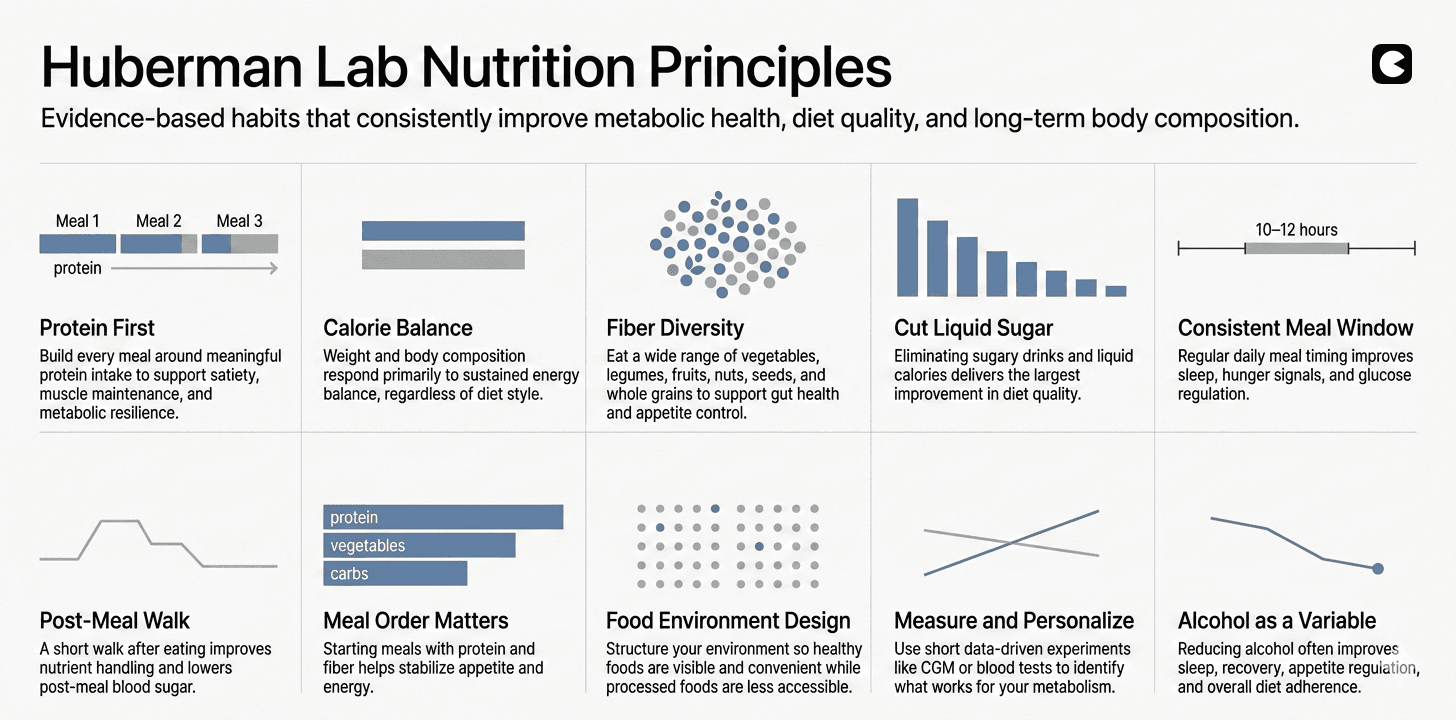
A clear hierarchy emerges across the guests. They disagree on plenty of details, but they converge on the same foundational priorities: get your protein and calories right first, then layer in behavioral tools like meal timing and environment design, then personalize with targeted measurement. Everything else is a second-order variable.
- Treat protein as the cornerstone macro. Aim for a meaningful daily total, distribute it across meals, and prioritize it during fat loss, aging, and hard training. Almost every guest on this list puts protein at the top of the hierarchy.
- Treat calorie balance as non-negotiable physics. Diet style (keto, Mediterranean, plant-based) is the vehicle for adherence. Pick the pattern you can sustain for months without willpower battles and the fat loss will follow.
- Use fiber as a dual tool for satiety and gut health. Aim for diversity of plant sources (vegetables, legumes, whole grains, nuts, seeds, fruits) rather than chasing one "best" prebiotic. Ramp gradually so your gut can adapt.
- Cut ultra-processed foods by starting with sugary drinks. Removing liquid calories gives you the best return on effort. Choose whole fruit over juice and watch for "health" products that are refined carbs with clever branding.
- Keep meal timing consistent and eat earlier when possible. A stable 10-to-12-hour eating window plus avoiding late-night snacking improves sleep, hunger signals, and blood sugar control without changing what you eat.
- Take a short walk after meals as your simplest metabolic tool. This habit blunts glucose spikes, improves nutrient handling, and reduces post-meal cravings, especially after your biggest or most carb-heavy meal.
- Design your food environment like your results depend on it, because they do. Remove trigger foods from easy reach, build go-to meals you can make without thinking, and set clear rules for treats instead of deciding in the moment.
- Measure, then personalize. Use a short continuous glucose monitor phase or targeted lab work (vitamin D, omega-3 index) to discover what actually works for your biology. Retest after changes instead of guessing.
- Treat alcohol as a nutrition variable with ripple effects. Reducing alcohol often improves sleep, appetite control, recovery, and overall diet adherence faster than adding another supplement.
01Micronutrients for Health & Longevity
Dr. Rhonda Patrick (Jan 1, 2026)
This is Dr. Patrick's second appearance on Huberman Lab for micronutrients (the first was in May 2022), and the 2026 conversation is more focused: fewer nutrients, deeper on each one, with updated dosing guidance and a stronger emphasis on moringa as a practical food-based intervention. This episode cuts through the noise to focus on a handful of micronutrients that actually matter for reducing inflammation and supporting your body's stress response. Dr. Patrick shares practical strategies for getting these nutrients from real food first, smart supplementation when needed, and how to use targeted testing to know if your approach is working instead of blindly stacking supplements and hoping for the best.
- Treat sulforaphane as a "prep-and-dose" nutrient: use cruciferous vegetables (especially broccoli sprouts) and prep in a way that preserves the active compounds.
- Use moringa as a food-based way to support antioxidant response pathways, rather than chasing many separate antioxidant pills.
- Prioritize marine omega-3s (EPA/DHA) via fatty fish or fish oil; don't assume "some fish sometimes" is enough.
- Make omega-3 status measurable (Omega-3 Index) if you want dosing to be evidence-guided rather than vibes-guided.
- Use vitamin D supplementation only as a bloodwork-guided correction, not a perpetual megadose habit.
- Treat magnesium as a common "quiet deficiency": emphasize dietary sources first, then supplement only to close a known gap.
02Metabolic health from your own biology
Dr. Michael Snyder (Sep 8, 2025)
Dr. Snyder's research reveals that nutrition is deeply personal: two people can eat identical "healthy" meals and experience completely different glucose and lipid responses. His approach focuses on using targeted measurement periods with continuous glucose monitors and lab work to discover your unique metabolic patterns, then building sustainable eating habits around what actually works for your biology.
- Use a short CGM/wearable "learning phase" to identify which meals reliably spike or stabilize you.
- Favor meals that consistently produce good downstream behavior (energy, mood, fewer cravings), not just good ideology.
- Use post-meal movement as a default "metabolic tool" (especially after the day's largest meal).
- Treat late-night eating as a controllable variable that often worsens glucose control and sleep quality.
- Don't make diet changes without retesting key markers; personalization requires feedback loops, not one-off experiments. Tools like Fuel Nutrition can help close this loop by tracking your daily intake against your targets so you can see what actually changed when your markers improve.
- When making changes, adjust one major variable at a time (meal timing, carbs, alcohol, etc.) so you can attribute effects.
03Fasting and time-restricted eating outcomes
Aug 28, 2025
Huberman breaks down time-restricted eating into practical steps that actually work in real life. He focuses on choosing a feeding window you can maintain long-term, identifying what commonly sabotages fasting efforts, and leveraging simple behaviors like walking that amplify the benefits without adding complexity or suffering.
- Build fasting around consistency first (same eating window most days) before making the window aggressive.
- Extend the overnight fast by ending eating earlier, not by delaying food until you're ravenous at night.
- Use an after-meal walk as a primary tool for glucose clearance and appetite control.
- Know what actually breaks a fast (especially sugar/calories) so you're not accidentally "snacking fasting."
- Use electrolytes/salt strategically if fasting causes headaches or lightheadedness, with blood-pressure awareness.
- If muscle gain is a goal, adjust the window and protein distribution rather than forcing a tight window that reduces total intake.
04Fat loss and muscle gain nutrition
Alan Aragon (Jul 7, 2025)
Alan Aragon cuts through the noise by demolishing popular diet myths and establishing a clear hierarchy: calories and protein matter most, then you can worry about diet style and meal timing. Throughout the conversation, he reveals how many trendy approaches succeed not because of magical metabolic effects, but simply because they help people eat more protein or fewer total calories.
- For fat loss, when calories and protein are matched, low-carb vs low-fat tends not to differ meaningfully in fat loss outcomes.
- Keto often "wins" in the real world because it increases protein and reduces food options, leading to fewer calories.
- Stop treating the "30-gram protein rule" as a hard cap; focus on total daily protein and workable distribution.
- The post-workout "anabolic window" is not a panic timer; training quality and day-level protein matter more than minute-level timing.
- Fasted training is not required for fat loss; choose fed vs fasted based on performance, recovery, and adherence.
- Use diet simplicity (repeatable meals, limited "trigger foods") as a legitimate tool for sustaining a deficit without constant willpower.
05How Different Diets Impact Your Health
Dr. Christopher Gardner (May 12, 2025)
Dr. Gardner compares ketogenic, vegetarian/vegan, and omnivorous diets, revealing that diet quality matters more than diet type. Across all eating patterns, reducing processed foods consistently drives better health outcomes. He positions protein, fiber, and fermented foods as universal foundations that work regardless of whether you eat meat, avoid carbs, or follow plant-based approaches.
- Choose a diet pattern you can sustain, then make "processed food elimination/reduction" the universal rule.
- Make fiber a non-negotiable anchor (especially if you're low-carb or highly animal-protein heavy).
- Include low-sugar fermented foods if tolerated as a gut-health lever tied to inflammation.
- Treat protein needs as contextual (age, training, satiety goals) rather than one fixed number for everyone.
- For suspected food sensitivities (gluten, dairy, soy), use structured elimination/rechallenge rather than permanent, untested restriction.
- Evaluate diets by objective outputs (energy, hunger, sleep, labs), not by labels (keto/vegan/omnivore).
06Diet and lifestyle for mental health
Dr. Chris Palmer (Mar 31, 2025)
Dr. Palmer returns for his second Huberman conversation on diet and mental health (the first was November 2022, which focused more narrowly on ketosis as a clinical intervention). This 2025 episode takes a wider view, positioning whole-food quality, alcohol reduction, and exercise alongside dietary interventions as a unified lifestyle approach for brain health. Dr. Palmer approaches nutrition as metabolic support for brain function, positioning mitochondria as the critical link between what we eat, inflammation levels, energy production, and psychiatric symptoms. His core message centers on mastering the fundamentals (sleep, movement, food quality) before exploring more targeted dietary interventions under proper clinical guidance.
- Use a whole-food, minimally processed baseline before assuming you need an extreme diet.
- Treat alcohol reduction/elimination as a high-impact nutrition move for mood, sleep, and brain energy.
- Consider carbohydrate restriction/ketosis as a therapeutic tool for some conditions, but only with clinical oversight (especially with meds).
- Don't let "supplements" replace food quality; use supplements to correct specific, plausible gaps.
- Pair nutrition changes with consistent exercise because mitochondrial adaptations are lifestyle-wide, not diet-only.
- Track symptom changes alongside diet (sleep, mood stability, focus) so you can identify your true drivers.
07How Foods & Nutrients Control Our Moods
Jan 23, 2025
Huberman explores how the foods we choose directly influence our brain chemistry, particularly dopamine and serotonin pathways that drive cravings and mood. The key insight: gut health and targeted nutrients create lasting changes in motivation and emotional stability over weeks, not just temporary post-meal effects.
- Distinguish dopamine-driven "seeking" from serotonin-linked satiety/settling, and plan meals to prevent dopamine chasing via sugar.
- Support the gut microbiome with diverse plant fibers and fermented foods because gut signaling is central to mood regulation.
- Prioritize omega-3 intake as a slow-building mood-support lever rather than an acute "feel better today" hack.
- Use meal composition (protein + fiber) to reduce rapid glucose swings that mimic anxiety/irritability.
- Expect belief/context effects: your expectations about food can shift perceived hunger and satisfaction.
- Build "anti-craving structure" (regular meals, predictable treats) rather than relying on willpower during low-energy states.
08Nutrition and fitness tools from Huberman
Dr. Layne Norton (Aug 12, 2024)
This is Norton's second Huberman appearance (the first was November 2022, covering the same calories-and-protein hierarchy). The 2024 conversation goes further into practical territory: GLP-1 agonists, artificial sweeteners as a harm-reduction tool, and how to evaluate "nutrition villains" on social media. Dr. Norton emphasizes evidence-based priorities over nutrition trends. Focus on the fundamentals that actually drive body composition changes: total calories, adequate protein, and consistent training. Avoid getting caught up in debates about seed oils, artificial sweeteners, or demonizing individual foods unless these changes produce measurable improvements in your energy, performance, or lab results.
- Treat energy balance as non-optional physics; pick a dietary style that you can adhere to for months, not days.
- Keep protein high enough to protect or build muscle, especially during fat loss phases.
- Use fiber as a dual tool for satiety and gut health; it's often the missing macronutrient in "clean" diets.
- Don't outsource decisions to social-media villains (seed oils, "toxins"); evaluate outcomes (hunger, labs, performance).
- Artificial sweeteners can be useful if they reduce calories without triggering compensatory eating; treat it as an individual-response experiment.
- GLP-1 agonists and similar drugs are medical tools; if used, pair them with resistance training + adequate protein to protect lean mass.
Fuel's full roundup on Dr. Layne Norton covers his leucine research, his metabolic-adaptation numbers, and his seed oil stance in more depth than either Huberman appearance alone.
09Exercise and eating for longevity
Dr. Gabrielle Lyon (Jun 24, 2024)
Dr. Lyon reframes nutrition through the lens of muscle as a longevity organ. Rather than focusing solely on weight loss, she emphasizes how muscle tissue acts as a metabolic buffer for glucose, supports overall health, and preserves function as we age. Her approach centers on protein quality and quantity while aligning dietary choices with resistance training to build and maintain lean mass throughout life. Fuel's dedicated roundup on Lyon's muscle-centric medicine breaks down her exact protein and per-meal targets.
- Treat muscle as a primary health target; diet should support maintaining/building it across the lifespan.
- Get adequate daily protein and distribute it across meals; don't rely on a single high-protein dinner to do all the work.
- Pair protein with resistance training to improve nutrient partitioning toward lean mass rather than fat storage.
- Older adults often need a higher "per-meal" protein stimulus than younger adults; adjust meal composition accordingly.
- Don't let fear of "bulking up" (especially for women) drive chronically low protein intake; low protein is a slow metabolic liability.
- Use supplements only to close specific gaps; make food quality and training the default strategy.
10Hunger biology and obesity medications
Dr. Zachary Knight (Jun 17, 2024)
Dr. Knight reveals that hunger and craving are brain outputs shaped by both physiology (satiety signals, dopamine) and environment (food cues, availability). He positions anti-obesity medications as tools that alter hunger circuitry rather than simple nutrition fixes, noting they can be useful for some people but aren't universal solutions.
- Separate reward-driven craving from true energy need; they require different interventions (environment vs calories).
- Use protein + fiber early in the day to strengthen satiety signaling and reduce late-day overeating.
- Use cue control as nutrition strategy: reduce exposure to trigger foods and food cues that amplify dopamine-driven seeking.
- Treat sleep as appetite medicine; sleep loss amplifies hunger and impulse-driven food choices.
- If considering GLP-1 agonists or similar medications, keep it clinician-led and plan nutrition to preserve lean mass.
- Retrain preferences gradually (repeat exposure, consistent meals) rather than cycling extreme restriction and rebound.
11Gut sense and the gut-brain axis
Dr. Diego Bohórquez (May 27, 2024)
Dr. Bohórquez reveals that your gut functions as a sophisticated sensory organ that directly communicates with your brain, influencing cravings, mood, and motivation within minutes of eating. Rather than viewing digestion as a simple mechanical process, he shows how specific foods can either hijack or optimize the gut-brain communication pathway. The key insight is that highly processed, hyperpalatable foods create chaotic signaling that drives compulsive eating, while whole foods with diverse fiber sources help establish clearer, more balanced communication between gut and brain.
- Think of meals as gut-to-brain signals; food choices can change cravings and mood through neural/hormonal routes.
- Prioritize fiber diversity to support microbiome-driven signaling that influences appetite and inflammation.
- Use low-sugar fermented foods if tolerated as a practical way to support microbiome diversity.
- Reduce hyperpalatable processed foods to avoid reinforcing "rapid reward" gut-brain loops.
- Treat non-nutritive sweeteners as personal experiments; some people notice appetite or GI changes that matter behaviorally.
- Slow eating and consistent meal timing help satiety signals arrive before you've overshot intake.
12How Sugar & Processed Foods Impact Your Health
Dr. Robert Lustig (Dec 18, 2023)
Dr. Lustig advocates for "de-processing" your diet rather than getting caught up in macro counting debates. His focus is on eliminating sugar and refined starches that are engineered to be overconsumed, particularly in liquid form, which crowd out essential fiber and protein from your meals.
- Remove sugary beverages first; they are the easiest way to overconsume sugar without satiety.
- Prefer whole fruit over juice; fiber changes absorption and reduces "hit-and-crash" eating.
- Treat "ultra-processed" as a practical red flag: long ingredient lists, refined grains, added sugars, engineered palatability.
- Build meals around protein + fibrous plants + minimally processed fats to stabilize hunger.
- Don't be misled by "low fat" products that compensate with sugar/refined starch; look at total composition.
- Use environment design (shopping defaults, meal prep) because sugar reduction fails most often at the cue/availability level.
13Intermittent fasting for health and cognition
Dr. Satchin Panda (Mar 13, 2023)
Dr. Panda reframes intermittent fasting as a tool for circadian health rather than a weight loss hack. His research shows that when you eat matters as much as what you eat, with consistent meal timing helping synchronize your body's internal clocks. The focus shifts from extreme fasting windows to sustainable patterns that support sleep quality and metabolic function.
- Aim for a consistent daily eating window; consistency stabilizes peripheral clocks (gut/liver) even before you tighten the window.
- Shift the window earlier if possible; late-night calories tend to impair sleep and metabolic control.
- Start with ~10–12 hours and tighten only if it improves outcomes without harming sleep/training.
- Make food quality count inside the window: protein + fiber remains foundational.
- Track intake (even briefly) to find "invisible" calories that break the window (creamers, snacks, alcohol).
- Individualize for athletes/pregnancy/history of eating disorders; timing tools should not create under-fueling.
14Water quality and intake for health
Mar 6, 2023
Huberman discusses water as a foundational nutrient that directly impacts performance and cognition. The key insight is viewing hydration as dynamic rather than static, where your needs shift based on temperature, exercise intensity, and caffeine intake. Rather than assuming your tap water is optimal, he advocates for actually testing and improving water quality when possible.
- Match water intake to conditions (exercise, humidity, heat) rather than using one static "8 glasses" rule.
- Use timing: hydrate earlier in the day and around exercise; avoid huge late boluses that disrupt sleep.
- Consider electrolytes when sweating heavily; fatigue can be low sodium/electrolyte, not just dehydration.
- If concerned about contaminants, test tap water and choose filtration based on what you're trying to remove.
- Treat "alkaline" and exotic water claims skeptically unless the evidence and mechanism are clear.
- Use water upgrades as complements to diet and sleep, not as substitutes for them.
15Nutrition and supplements for fitness
Dr. Andy Galpin (Feb 22, 2023)
Dr. Galpin cuts through the noise by focusing on what actually moves the needle: total calories, adequate protein, proper hydration, and electrolyte balance. He argues that supplements are only worth considering once these fundamentals are dialed in. The overarching theme is keeping nutrition practical and sustainable rather than turning it into an obsessive pursuit that interferes with training and life.
- Anchor performance/body comp goals in total calories and protein; treat carbs/fat as adjustable knobs.
- Choose fasted vs fed training based on performance and adherence, not fat-loss folklore.
- Hydrate before training and during longer sessions; mild dehydration impairs strength and cognition.
- Replace electrolytes (especially sodium) when sweating; "flat workouts" can be hydration/sodium issues.
- Use a short list of high-evidence, lower-cost supplements rather than large stacks.
- Coordinate nutrition timing around training mainly to improve session quality and recovery (not to chase tiny metabolic edges).
16Female hormone health for vitality
Dr. Sara Gottfried (Jan 30, 2023)
Dr. Gottfried frames nutrition as a powerful tool for hormone optimization, with particular emphasis on managing blood sugar and supporting gut health. What makes this approach unique is the recognition that hormonal transitions like perimenopause, PCOS, and fertility journeys require different nutritional strategies than standard health advice.
- Use glucose/insulin management as a core strategy (especially for PCOS): minimize refined carbs and prioritize mixed meals.
- Consider short-term CGM or structured testing to identify your personal glycemic triggers during hormonal transitions.
- Put protein early in the day to stabilize appetite and reduce late-day cravings.
- Support the microbiome with fiber diversity and fermented foods because gut health interacts with hormones.
- Be cautious with aggressive fasting or chronic under-eating if it disrupts sleep, mood, or cycle regularity.
- Treat stress reduction as "nutrition adjacent" because cortisol shifts appetite, cravings, and insulin sensitivity.
17Diet & Nutrition for Mental Health
Dr. Chris Palmer (Nov 21, 2022)
Dr. Palmer presents a metabolic perspective on mental health: mitochondrial function and brain energy can be directly influenced by dietary choices, with ketosis positioned as a therapeutic intervention rather than a casual weight loss strategy. His approach treats dietary changes as clinical trials that require structure, monitoring, and integration with broader lifestyle factors.
- Consider ketosis as a brain-energy intervention that can mimic aspects of fasting physiology.
- Reduce highly processed foods first; they degrade both metabolic and mental health baselines.
- If attempting keto, plan for adherence (food environment, social schedule) and monitor interactions with psychiatric meds.
- Track outcomes beyond weight: sleep, mood stability, cognition, and anxiety levels matter.
- Alcohol is treated as metabolically costly for mitochondria and often incompatible with sustained improvement.
- Use supplements (including exogenous ketones) only as targeted adjuncts, not as substitutes for dietary structure.
18Eating for health fat loss and lean muscle
Dr. Layne Norton (Nov 7, 2022)
Dr. Norton delivers nutrition fundamentals backed by rigorous research. His approach cuts through diet culture noise by focusing relentlessly on what actually drives results at the population level. The real value lies in his concrete, actionable heuristics around fiber and protein that you can implement without turning every meal into a math problem.
- Treat calorie balance as the driver of weight change; everything else is a compliance strategy.
- Use protein as the cornerstone macro for satiety and lean-mass protection during fat loss.
- A practical fiber starting point discussed is ~15 g per 1,000 calories (adjust for tolerance).
- Don't fear single macros; favor minimally processed sources of carbs and fats that fit your preferences.
- Use resistance training to preserve/gain muscle; nutrition plans without training leave results on the table.
- Treat "hot topic" claims (seed oils, sweeteners, red meat) as second-order variables unless they change your total intake/behavior.
19Compulsive eating biology and treatments
Dr. Casey Halpern (Sep 26, 2022)
Dr. Halpern focuses on the neurobiology behind compulsive eating rather than traditional diet advice. His key insight is that binge eating stems from specific brain reward circuits, not lack of willpower. According to Halpern, effective nutrition strategies must address environmental triggers and often require professional support alongside dietary changes.
- Treat loss-of-control eating as a circuit-level problem; shame rarely improves outcomes.
- Identify triggers (stress, cue exposure, restriction) and change the environment before trying to "white-knuckle" cravings.
- Use structured meals (protein + fiber) to reduce physiological vulnerability to binge episodes.
- Avoid extreme restriction; it often increases rebound binge risk.
- Use delay-and-disrupt tactics for cravings (short walk, water, call someone) to outlast the peak urge.
- For severe binge eating, prioritize evidence-based clinical treatment; tech interventions are adjuncts, not replacements.
20Taste biology and sugar craving
Dr. Charles Zuker (Jul 18, 2022)
Dr. Zuker reveals that sugar cravings aren't just personality quirks or moral failings. They're hardwired brain circuits that respond to what we repeatedly expose ourselves to. The encouraging news is that these circuits are plastic. You can actually retrain your taste preferences by strategically changing what foods you keep around and how often you encounter ultra-sweet flavors.
- Separate "wanting" from "liking"; you can crave something even when it no longer tastes that good.
- Reduce repeated exposure to hyper-sweet foods to lower your sweetness baseline over time.
- Use meal simplicity intentionally: more variety often drives higher intake ("specific satiety" works against you).
- Treat thirst and hunger distinctly; hydration errors can masquerade as "snack hunger."
- Expectation and smell strongly shape perceived flavor and craving; control cues when you're trying to change diet.
- Build a pantry where the default options are aligned with your goals, because taste circuits are cue-driven.
21Micronutrients for Health & Longevity
Dr. Rhonda Patrick (May 2, 2022)
Dr. Patrick delivers a comprehensive guide to micronutrients and phytochemicals that directly impact how your body handles stress, fights inflammation, and supports longevity. Her approach focuses on actionable strategies: specific foods to prioritize, targeted supplements that actually move the needle, and when lab testing becomes worthwhile rather than guesswork.
- Use sulforaphane-rich foods (especially broccoli sprouts/crucifers) as a repeatable, food-based lever.
- Treat omega-3 intake as a measurable target (Omega-3 Index testing) rather than a vague "eat more fish" intention.
- Vitamin D: correct deficiency with bloodwork guidance; don't guess dose long-term.
- Diversify omega-3 sources (EPA vs DHA emphasis) depending on goals (mood, inflammation, cognition).
- Use diet first for minerals like magnesium; supplement strategically when diet can't cover the gap.
- Prefer "few high-impact interventions" over broad supplement stacks; simplify to what you can maintain.
22Tools for sugar cravings and metabolism
Mar 21, 2022
Huberman explains that sugar cravings aren't a willpower problem but a predictable response to poor sleep, blood sugar swings, and environmental triggers. His approach focuses on simple behavioral changes that work with your biology rather than against it: eat protein first, take a short walk after meals, and design your environment so you don't have to rely on self-control in moments of weakness.
- Treat sleep as a primary anti-craving tool; poor sleep increases craving intensity and impulsive eating.
- Use a brief after-meal walk to blunt glucose spikes and reduce rebound hunger.
- Start meals with protein/fiber to slow glucose rise and reduce "urgent" dessert cravings.
- Use cue control: remove hyper-sweet foods from immediate reach/visibility to reduce dopamine-driven seeking.
- Treat low-cal sweeteners as tools, not miracles; keep them only if they reduce total intake without increasing craving.
- Build structured treat rules (timing/frequency) so cravings become predictable habits rather than daily negotiations.
23Salt for mental and physical performance
Mar 14, 2022
Huberman clarifies that sodium needs vary dramatically based on sweat loss and activity context. Many people experiencing fatigue or brain fog during training, heat exposure, or fasting are actually dealing with hydration and electrolyte imbalances rather than energy deficits. The key insight is choosing targeted sodium intake instead of passively consuming most sodium through processed foods.
- Match sodium to sweat loss; training in heat changes requirements.
- If fasting or long workouts cause headaches/lightheadedness, consider electrolytes rather than assuming lack of willpower.
- Hydration without sodium during heavy sweat can worsen performance; "more water" isn't always the fix.
- Distinguish "targeted salt" from "processed food sodium"; they come with very different nutritional baggage.
- Use objective feedback (blood pressure, swelling, performance) to decide if you should increase or decrease sodium.
- Treat sodium strategies as individualized; if you have hypertension/kidney disease, clinician guidance matters.
24Build maintain and repair gut health
Dr. Justin Sonnenburg (Mar 7, 2022)
Dr. Sonnenburg reveals a crucial distinction between fermented foods and fiber that most people miss. Fermented foods actively increase microbiota diversity and reduce inflammatory signals in your gut, while fiber provides the raw material your beneficial bacteria need to thrive. Both matter, but fiber increases need to happen slowly to avoid digestive distress. He also challenges the popular notion that cleanses can replace consistent dietary habits for gut health.
- Add fermented foods gradually and consistently; small daily exposure tends to beat occasional extremes.
- Ramp fiber slowly to avoid GI distress; consistency matters more than sudden high doses.
- Aim for diversity of plant fibers rather than chasing one "best" prebiotic.
- Reduce ultra-processed foods as a microbiome protection strategy.
- Treat probiotics as context-dependent; use them as trials, not permanent defaults.
- Be cautious with cleanses/fasts sold as gut resets; durable changes come from diet patterns.
25Gut microbiome for brain and body health
Feb 28, 2022
This episode reveals how your gut bacteria directly influence brain chemistry, mood, and cognitive performance. Huberman shows that simple dietary changes like eating more diverse plants and fermented foods can be more powerful than expensive supplement protocols for supporting mental clarity and emotional balance.
- Increase plant diversity across the week; microbiome diversity tracks with dietary diversity more than perfection.
- Use fermented foods if tolerated; choose low-sugar versions to avoid undermining metabolic goals.
- Scale fiber up gradually; let your gut adapt rather than assuming discomfort means "fiber is bad."
- Treat stress and sleep as gut modulators; gut health isn't diet-only.
- Be cautious with frequent artificial sweeteners/emulsifiers if you notice GI or appetite disruptions.
- Use consistent meal timing and avoid late-night eating to reduce gut disruption and improve sleep.
26Time light food and exercise for sleep
Dr. Samer Hattar (Oct 25, 2021)
Dr. Hattar explains how meal timing functions as a powerful circadian signal that synchronizes your body's internal clocks. When you eat at inconsistent times, especially late at night, you disrupt the natural rhythm that governs sleep quality and hunger patterns the following day.
- Keep meal timing consistent day-to-day; irregularity destabilizes appetite and energy rhythms.
- Avoid large meals close to bedtime to protect sleep depth and next-day hunger control.
- Prefer earlier eating windows when possible; late eating often shifts hunger later and worsens sleep.
- Use morning light exposure to stabilize circadian rhythms that influence appetite timing.
- If you must shift schedule (travel/shift work), pair changes in light and food timing rather than changing only one.
- Treat caffeine timing as part of the "food timing system" because it can suppress appetite early and push eating late.
27Nutrients For Brain Health & Performance
Oct 18, 2021
Huberman breaks down the most effective nutrients for brain performance, cutting through supplement marketing to focus on evidence-based options that actually move the needle on cognitive function and mental energy.
- Prioritize omega-3 intake (especially EPA/DHA) as a structural and signaling support for the nervous system.
- Consider creatine (food or supplement) as a brain-energy support tool, especially if dietary intake is low.
- Ensure adequate choline from diet (eggs/meat/legumes depending on diet pattern) to support acetylcholine-related functions.
- Don't ignore micronutrients (magnesium, B vitamins) when chasing "nootropics"; deficiencies blunt everything else.
- Use supplement trials one at a time and track outputs (sleep, focus, mood) to avoid placebo-driven stacking.
- Treat sleep and exercise as the multipliers that make brain-nutrition strategies work, not optional add-ons.
28Effects of Fasting & Time Restricted Eating on Fat Loss & Health
Oct 11, 2021
Huberman presents fasting as a practical tool for managing how much you eat and when you eat it, rather than a metabolic shortcut. The key insights focus on maintaining consistent eating windows, timing meals earlier in the day, and structuring your fasting approach to support your training and sleep quality instead of working against them.
- Pick an eating window you can repeat; consistency beats occasional extreme fasts.
- If fat loss is the goal, treat the calorie deficit as the mechanism; fasting is the structure that can make it easier.
- Place the eating window earlier and finish eating well before sleep to protect sleep and metabolic control.
- Break fasts with protein/fiber rather than a high-sugar refeed that triggers rebound hunger.
- Adjust fasting around training: avoid fasting patterns that degrade performance or recovery if strength/muscle is a goal.
- Avoid prolonged fasting if you have a history of eating disorders or if it increases binge–restrict cycling.
29Healthy eating vs eating disorders
Sep 6, 2021
Huberman emphasizes that nutrition advice cannot be separated from mental health. When "healthy eating" becomes a source of obsession, restriction, or binge-purge cycles, it stops being healthy. He recommends avoiding any nutrition protocols that worsen disordered eating patterns and seeking professional treatment for clinically significant eating disorder symptoms.
- Use structure without rigidity: consistent meals that meet needs beat perfectionist food rules.
- Distribute protein earlier in the day rather than concentrating it late, as discussed in relation to protein assimilation timing.
- If using time-restricted eating, avoid windows that push most calories late at night, which can worsen sleep and overeating.
- Avoid "cheat day" framing if you're prone to binge–restrict cycles; it can reinforce the cycle.
- For anorexia/bulimia/binge eating, prioritize evidence-based clinical treatment; nutrition advice alone is not treatment.
- Treat food fear and habit loops as learnable/rewireable behaviors—best done with professional guidance and support.
30Smell taste and chemical control of appetite
Jun 21, 2021
Huberman explains that our eating behavior is heavily influenced by sensory cues like smell and taste, which can trigger hunger and food preferences even when we don't actually need calories. He suggests treating your sensory environment as a tool you can control to support your dietary goals.
- Reduce exposure to high-reward food cues (smell routes, kitchen visibility) when trying to control intake.
- Slow down eating to increase sensory satisfaction and allow satiety signaling to catch up.
- Improve palatability of healthy meals using spices, texture, and temperature so "healthy" doesn't mean "punishing."
- Use strong sensory interrupts (mint, tooth brushing, gum) to disrupt cue-triggered cravings.
- If smell function is reduced, structured odor exposure can affect flavor perception and food choices over time.
- Treat eating environment (screens, stress, scent) as part of the diet, because it changes how much you consume.
31Hormones that control hunger and satiety
Apr 19, 2021
Huberman dives deep into the mechanics of hunger and fullness, revealing how the order of foods on your plate can dramatically alter your blood sugar response and cravings hours later. The episode stands out for its practical focus on gut peptides and meal sequencing as tools for appetite control.
- Start meals with fibrous vegetables to slow glucose rise and increase satiety signaling.
- Consider meal order (fiber/protein first, starches/sugars later) as a simple glucose-and-craving control tool.
- Support satiety peptides (e.g., CCK) via adequate dietary fats (including omega-3s) rather than chronically ultra-low-fat eating.
- Certain amino acids were discussed as appetite modulators; treat supplements as optional, food-first where possible.
- Morning light exposure can influence appetite-related neuroendocrine signaling; use it to stabilize appetite timing.
- Use small, repeatable "sensory" strategies (e.g., sour flavors) to modulate craving intensity rather than relying on willpower.
32How Foods and Nutrients Control Our Moods
Mar 15, 2021
Huberman reveals how your daily food choices directly influence your emotional well-being through three key pathways: gut-brain communication via the vagus nerve, amino acids that build mood-regulating neurotransmitters, and inflammatory responses that can dampen or elevate your mental state. Rather than relying on temporary comfort foods for mood boosts, he emphasizes that consistent dietary patterns create lasting changes in how you feel day to day.
- Treat protein as a neurotransmitter-precursor input (amino acids feed dopamine/serotonin synthesis pathways).
- Prioritize omega-3 intake as a slower but meaningful lever for mood and inflammation.
- Support the gut microbiome with fiber diversity and fermented foods to improve gut-derived signaling relevant to mood.
- Stabilize blood sugar swings (protein + fiber with carbs) to reduce irritability/anxiety-like fluctuations.
- Use consistent meal timing to stabilize energy and mood across the day.
- Treat "cravings" as signals that can be shaped by diet quality and sleep, not as fixed personality traits.