WADA listed glycerol as a plasma expander from 1 January 2010 and removed it on 1 January 2018.722 It is not on the 2026 Prohibited List.1 Jardine and colleagues then took a combined glycerol-plus-sodium protocol into the field. Thirteen trained runners drank 1.2 g per kg glycerol with 7.5 g per L sodium chloride in 25 mL per kg fluid, retained 1,189 mL extra, and expanded plasma volume 9.0%. Half-marathon times were 101.5 versus 101.7 minutes at about 24 °C wet-bulb globe temperature. Gastrointestinal symptoms did not differ.3 Physiology moved. The clock did not.
The extra litre is real. It is still the wrong tool for a well-fueled half-marathon with bottles on course. Combined glycerol and sodium retained more fluid than either alone in Goulet 2018.4 It is not a proven race-time protocol.
01Glycerol holds water in a different compartment than sodium
Glycerol is 1,2,3-propanetriol. It distributes through total body water, inside cells and out. Sodium stays extracellular and expands plasma and interstitium. That split is why the combination holds more whole-body water while plasma volume looks like sodium alone.4 Pair the preload with the drinking plan in the Complete Guide to Hydration.
Freund and colleagues gave 11 resting men glycerol or water. Three-hour retention was 60% with glycerol and 32% with water. Peak urine flow was 6.2 versus 10.5 mL per min. Peak free-water clearance was 1.2 versus 8.2 mL per min. Glycerol is reabsorbed in the tubules, which steepens the concentration gradient in the medulla and pulls water back with it.9 The Australian Institute of Sport reports greater retention for up to 4 hours, with peak urine 60 to 80 minutes after ingestion.7 van Rosendal's 2010 guidelines found 1.2 g per kg retained more than 1 L at 2 hours, and 1.0 g per kg retained 350 to 500 mL.6 Goulet's 2007 meta-analysis of 14 studies put the extra retention at 7.7 ± 2.8 mL per kg versus water hyperhydration.10
02Combined glycerol and sodium retains more fluid than either alone
Goulet 2018 is the head-to-head. Fifteen men drank an observed mean of 1,885 mL, or 24.9 mL per kg body mass, over 60 minutes, then sat for 3 hours. The prescribed protocol was 30 mL per kg fat-free mass with 1.4 g glycerol per kg fat-free mass. The observed glycerol mean was 1.2 g per kg body mass. Salt was 14.0 g, 7.5 g per L. Combined retained 1,435 mL, 77% of the load. Salt alone kept 1,127 mL. Glycerol alone kept 729 mL. Plasma volume rose 11.3% with combined and with salt. Glycerol only reached 7.6%.4 Savoie 2015 found the same pattern in 17 men. Salt retained 1,144 mL and lifted plasma volume 11.9%. Glycerol retained 795 mL and lifted plasma volume 4.0%. Water retained 90 mL and plasma volume fell 0.7%.5
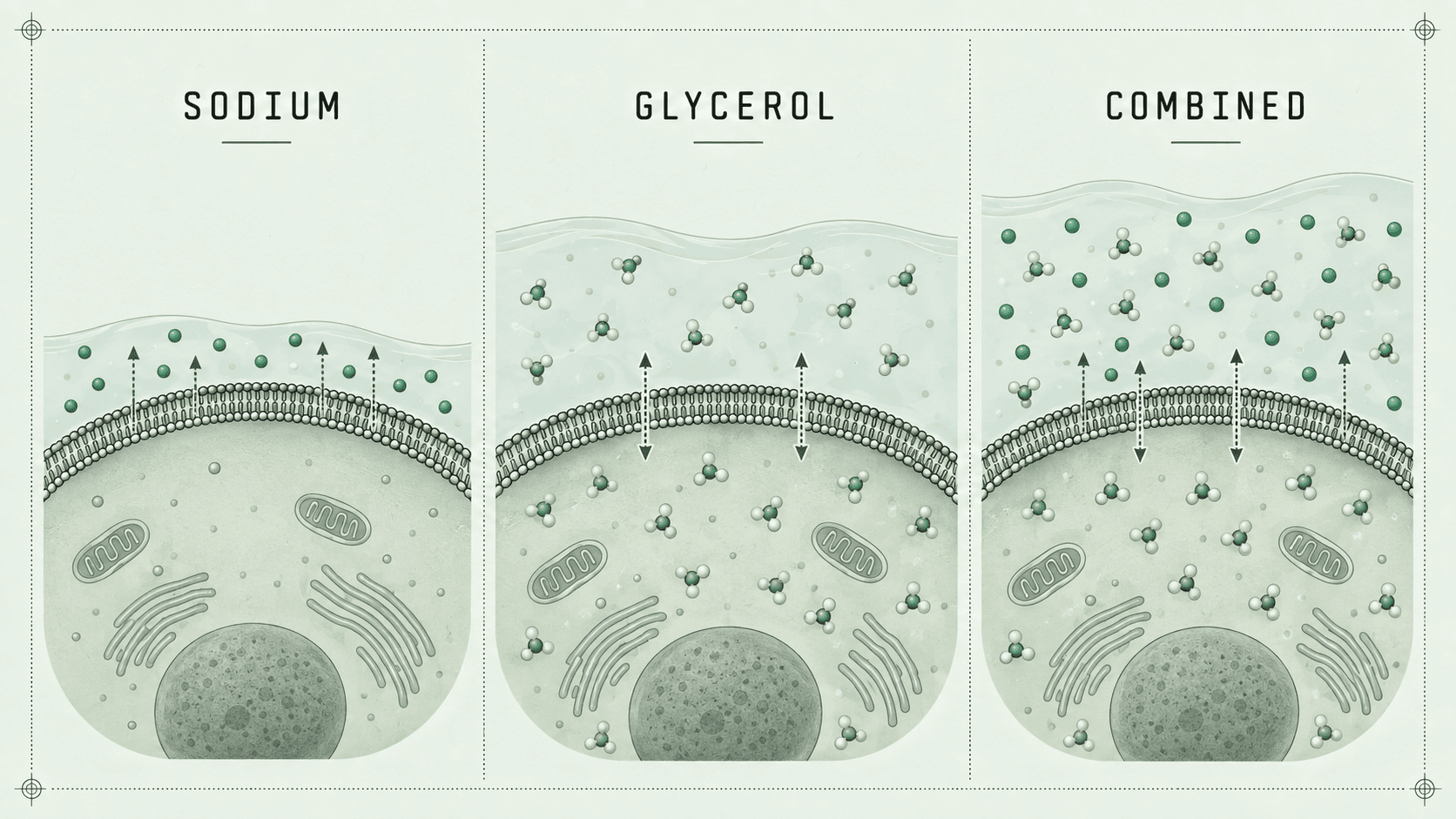
If the goal is plasma volume, sodium loading is the main lever. That case is already made in Sodium Loading for Endurance Racing. If the goal is a bigger total-body water reservoir against a large sweat deficit when drinking is hard, add glycerol on top of the salt.
| Protocol | Study | Fluid retained | Plasma volume |
|---|---|---|---|
| Combined glycerol plus salt | Goulet 2018, n=15 | 1,435 ± 140 mL (77%) | +11.3% |
| Salt only | Goulet 2018 | 1,127 ± 212 mL (61%) | +11.3% |
| Glycerol only | Goulet 2018 | 729 ± 115 mL (39%) | +7.6% |
| Salt only | Savoie 2015, n=17 | 1,144 mL | +11.9% |
| Glycerol only | Savoie 2015 | 795 mL | +4.0% |
| Water only | Savoie 2015 | 90 mL | −0.7% |
03The extra litre still finished in the same time
Goulet's 2007 performance meta-analysis pooled four studies and found a 2.62% ± 1.60% improvement, p=0.047. The authors noted a dearth of data. The pool mixed time-to-exhaustion with time trials.10 Montner 1996 is the loud number people still quote. Eleven cyclists lasted 93.8 versus 77.4 minutes in temperate air, a 21% gain on a time-to-exhaustion test, with heart rate 2.8 bpm lower and core temperature unchanged.11 Time-to-exhaustion tests let a subject ride until they quit, so a small physiological edge compounds into a large percent difference. A fixed-distance race does not work that way.
Anderson 2001 put six men in 35 °C with 1 g per kg in 20 mL per kg and got 252 versus 240 kJ in the performance bout, a 5% bump, with late steady-state rectal temperature 38.7 versus 39.1 °C.12 Hitchins 1999 gave eight cyclists about 600 mL extra at 32 °C and 5% more work in the variable phase, with no difference in rectal temperature, sweat, or heart rate.13 Coutts 2002 took ten Olympic-distance triathletes outdoors. The hot-versus-warm slowdown was 11 min 40 s on placebo and 1 min 47 s on glycerol. Small sample, two weather days.14 Goulet 2006 then rode six trained men at 25 °C with 500 mL per hour during the ride. Heart rate, rectal temperature, sweat, and performance did not differ.15
Jardine 2025 found no performance benefit from the combined protocol in a warm-condition field half-marathon. The study included 13 trained runners at about 24 °C wet-bulb globe temperature, with 1,189 mL extra fluid retention, plasma volume up 9.0%, and times of 101.5 versus 101.7 minutes.3 Jolicoeur Desroches 2023 ran a 5 km in the heat in 10 people. 22.95 versus 22.52 minutes. Short, fast, extra mass.16
Jardine's 2023 review of all hyperhydration, sodium, glycerol, and mixed, found time-trial improvement in two studies and capacity gains of 14.3% to 26.2% in five. Heart rate fell 3 to 11 bpm in nine studies. Core temperature fell 0.1 to 0.8 °C in eight. Plasma volume rose 3.5% to 12.6% across ten studies of mixed methods. Glycerol-only plasma volume sat at 3.5% to 6.6% in five studies. The 12.6% top end is not a glycerol-only effect. Gastrointestinal symptoms appeared in 26 studies.17 Lyons 1990, the origin story, used six subjects in a hot-environment exercise study.18 Later papers in trained athletes did not replicate a large core-temperature drop.17
04Save it for a 2 percent deficit you cannot drink through
The candidate event is long or hot enough that a 2% body-mass deficit is likely even with a drinking plan. A marathon in heat. An Olympic triathlon with a swim you cannot drink through. A long time trial with aero constraints. Any sport with restricted fluid access. A high sweat rate and a history of dumping a pre-race water load as urine both strengthen the case. Heat does too, especially if you are unacclimated. Latzka tested already heat-acclimated men and saw almost nothing extra versus water hyperhydration.19
Skip the cool short race, the recreational 5 km, and any athlete who can stay inside 2% body mass by drinking. Extra mass is a tax when there is no deficit to spend.
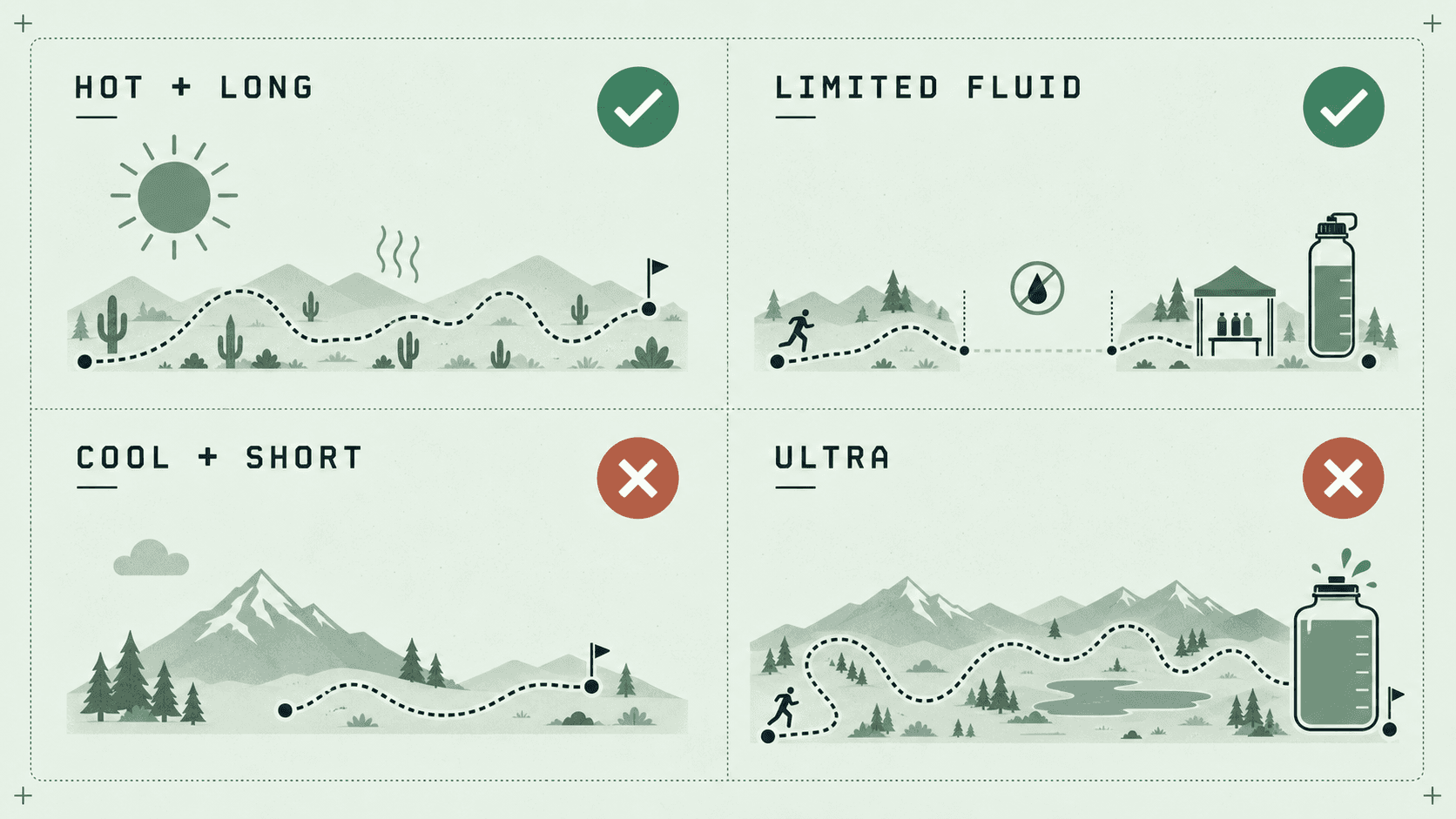
| Race context | Glycerol on top of sodium | Why |
|---|---|---|
| Hot marathon, Olympic triathlon, long aero TT | High | A 2% deficit is likely and drinking is restricted |
| High sweat rate, history of dumping a water load | High | Glycerol is for the athlete who pees out a water load |
| Cannot drink during, swim, aid gaps, gut that shuts | High | The reservoir has to be on board at the gun |
| Heat, especially if unacclimated | Moderate to high | Latzka saw almost nothing extra once men were already heat-acclimated |
| Cool short race, recreational 5 km, can stay within 2% | Skip | Extra mass with no deficit to spend |
| Ultra | Skip | AIS warns against prolonged fluid overloading |
05The 1.2 g per kg combined protocol
AIS uses 1.2 to 1.4 g per kg glycerol in about 25 mL per kg fluid.7 van Rosendal used 26 mL per kg. Jardine used 25. Sodium chloride is 7.5 g per L, about 128 mmol per L sodium, about 3 g sodium per litre. Take it as four equal boluses over 60 minutes. Finish 90 to 180 minutes before the gun, which is the AIS window. Jardine finished 120 minutes pre. Prefer that over van Rosendal's tighter 30 minutes after the last sip; rehearse the full schedule rather than assuming a predictable bathroom interval.367
A 70 kg athlete takes 84 g glycerol in 1,750 mL fluid with about 13.1 g NaCl. Combined extra water sits near 1.35 L, about 19 mL per kg in Goulet 2018.4
| Body mass | Glycerol (1.2 g/kg) | Fluid (25 mL/kg) | NaCl (7.5 g/L) |
|---|---|---|---|
| 60 kg | 72 g | 1,500 mL | 11.3 g |
| 70 kg | 84 g | 1,750 mL | 13.1 g |
| 80 kg | 96 g | 2,000 mL | 15.0 g |
| 90 kg | 108 g | 2,250 mL | 16.9 g |
Weigh the glycerol. Density is about 1.26 g/mL, so a kitchen measuring cup will miss. Use an ingestion-grade food or pharmaceutical product that meets its applicable specification. Industrial glycerin is the wrong bottle. Propylene glycol is a different molecule. A 4.6% glycerol drink with 7.5 g per L salt tastes like salty syrup. Flavor it with a sports drink or cordial you already tolerate.
Glycerol is an osmolyte. The 4.3 kcal per g is incidental. Do not cut breakfast carbohydrate to make room unless the gut cannot handle both. Gut Training for Race Nutrition is how you find that out. Slot the drink into How to Set Up a Race-Week Nutrition Plan the same way you slot the carbohydrate breakfast.
Do not stack the load with aggressive plain water. ACSM 2007 warned that hyperhydration can dilute plasma sodium and raise hyponatremia risk.8 The Amateur Athlete's Sodium Mistake is usually too little context around salt. The glycerol version of that mistake is too much water on top of a preload.
06Mix, sip, and plan the bathroom stop
Start the four boluses 180 minutes before the gun so the last sip lands at 120 minutes. Plan a bathroom stop before the start, but do not treat its timing as predictable because urine output varies with the fluid load.7
| Time before the gun | Action |
|---|---|
| 180 min | First of four equal boluses |
| 160 min | Second bolus |
| 140 min | Third bolus |
| 120 min | Fourth bolus, load finished |
| 120 to 90 min | Allow time for a bathroom stop; individual timing varies with the fluid load |
| 90 min | Stop large boluses. Small comfort sips only |
| Gun | Start the during-race fluid plan |
Rehearse the exact drink in training. Never debut it on race morning.
07Skip it for the gut, the kidneys, or an ultra
The Australian Institute of Sport lists glycerol as a Group A performance supplement for athletes who will otherwise start with a fluid deficit they cannot drink through.7 ACSM 2007 is the counterweight. The position stand called the benefits equivocal, listed extra voiding as a disadvantage, and saw no clear advantage over starting euhydrated.8 The 2016 Academy of Nutrition and Dietetics, Dietitians of Canada, and ACSM joint statement noted that glycerol was prohibited by WADA at that time.20 ISSN has no glycerol position stand. Use the AIS protocol. Do not read ACSM as an endorsement.
van Rosendal, citing Robergs 1998, reports nausea, gastrointestinal discomfort, headache, light-headedness, and diarrhea among possible adverse effects. Use is not advised without clinician guidance during pregnancy or in people with diabetes, renal disease, migraine or headache disorders, cardiovascular disease, or liver disorders.621 First-timers and GI-fragile athletes belong on the skip list with those medical exclusions. People who already overdrink belong there too, because extra retained water on top of aggressive intake is how hyponatremia gets a head start.
AIS says glycerol-induced hyperhydration is not recommended prior to ultras because of prolonged fluid overloading.7 That warning is the right one. Ultra-distance fueling already has a longer window for both hypohydration and overdrinking. Female race data are thin. The head-to-head retention trials were men, and the Jardine field race was almost entirely men. Do not assume the same race result in women.
If the next race has bottles on course and you can stay inside 2 percent, leave the glycerol on the shelf. If it is a hot marathon, an Olympic triathlon, or a long time trial where drinking will fail, weigh 1.2 g per kilogram, salt the bottle, and rehearse the bathroom stop on a training day that looks like race day.
Footnotes
World Anti-Doping Agency. The 2026 Prohibited List. Effective 1 January 2026. S5 names intravenous albumin, dextran, hydroxyethyl starch, and mannitol as plasma expanders. Glycerol is not listed. wada-ama.org.
Back to textBack to text 2Koehler K, Thevis M, Schänzer W. Meta-analysis: Effects of glycerol administration on plasma volume, haemoglobin, and haematocrit. Drug Test Anal. 2013;5(11-12):896-899. PubMed. doi:10.1002/dta.1580.
Back to textJardine WT, Condo D, Aisbett B, et al. The Addition of Glycerol and Sodium Chloride to a Hyperhydration Protocol Does Not Improve Half-Marathon Time-Trial Performance in Trained Runners in Warm Conditions. Int J Sports Physiol Perform. 2025;20(6):770-778. PubMed. doi:10.1123/ijspp.2024-0268.
Back to textBack to text 2Back to text 3Back to text 4Back to text 5Goulet EDB, De La Flore A, Savoie FA, Gosselin J. Salt + Glycerol-Induced Hyperhydration Enhances Fluid Retention More Than Salt- or Glycerol-Induced Hyperhydration. Int J Sport Nutr Exerc Metab. 2018;28(3):246-252. PubMed. doi:10.1123/ijsnem.2017-0310.
Back to textBack to text 2Back to text 3Back to text 4Back to text 5Back to text 6Savoie FA, Dion T, Asselin A, Goulet EDB. Sodium-induced hyperhydration decreases urine output and improves fluid balance compared with glycerol- and water-induced hyperhydration. Appl Physiol Nutr Metab. 2015;40(1):51-58. PubMed. doi:10.1139/apnm-2014-0243.
Back to textBack to text 2van Rosendal SP, Osborne MA, Fassett RG, Coombes JS. Guidelines for Glycerol Use in Hyperhydration and Rehydration Associated with Exercise. Sports Med. 2010;40(2):113-129. PubMed. doi:10.2165/11530760-000000000-00000.
Back to textBack to text 2Back to text 3Back to text 4Back to text 5Australian Institute of Sport. Glycerol. Group A performance supplement. Protocol 1.2 to 1.4 g/kg in about 25 mL/kg fluid, 90 to 180 min pre-exercise. Removed from the WADA Prohibited List on 1 January 2018. ausport.gov.au.
Back to textBack to text 2Back to text 3Back to text 4Back to text 5Back to text 6Back to text 7Back to text 8Back to text 9Back to text 10Back to text 11Sawka MN, Burke LM, Eichner ER, Maughan RJ, Montain SJ, Stachenfeld NS. American College of Sports Medicine position stand. Exercise and fluid replacement. Med Sci Sports Exerc. 2007;39(2):377-390. DOI.
Back to textBack to text 2Back to text 3Freund BJ, Montain SJ, Young AJ, et al. Glycerol hyperhydration: hormonal, renal, and vascular fluid responses. J Appl Physiol. 1995;79(6):2069-2077. PubMed. doi:10.1152/jappl.1995.79.6.2069.
Back to textGoulet EDB, Aubertin-Leheudre M, Plante GE, Dionne IJ. A Meta-Analysis of the Effects of Glycerol-Induced Hyperhydration on Fluid Retention and Endurance Performance. Int J Sport Nutr Exerc Metab. 2007;17(4):391-410. PubMed. doi:10.1123/ijsnem.17.4.391.
Back to textBack to text 2Montner P, Stark DM, Riedesel ML, et al. Pre-exercise glycerol hydration improves cycling endurance time. Int J Sports Med. 1996;17(1):27-33. PubMed. doi:10.1055/s-2007-972804.
Back to textAnderson MJ, Cotter JD, Garnham AP, Casley DJ, Febbraio MA. Effect of glycerol-induced hyperhydration on thermoregulation and metabolism during exercise in heat. Int J Sport Nutr Exerc Metab. 2001;11(3):315-333. PubMed. doi:10.1123/ijsnem.11.3.315.
Back to textHitchins S, Martin DT, Burke L, et al. Glycerol hyperhydration improves cycle time trial performance in hot humid conditions. Eur J Appl Physiol Occup Physiol. 1999;80(5):494-501. PubMed. doi:10.1007/s004210050623.
Back to textCoutts A, Reaburn P, Mummery K, Holmes M. The effect of glycerol hyperhydration on olympic distance triathlon performance in high ambient temperatures. Int J Sport Nutr Exerc Metab. 2002;12(1):105-119. PubMed. doi:10.1123/ijsnem.12.1.105.
Back to textGoulet EDB, Robergs RA, Labrecque S, Royer D, Dionne IJ. Effect of glycerol-induced hyperhydration on thermoregulatory and cardiovascular functions and endurance performance during prolonged cycling in a 25 degrees C environment. Appl Physiol Nutr Metab. 2006;31(2):101-109. PubMed. DOI.
Back to textJolicoeur Desroches A, Naulleau C, Deshayes TA, Parent-Roberge H, Pancrate T, Goulet EDB. Effect of Glycerol-Induced Hyperhydration on a 5-kilometer Running Time-Trial Performance in the Heat in Recreationally Active Individuals. Nutrients. 2023;15(3):599. PubMed. doi:10.3390/nu15030599.
Back to textJardine WT, Aisbett B, Kelly MK, et al. The Effect of Pre-Exercise Hyperhydration on Exercise Performance, Physiological Outcomes and Gastrointestinal Symptoms: A Systematic Review. Sports Med. 2023;53(11):2111-2134. DOI.
Back to textBack to text 2Lyons TP, Riedesel ML, Meuli LE, Chick TW. Effects of glycerol-induced hyperhydration prior to exercise in the heat on sweating and core temperature. Med Sci Sports Exerc. 1990;22(4):477-483. PubMed.
Back to textLatzka WA, Sawka MN, Montain SJ, et al. Hyperhydration: tolerance and cardiovascular effects during uncompensable exercise-heat stress. J Appl Physiol. 1998;84(6):1858-1864. PubMed. doi:10.1152/jappl.1998.84.6.1858.
Back to textThomas DT, Erdman KA, Burke LM. American College of Sports Medicine Joint Position Statement. Nutrition and Athletic Performance. Med Sci Sports Exerc. 2016;48(3):543-568. PubMed. doi:10.1249/MSS.0000000000000852.
Back to textRobergs RA, Griffin SE. Glycerol. Biochemistry, pharmacokinetics and clinical and practical applications. Sports Med. 1998;26(3):145-167. PubMed. doi:10.2165/00007256-199826030-00002.
Back to textWorld Anti-Doping Agency. 2010 Prohibited List. Summary of Major Modifications. Glycerol added as an example of a plasma expander, oral and intravenous. Effective 1 January 2010. wada-ama.org.
Back to textBack to text 2