Long endurance events can lower blood choline, and a choline supplement reliably pushes it back up. In controlled trials of cyclists, soldiers, marathoners, and triathletes, the higher blood number did not produce a faster finish or a longer time to exhaustion. Alpha-GPC has a few small positive results for force, jump power, and one cognitive test, and each sits beside null results from the same studies.
01Marathon running lowers plasma choline
The endurance case for choline starts with a real observation. Runners in the 1985 and 1986 Boston Marathons showed plasma choline declines that later reviews summarize as about 40 percent.16 When Buchman and colleagues measured 23 runners before and after the 1997 Houston Marathon, plasma free choline fell from 19.2 to 14.6 nmol/mL, a drop of about 24 percent, and was still below baseline 48 hours later.2
In the same runners, plasma choline showed no correlation with finish time or with how closely runners hit their predicted times, and the size of the plasma drop did not predict either. Only the percent fall in urinary free choline correlated with the predicted-to-actual time ratio, a single association in 23 people.2
Plasma choline is a pool in transit between the liver, the gut, and tissues that take it up. Buchman's group proposed faster metabolism or tissue uptake as the reason for the post-race fall, which is a different state from a shortage.2 None of these studies measured choline or acetylcholine in muscle or brain. The claim that runners "run low" on brain choline is an inference from a blood draw.
Penry and Manore reviewed the field in 2008 and landed on a conditional hypothesis. Supplementation might help only in events that push circulating choline below normal.22 That condition has rarely been confirmed in the people who were then given a supplement.
02Choline intake versus supplementation
Choline is an essential nutrient with an Adequate Intake of 550 mg a day for adult men and 425 mg for nonpregnant, nonlactating adult women, and a Tolerable Upper Intake Level of 3.5 grams a day from all sources.3 Most U.S. adults eat less than the AI,4 and the choline glossary entry covers the food sources, the liver-fat evidence, and who needs to plan intake deliberately.
An AI is an intake level assumed to ensure nutritional adequacy when the data are too thin to set an average requirement. Falling below it is not a diagnosis of deficiency. Exceeding it is not a sports target. The UL marks a safety ceiling, and a dose below it carries no promise of benefit.
An athlete who eats few eggs, little meat or fish, and no soy may have a real dietary gap, and food is the first way to close it. An athlete looking for a faster 10K or a sharper pre-lift mind is asking whether extra choline on top of an adequate diet changes performance. Nutrient requirement studies answer the first question. The trials below answer the second.

Eggs and soy contribute dietary choline. Assess habitual intake before treating choline as a performance supplement.3
Lee and colleagues randomized 37 healthy adults aged 50 to 69 to low, medium, or high choline intake from egg yolk and protein powder during 12 weeks of resistance training. The low-intake group gained less composite strength than the other two groups, 19.4 percent compared with about 47 percent.21 The sample was small, the participants were older, and the U.S. Poultry & Egg Association funded the work. The trial tested habitual intake during training and says nothing about an acute dose before a session.
Choline also shares a methyl-group supply with creatine synthesis, which matters for people who lean on egg whites. How choline and creatine share a methyl-group budget covers that mechanism.
03Endurance trials found no performance gain
Four controlled trials gave trained people choline preparations, raised their plasma levels, and found no performance effect. A fifth randomized trial tested krill oil as a source of choline.11
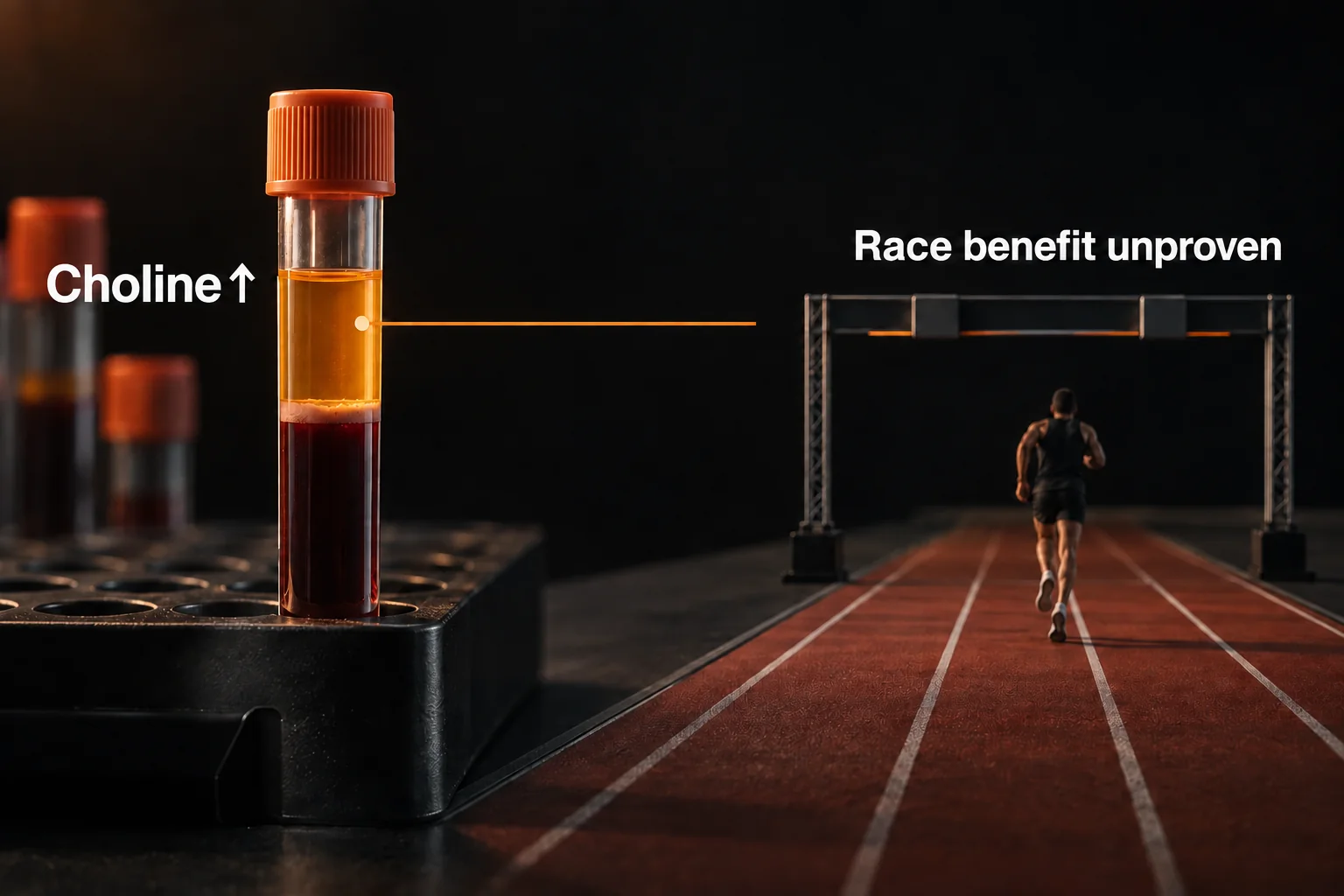
Controlled endurance trials raised blood choline without finding a reliable performance benefit. A blood response alone does not establish a faster finish.7891011
Spector and colleagues gave 20 trained male cyclists 2.43 grams of choline bitartrate one hour before riding to exhaustion, either at about 150 percent of VO2max or at 70 percent. Serum choline rose 37 and 52 percent. Time to fatigue and work performed did not change. Choline did not fall during either placebo ride, so the premise of depletion never appeared.7
Warber and colleagues gave 14 soldiers 8.425 grams of choline citrate before and midway through four hours of treadmill walking with a 34.1 kg load. Plasma choline rose 128 percent after the supplement and stayed flat on placebo. Run time to exhaustion, squats, and perceived exertion showed no significant effect.8 Deuster and colleagues ran a similar crossover in 13 men at 50 mg per kilogram of body weight. Plasma choline rose. Physical tasks, reaction time, logical reasoning, vigilance, spatial memory, and working memory did not improve, and plasma choline again held steady on placebo.9
Buchman's 2000 pilot randomized 12 marathoners to lecithin supplying about 1.1 grams of choline a day, started the day before the race. Plasma free choline fell on placebo and rose on lecithin. The ratio of actual to predicted finish time was 1.03 with lecithin and 1.07 with placebo, a difference that was not significant (p = 0.36).10 With 12 runners and noisy race-day predictions, the trial could miss a small effect. It gives no support for a large one.
Storsve and colleagues gave 47 triathletes 4 grams a day of krill oil, providing 316 mg of choline, or vegetable oil for five weeks before an Ironman-distance or shorter race. The krill group had higher serum choline across the race measurements. Ironman-distance race times were 844 minutes with krill oil and 881 with placebo (p = 0.29). Shorter-distance times were 136 and 121 minutes (p = 0.64), with the krill group slower.11 The study was designed around biomarkers, and the krill oil manufacturer funded it and employed three of the authors.
Against that record stands one positive result. Sandage and colleagues reported in a 1992 abstract that 10 runners given 2.8 grams of choline citrate before and midway through a 20-mile run finished in 153.7 minutes, compared with 158.9 on placebo.56 The full methods and data were never published in a peer-reviewed paper, and secondary accounts describe the dosing schedule differently.
| Study | Population | Supplement | Plasma choline | Performance |
|---|---|---|---|---|
| Sandage 1992 (abstract) | 10 runners | 2.8 g choline citrate | Rose | 20-mile time faster, 153.7 vs 158.9 min |
| Spector 1995 | 20 trained cyclists | 2.43 g choline bitartrate, 1 h before | Rose 37 to 52% | No change in time to fatigue or work |
| Warber 2000 | 14 soldiers | 8.425 g choline citrate, split dose | Rose 128% | No change in run to exhaustion, squats, or effort |
| Buchman 2000 | 12 marathoners | Lecithin, about 1.1 g choline/day | Maintained | No significant finish-time benefit (p = 0.36) |
| Deuster 2002 | 13 men | 50 mg/kg choline | Rose | No physical or cognitive benefit |
| Storsve 2020 | 47 triathletes | Krill oil, 316 mg choline/day for 5 weeks | Higher concentrations overall | No significant race-time difference |
The pattern is consistent. Supplements move the blood marker, and the performance outcome stays put. In three of the lab trials, placebo conditions did not deplete choline in the first place, which removes the problem the supplement was meant to solve.789 Each trial is small, and none enrolled athletes selected for low choline intake or low starting levels. That is the one group the depletion hypothesis would predict to respond, and it remains untested.
04Alpha-GPC strength and power results
Alpha-GPC is a choline compound that is about 41 percent choline by weight, so 600 mg of Alpha-GPC supplies roughly 250 mg of choline.18 It is marketed for strength, power, and focus, and each trial improved a different endpoint.
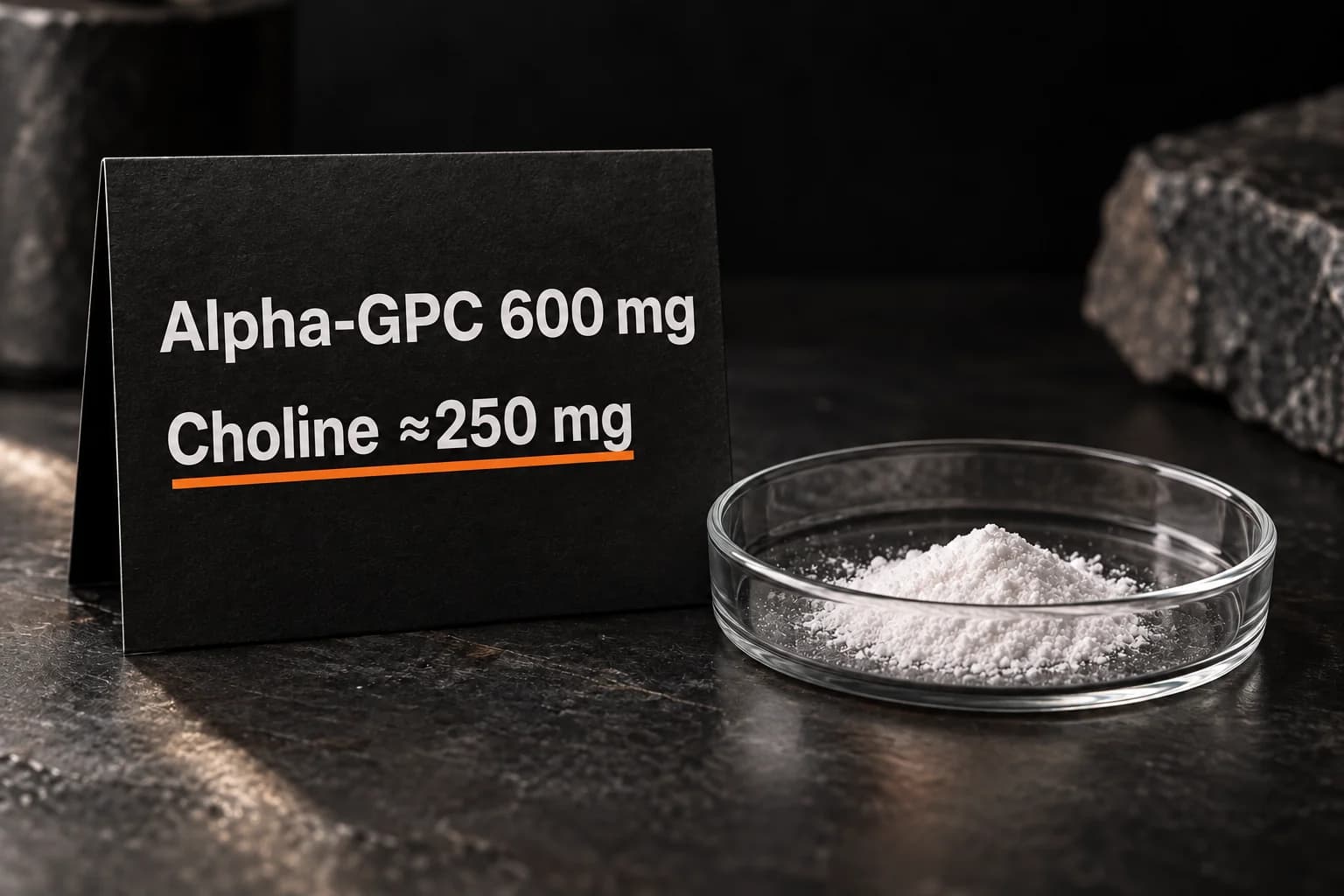
The compound weight and choline content are different quantities. This example explains label arithmetic and is not a recommended performance dose.18
Ziegenfuss and colleagues gave seven resistance-trained men 600 mg of Alpha-GPC 90 minutes before squats, then tested bench press throws. Peak force was 933 N compared with 818 N on placebo, the 14 percent figure often repeated online. Peak power, rate of force development, resting metabolic rate, and heart rate did not differ significantly.12 Summaries that call this a power increase have relabeled the outcome. The report is a conference poster, and Chemi Nutra, an Alpha-GPC supplier, supported it.
Bellar and colleagues gave 13 college-aged men 600 mg a day for six days. Change in isometric mid-thigh pull force favored Alpha-GPC, 98.8 N compared with a 39.0 N decline on placebo (p = 0.044). The upper-body isometric test was not significant.13 The standard deviation of the Alpha-GPC change was 236.9 N, more than twice the average gain, which shows how widely individual responses varied.
Marcus and colleagues randomized 48 college-aged men to 250 mg or 500 mg of Alpha-GPC, 200 mg of caffeine, or placebo daily for seven days. Serum free choline rose in both Alpha-GPC groups. Isometric strength and psychomotor vigilance did not differ between groups. Countermovement jump velocity and power showed group differences, with the largest improvement in the 250 mg group.14 A lower dose outperforming a higher one in a small sample is a reason for caution about any dose-response claim. Chemi Nutra partly funded this trial and the Bellar trial.
| Study | Participants | Dose and timing | Improved | No significant change |
|---|---|---|---|---|
| Ziegenfuss 2008 (abstract) | 7 trained men | 600 mg, 90 min before | Peak bench-throw force | Peak power, rate of force development |
| Bellar 2015 | 13 college men | 600 mg/day for 6 days | Mid-thigh pull force change | Upper-body isometric force |
| Marcus 2017 | 48 college men | 250 or 500 mg/day for 7 days | Jump velocity and power, largest at 250 mg | Isometric strength, vigilance |
| Kerksick 2024 | 20 trained men | 315 or 630 mg, 60 min before | Stroop score and time, plus post-hoc Flanker reaction time | Overall Flanker comparison, N-Back, jumps, bench throws, growth hormone |
Across four trials, 88 men took part in total. No women were studied. Doses and timing differ in every trial, from a single dose 60 or 90 minutes before testing to six or seven days of daily use. Each positive result comes from a different endpoint, and none has been independently replicated.
05Alpha-GPC focus and growth hormone
The strongest focus result comes from Kerksick's 2024 crossover in 20 resistance-trained men given 315 mg or 630 mg of Alpha-GPC 60 minutes before testing. The Stroop total score improved more than placebo at both doses, and the higher dose also shortened Stroop completion time. The overall Flanker comparison and N-Back test showed no significant differences, though a post-hoc comparison found faster Flanker-compatible reaction time at the higher dose. Vertical jumps, bench press throws, mood scales, and growth hormone did not change.15 An Alpha-GPC manufacturer funded the study, the author is a paid scientific advisor to that company, and the trial was registered after the fact. With three cognitive tests and several scores per test, the positive cognitive findings remain preliminary.
Cognitive findings from older adults with impairment cannot be assumed to transfer to young athletes with intact cognition.18 The Deuster trial, which tested choline itself on reaction time, vigilance, and working memory after exhausting exercise, found nothing.9
Ziegenfuss reported a 44-fold rise in peak growth hormone with Alpha-GPC compared with 2.6-fold on placebo.12 The Alpha-GPC condition started from a baseline of 0.19 ng/mL and the placebo condition from 1.9 ng/mL, a tenfold difference that inflates the fold-change comparison. Peak values were 8.4 and 5.0 ng/mL. Kerksick found no growth hormone effect.15 A transient post-exercise hormone rise is a surrogate marker. It has not been shown to produce more muscle or strength.
A multi-ingredient formula with Alpha-GPC, Huperzia, ginseng, and black pepper improved rate of torque development during a fatiguing task in 14 college football players, with no baseline strength or jump effect.16 A seven-day product combining BCAAs, citrulline, and 300 mg of Alpha-GPC raised peak power and time to fatigue in 30 cyclists without improving 20 km time-trial completion time.17 Neither design can attribute any result to Alpha-GPC.
06Alpha-GPC and stroke risk
Fuel's Huberman supplement guide mentions an Alpha-GPC stroke signal. It comes from a South Korean national insurance cohort of adults 50 and older. In the matched analysis, 108,216 people prescribed Alpha-GPC had a higher adjusted 10-year stroke risk than 1,082,160 nonusers (hazard ratio 1.43), with higher risk at longer prescription duration.19 A 2025 cohort of 508,107 people with mild cognitive impairment reported lower stroke risk among users who did not progress to dementia.20
Both studies are observational and involve older adults prescribed Alpha-GPC for cognitive concerns. People prescribed a memory drug differ from nonusers in ways matching cannot fully capture. Neither cohort estimates risk for a healthy 28-year-old taking Alpha-GPC before training. The athletic trials were too short and too small to detect rare cardiovascular events, so they cannot rule a risk in or out. Given the thin performance evidence, the uncertain safety question carries more weight than it would for a supplement with a proven benefit.
07Dietary gaps versus performance claims
For a possible dietary gap, compare a few days of real food intake with the AI for your life stage: 550 mg/day for adult men, 425 for nonpregnant, nonlactating adult women, 450 during pregnancy, or 550 during lactation.3 Eggs, meat, fish, dairy, and soy supply most dietary choline, and the choline glossary lists amounts per serving. If intake is low because of pregnancy, a vegan diet, or a very low food volume, that is a nutrient-planning question with a known target.
For a performance claim, no choline form has a validated performance dose. The endurance trials used several choline sources at widely different doses and found no reliable benefit. The Alpha-GPC trials tested 250 to 630 mg and found scattered single-endpoint results. The marathoners and triathletes whose plasma choline fell during racing finished no faster when a supplement kept it higher.
Carbohydrate during long efforts has repeated trial support and is covered in endurance athlete fueling. Caffeine and creatine have established doses in the pre-workout stack guide, and the pre-workout nutrition glossary covers the meal before training.
Choline research has spent 40 years measuring what supplements do to blood and far less time confirming what they do to athletes. Until a trial enrolls athletes with confirmed low choline status and measures an actual race or lift, choline belongs on the food log.
Footnotes
Conlay LA, Wurtman RJ, Blusztajn K, Coviella IL, Maher TJ, Evoniuk GE. Decreased plasma choline concentrations in marathon runners. N Engl J Med. 1986. PubMed
Back to textBuchman AL, Jenden D, Roch M. Plasma free, phospholipid-bound and urinary free choline all decrease during a marathon run and may be associated with impaired performance. J Am Coll Nutr. 1999. PubMed
Back to textBack to text 2Back to text 3Back to text 4National Institutes of Health Office of Dietary Supplements. Choline fact sheet for health professionals. NIH ODS
Back to textBack to text 2Back to text 3Back to text 4Wallace TC, Fulgoni VL 3rd. Assessment of total choline intakes in the United States. J Am Coll Nutr. 2016. PubMed
Back to textSandage BW, Sabounjian RN, White R, Wurtman RJ. Choline citrate may enhance athletic performance [abstract]. Physiologist. 1992, volume 35, page 236a.
Back to textBack to text 2Jäger R, Purpura M, Kingsley M. Phospholipids and sports performance. J Int Soc Sports Nutr. 2007. PMC
Back to textBack to text 2Spector SA, Jackman MR, Sabounjian LA, Sakkas C, Landers DM, Willis WT. Effect of choline supplementation on fatigue in trained cyclists. Med Sci Sports Exerc. 1995. PubMed
Back to textBack to text 2Back to text 3Back to text 4Warber JP, Patton JF, Tharion WJ, et al. The effects of choline supplementation on physical performance. Int J Sport Nutr Exerc Metab. 2000. PubMed
Back to textBack to text 2Back to text 3Back to text 4Deuster PA, Singh A, Coll R, Hyde DE, Becker WJ. Choline ingestion does not modify physical or cognitive performance. Mil Med. 2002. PubMed
Back to textBack to text 2Back to text 3Back to text 4Back to text 5Buchman AL, Awal M, Jenden D, Roch M, Kang SH. The effect of lecithin supplementation on plasma choline concentrations during a marathon. J Am Coll Nutr. 2000. PubMed
Back to textBack to text 2Back to text 3Storsve AB, Johnsen L, Nyborg C, Melau J, Hisdal J, Burri L. Effects of krill oil and race distance on serum choline and choline metabolites in triathletes. Front Nutr. 2020. PMC
Back to textBack to text 2Back to text 3Back to text 4Ziegenfuss T, Landis J, Hofheins J. Acute supplementation with alpha-glycerylphosphorylcholine augments growth hormone response to, and peak force production during, resistance exercise. J Int Soc Sports Nutr. 2008, volume 5, supplement 1, abstract P15. PMC
Back to textBack to text 2Back to text 3Bellar D, LeBlanc NR, Campbell B. The effect of 6 days of alpha glycerylphosphorylcholine on isometric strength. J Int Soc Sports Nutr. 2015. PMC
Back to textBack to text 2Marcus L, Soileau J, Judge LW, Bellar D. Evaluation of the effects of two doses of alpha glycerylphosphorylcholine on physical and psychomotor performance. J Int Soc Sports Nutr. 2017. PMC
Back to textBack to text 2Kerksick CM. Acute alpha-glycerylphosphorylcholine supplementation enhances cognitive performance in healthy men. Nutrients. 2024. PMC
Back to textBack to text 2Back to text 3Gage M, Phillips K, Noh B, Yoon T. Choline-based multi-ingredient supplementation can improve explosive strength during a fatiguing task. Int J Environ Res Public Health. 2021. PMC
Back to textHarrington RN. Effects of branched chain amino acids, l-citrulline, and alpha-glycerylphosphorylcholine supplementation on exercise performance in trained cyclists. J Int Soc Sports Nutr. 2023. PMC
Back to textKansakar U, Trimarco V, Mone P, Varzideh F, Lombardi A, Santulli G. Choline supplements: an update. Front Endocrinol. 2023. PMC
Back to textBack to text 2Back to text 3Lee G, Choi S, Chang J, et al. Association of L-α glycerylphosphorylcholine with subsequent stroke risk after 10 years. JAMA Netw Open. 2021. PMC
Back to textKim HK, Park S, Kim SW, et al. Association between L-α glycerylphosphorylcholine use and delayed dementia conversion. J Prev Alzheimers Dis. 2025. PMC
Back to textLee CW, Lee TV, Galvan E, et al. The effect of choline and resistance training on strength and lean mass in older adults. Nutrients. 2023. PMC
Back to textPenry JT, Manore MM. Choline: an important micronutrient for maximal endurance-exercise performance? Int J Sport Nutr Exerc Metab. 2008. PubMed
Back to text