Percent visceral adipose tissue (VAT) often falls faster than percent abdominal subcutaneous adipose tissue (SAT) during modest fat loss. Absolute SAT still accounts for more of the lost fat mass because the depot is larger.13
Headlines that call visceral fat easier to lose flatten that split. HIIT is not required, but it can reduce this depot.13 A weekly DEXA appointment does not replace a calorie deficit or aerobic work. Rank everything else after those two facts.
01Visceral fat is not the pinchable belly
Visceral fat sits inside the abdominal cavity around organs. SAT is the pinchable layer under the skin. They are different depots, so scale weight cannot show which one changed.5
Age and menopause shift the map. Lovejoy followed perimenopausal women for four years. Only those who became postmenopausal had a significant VAT increase, from 88.0 to 97.5 cm².23 Samargandy and the SWAN Heart study reported VAT rising 8.2% per year from two years before the final menstrual period to that period, then 5.8% per year after.24 Protein, lifting, and deficit decisions for that shift are in women's fat loss across menopause.
02Percent visceral fat falls faster while subcutaneous fat still loses more mass
Chaston and Dixon extracted 98 cohort time points from 61 imaging studies. Percentage weight loss was the only variable that influenced the ratio of percent visceral to percent subcutaneous fat change (r = −0.29, P = 0.005). Modest loss generated preferential percent VAT loss. The effect attenuated with greater loss. Diet, exercise, and surgery were not influences except a very-low-calorie window shorter than four weeks that was gone by 12 to 14 weeks.1
Hall and Hallgreen modeled the fade mathematically. Because visceral fat is a smaller depot, a given kilogram of loss represents a larger percent of that depot, but the advantage shrinks as total fat mass falls (scaling exponent k = 1.3 ± 0.1).2 The percent advantage is real at modest loss. It is a property of starting depot size.
Merlotti analyzed 89 studies. Absolute SAT decrease exceeded VAT when measured as area, volume, or weight. Percent VAT decrease exceeded percent SAT, with no differences between strategies. There are no shortcuts to losing VAT with the available strategies.3
Abe's 65-study review puts the same split in square centimeters. Abdominal SAT area fell about 10 cm² per 1 kg of total fat lost, similar across treatments. Exercise alone changed VAT by −26.3 cm² and SAT by −31.5 cm². Restriction plus exercise changed VAT by −33.6 cm² and SAT by −65.1 cm². Restriction alone changed VAT by −51.6 cm² and SAT by −87.2 cm².4 The pooled restriction estimates were larger in both depots. Exercise produced closer VAT and SAT area changes because the energy deficit was usually smaller. Abe does not show exercise beating diet for VAT.
Junker's LION MRI cohort lost a mean 11.61 kg on an 8-week low-calorie diet. Absolute SAT fell 3.24 L and VAT 1.24 L. Total adipose volume fell 21.46% for SAT and 21.79% for VAT; apparent lipid volume fell 23.10% for SAT and 25.83% for VAT.5 At roughly 12 kg the percent-VAT advantage narrows.
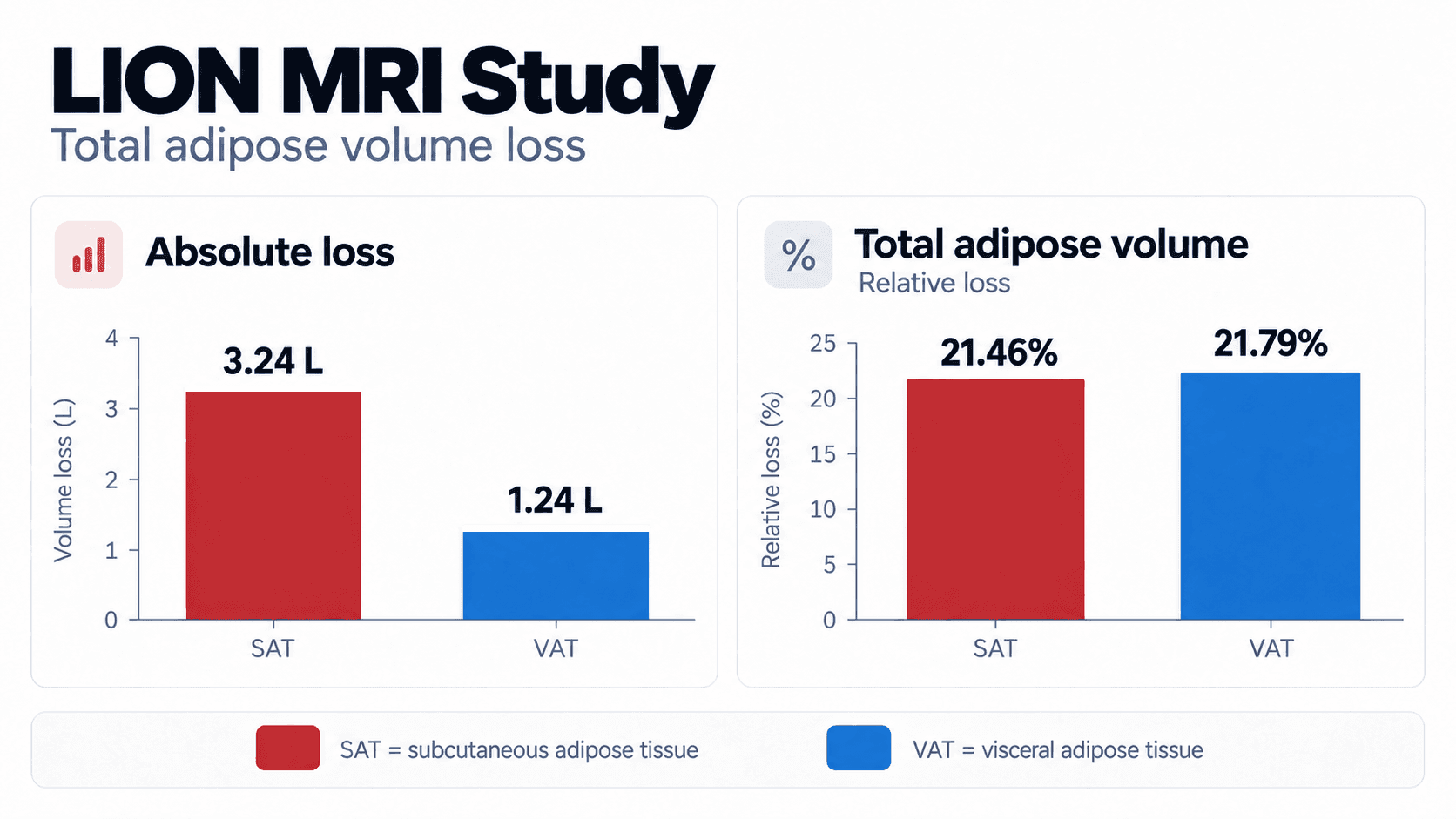
If a coach quotes visceral fat coming off first, ask whether they mean percent or kilograms. Percent is often true at modest loss. Kilograms still come mostly from SAT.
03How a deficit and exercise each reduce visceral fat independently
Ross randomized 52 obese men for 12 weeks. Both weight-loss groups dropped 7.5 kg (8%). Diet and exercise weight-loss arms had similar VAT drops. Abdominal and visceral fat also fell in the exercise-without-weight-loss arm (P = 0.001).6
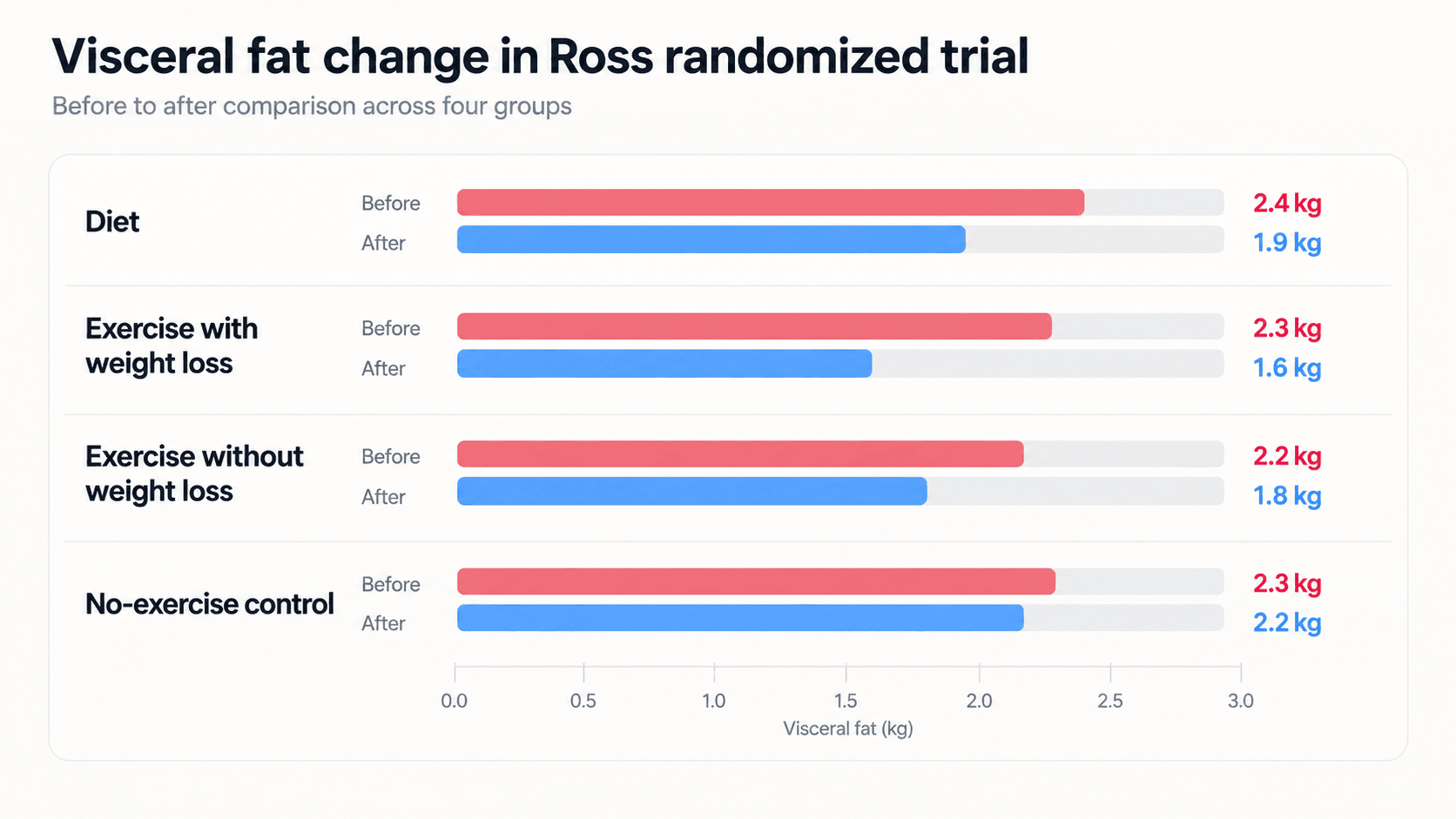
In 54 premenopausal women over 14 weeks, Ross measured VAT in kilograms. Diet went 2.4 to 1.9. Exercise with loss went 2.3 to 1.6. Exercise without loss went 2.2 to 1.8. Control went 2.3 to 2.2.7 Matched loss made diet and exercise look alike. Daily exercise with weight held still emptied VAT.
Slentz's no-exercise controls gained VAT (+8.6%). About 11 miles per week prevented that gain. The highest dose, about 17 miles per week of jogging, dropped VAT 6.9%.8 Add mileage when weight is stable or when aerobic work serves a separate goal.
Vissers pooled exercise without caloric restriction (Hedges g = −0.497). Aerobic work without a diet can drop VAT more than 30 cm² in women and more than 40 cm² in men on CT, even after 12 weeks.9
Jayedi's 2024 dose-response meta-analysis of 116 RCTs in 6,880 adults with overweight or obesity found each 30 minutes per week of aerobic exercise associated with VAT −1.60 cm², SAT −1.37 cm², and waist −0.56 cm. The relationship ran linearly through 300 minutes per week.10 Add minutes before you add a new protocol.
Cardio is optional if the deficit is real. Cardio is the tool if weight is stuck or you want VAT change at a stable weight.
| Lever | What imaging shows | Coaching use |
|---|---|---|
| Calorie deficit | Modest loss prefers percent VAT. Absolute SAT still larger. Method of loss rarely matters. | First move. Protein-protected. |
| Aerobic with weight loss | VAT kg drops similar to diet when loss is matched. | Default when you are cutting. |
| Aerobic without weight loss | Ross VAT 2.2 to 1.8 kg in women. Jayedi −1.60 cm² per 30 min/week. | Use when weight is stable or stuck. |
| Resistance training | SMD −0.49 versus sitting. Weakest in Chen's ranking. | Keep muscle through the cut. |
| HIIT | Reduces VAT versus no exercise; effect varies by protocol.13 | Time efficiency only. |
| Alcohol | Beer and spirits associate with greater DXA VAT. Observational. | Cut beer and spirits before you add a protocol. |
| Liquid sugar | Stanhope +14.0% intra-abdominal fat at 25% energy as fructose beverages. | Drop soda-dose fructose. Fruit is a different exposure. |
| Sleep | Covassin found an adjusted 7.8 cm² VAT difference after 14 days of sleep restriction. Small n.17 | Treat it as a study-specific signal, not a universal calorie target. |
04Lifting protects muscle not visceral fat
Wewege compared full-body resistance training with a no-exercise control. The standardized mean difference for VAT was −0.49, a moderate effect.11 A matched deficit was not tested.
Chen's 84-RCT network meta-analysis ranked vigorous aerobic SMD −0.70, HIIT −0.64, aerobic plus resistance −0.61, moderate aerobic −0.53, and resistance −0.46 versus control. Resistance training showed statistically significant VAT reductions in males and in people with body fat under 40%; subgroup estimates in females and people at or above 40% were not statistically significant.12 The network ranked the resistance effect below the aerobic options, so use lifting to keep muscle rather than treating it as a VAT shortcut.
Lift to keep muscle through a cut. Do not expect resistance training to outrank a deficit or a pile of aerobic minutes for VAT.
05HIIT is not required for visceral fat loss
Maillard pooled HIIT versus nothing across 39 studies. VAT effect size −0.24. Running −0.44. Protocols under 90% peak heart rate reduced VAT. Protocols over 90% did not.13
Steele compared interval training with moderate-intensity continuous training. The whole-body fat-mass difference was trivial (−0.02) with high certainty.14 That supports time efficiency as the HIIT case; it does not establish a VAT-specific mechanism.
06Rank alcohol, liquid sugar, and sleep after the deficit
Larsen used UK Biobank DXA in 1,869 older White adults. Beer (β = 0.069) and spirits (β = 0.014) associated with greater VAT. Red wine associated with less (β = −0.023).15 Observational. Do not prescribe wine. The oxidation and recovery cost of drinking is on the alcohol and body composition page.
Stanhope fed 32 overweight adults beverages providing 25% of energy as fructose or glucose for 10 weeks. Weight gain was similar. Intra-abdominal fat rose 14.0% with fructose (P < 0.05) and 3.2% with glucose (not significant). Insulin sensitivity fell 17% with fructose.16 The study tested sugar-sweetened beverages, not whole fruit; fructose is a separate topic.
Covassin restricted 12 inpatients to 4 hours versus 9 hours time in bed for 14 days. Intake rose 308 kcal per day. Weight rose 0.5 kg. CT VAT showed an adjusted between-condition difference of 7.8 cm² (P = 0.042), while VAT within the 4-hour condition rose about 11% (P = 0.005). VAT kept accumulating into a 3-day recovery.17 Small n. Treat it as a ranked extra. The sleep and fat loss page already owns hunger.
GLP-1 drugs are a medical lever. The STEP 1 DXA substudy (n = 140) reported a within-treatment, from-baseline regional visceral fat mass reduction of −27.4% at week 68 with semaglutide. That number is a DXA regional estimate.18 SURMOUNT-1 waist fell 18.5 cm on tirzepatide 15 mg versus 4.0 cm on placebo at 72 weeks.19 Tesamorelin is a specialist HIV-lipodystrophy VAT drug,26 covered under peptides for body recomposition. Do not treat it as a cut stack.
07Track waist weekly and treat DEXA visceral fat as an estimate
Micklesfield compared DXA-VAT with expert CT in 272 women. Correlation r = 0.93, standard error 16 cm².20 Kaul's CoreScan versus CT had r² = 0.957, mean bias +56 cm³, and 95% limits of agreement from −355 to +468 cm³.21 Group agreement is useful. Individual error bands are large enough to fake a win. ISCD still lists optional VAT as having uncertain clinical utility in many routine settings.27 Details live on the DEXA page.
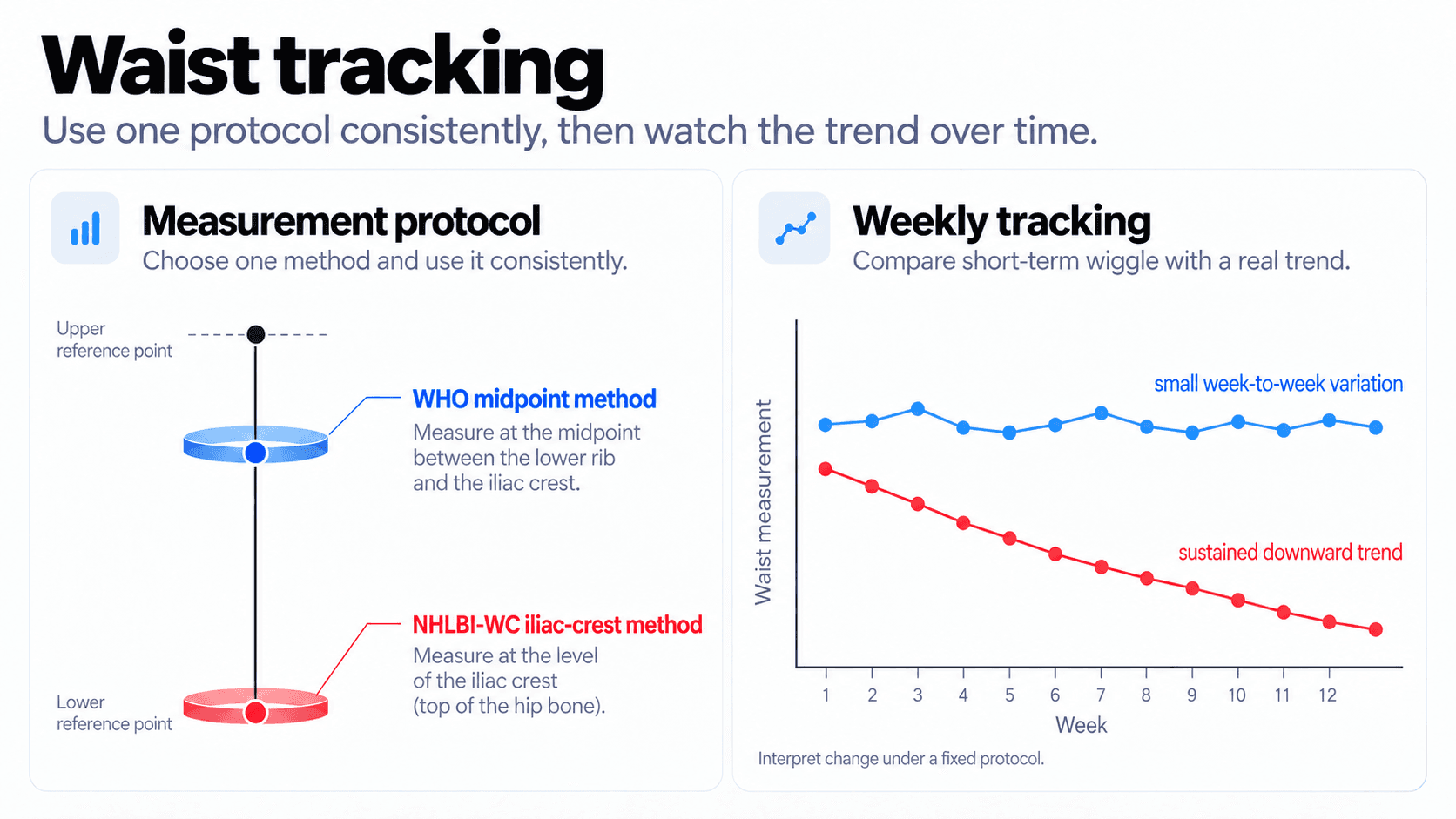
Waist circumference is the weekly tool. Pick one bony-landmark site. Never switch. CDC's NHANES methodology study found the NHLBI-WC iliac-crest method and WHO midpoint method differed by 0.81 cm in men and 3.21 cm in women.22 Treat small week-to-week changes as indeterminate and look for a sustained direction under a fixed protocol rather than treating one reading as a signal. Men who want that tape next to a strength number can use the waist-to-strength dashboard.
| Tool | Best use | Main limit |
|---|---|---|
| Waist circumference | Weekly trend under a fixed bony landmark | Does not separate VAT from SAT |
| DEXA VAT | Periodic estimate when a compartment read would change the plan | SEE 16 cm². Limits of agreement of hundreds of cm³ |
| CT or MRI | Research or clinical reference | Cost, access, CT radiation |
| Scale weight | Energy-balance trend | Blind to location |
08Local fat-loss shortcuts do not empty visceral fat
Vispute trained abs for 6 weeks in 24 people. Abdominal circumference and skinfolds did not change.25 Local training, belts, and wraps are covered in spot reduction.
The cited abdominal-exercise trial does not support a local-fat-loss shortcut.
Hold a protein-protected deficit. Add aerobic minutes if the scale is stuck or you want VAT change without a cut. Lift to keep muscle. Cut the beer and the soda first. Sleep enough to avoid repeating the intake pattern seen in the small sleep-restriction study. Measure the waist on the same bones, same time of day, same breath, every week. If that tape is not moving, change the deficit or the minutes. Do not buy another scan.
09References
Footnotes
Chaston TB, Dixon JB. Factors associated with percent change in visceral versus subcutaneous abdominal fat during weight loss: findings from a systematic review. Int J Obes (Lond). 2008. PubMed
Back to textBack to text 2Back to text 3Hall KD, Hallgreen CE. Increasing weight loss attenuates the preferential loss of visceral compared with subcutaneous fat: a predicted result of an allometric model. Int J Obes (Lond). 2008. PubMed
Back to textMerlotti C, Ceriani V, Morabito A, Pontiroli AE. Subcutaneous fat loss is greater than visceral fat loss with diet and exercise, weight-loss promoting drugs and bariatric surgery: a critical review and meta-analysis. Int J Obes (Lond). 2017. PubMed
Back to textBack to text 2Back to text 3Abe T, Song JS, Bell ZW, et al. Comparisons of calorie restriction and structured exercise on reductions in visceral and abdominal subcutaneous adipose tissue: a systematic review. Eur J Clin Nutr. 2022. PubMed
Back to textBack to text 2Junker D, Wu M, Reik A, et al. Impact of baseline adipose tissue characteristics on change in adipose tissue volume during a low calorie diet in people with obesity. Results from the LION study. Int J Obes (Lond). 2024. PubMed PMC
Back to textBack to text 2Ross R, Dagnone D, Jones PJ, et al. Reduction in obesity and related comorbid conditions after diet-induced weight loss or exercise-induced weight loss in men. A randomized, controlled trial. Ann Intern Med. 2000. PubMed
Back to textRoss R, Janssen I, Dawson J, et al. Exercise-induced reduction in obesity and insulin resistance in women: a randomized controlled trial. Obes Res. 2004. PubMed
Back to textBack to text 2Slentz CA, Aiken LB, Houmard JA, et al. Inactivity, exercise, and visceral fat. STRRIDE: a randomized, controlled study of exercise intensity and amount. J Appl Physiol. 2005. PubMed
Back to textVissers D, Hens W, Taeymans J, Baeyens JP, Poortmans J, Van Gaal L. The effect of exercise on visceral adipose tissue in overweight adults: a systematic review and meta-analysis. PLoS One. 2013. PubMed PMC
Back to textJayedi A, Soltani S, Emadi A, Zargar MS, Najafi A. Aerobic exercise and weight loss in adults: a systematic review and dose-response meta-analysis. JAMA Netw Open. 2024. PubMed PMC
Back to textBack to text 2Wewege MA, Desai I, Honey C, et al. The effect of resistance training in healthy adults on body fat percentage, fat mass and visceral fat: a systematic review and meta-analysis. Sports Med. 2022. PubMed
Back to textChen X, He H, Xie K, Zhang L, Cao C. Effects of various exercise types on visceral adipose tissue in individuals with overweight and obesity: a systematic review and network meta-analysis of 84 randomized controlled trials. Obes Rev. 2024. PubMed
Back to textMaillard F, Pereira B, Boisseau N. Effect of high-intensity interval training on total, abdominal and visceral fat mass: a meta-analysis. Sports Med. 2018. PubMed
Back to textBack to text 2Back to text 3Steele J, Plotkin D, Van Every D, et al. Slow and steady, or hard and fast? A systematic review and meta-analysis of studies comparing body composition changes between interval training and moderate intensity continuous training. Sports (Basel). 2021. PubMed PMC
Back to textLarsen BA, Klinedinst BS, Le ST, et al. Beer, wine, and spirits differentially influence body composition in older white adults. A United Kingdom Biobank study. Obes Sci Pract. 2022. PubMed PMC
Back to textStanhope KL, Schwarz JM, Keim NL, et al. Consuming fructose-sweetened, not glucose-sweetened, beverages increases visceral adiposity and lipids and decreases insulin sensitivity in overweight/obese humans. J Clin Invest. 2009. PubMed PMC
Back to textBack to text 2Covassin N, Singh P, McCrady-Spitzer SK, et al. Effects of experimental sleep restriction on energy intake, energy expenditure, and visceral obesity. J Am Coll Cardiol. 2022. PubMed
Back to textBack to text 2Back to text 3King R, Wilding JPH, Batterham RL, et al. Impact of semaglutide on body composition in adults with overweight or obesity: exploratory analysis of the STEP 1 study. ENDO 2021 poster. Poster PDF
Back to textJastreboff AM, Aronne LJ, Ahmad NN, et al. Tirzepatide once weekly for the treatment of obesity. N Engl J Med. 2022. PubMed
Back to textMicklesfield LK, Goedecke JH, Punyanitya M, Wilson KE, Kelly TL. Dual-energy X-ray performs as well as clinical computed tomography for the measurement of visceral fat. Obesity (Silver Spring). 2012. PubMed PMC
Back to textBack to text 2Kaul S, Rothney MP, Peters DM, et al. Dual-energy X-ray absorptiometry for quantification of visceral fat. Obesity (Silver Spring). 2012. PubMed PMC
Back to textOstchega Y, Seu R, Sarafrazi Isfahani N, Zhang G, Hughes JP. Waist Circumference Measurement Methodology Study: National Health and Nutrition Examination Survey, 2016. Vital Health Stat 2. 2019. CDC
Back to textLovejoy JC, Champagne CM, de Jonge L, Xie H, Smith SR. Increased visceral fat and decreased energy expenditure during the menopausal transition. Int J Obes (Lond). 2008. PubMed PMC
Back to textSamargandy S, Matthews KA, Brooks MM, et al. Abdominal visceral adipose tissue over the menopause transition and carotid atherosclerosis: the SWAN heart study. Menopause. 2021. PubMed
Back to textVispute SS, Smith JD, LeCheminant JD, Hurley KS. The effect of abdominal exercise on abdominal fat. J Strength Cond Res. 2011. PubMed
Back to textTheratechnologies Inc. EGRIFTA WR (tesamorelin) prescribing information. 2025. FDA label
Back to textInternational Society for Clinical Densitometry. 2023 Official Positions. ISCD
Back to text