Hallberg, Brune, and Rossander added 25 mg of phytate phosphorus to a wheat roll and iron absorption fell 64%. Two milligrams already cut it 18%. Two hundred fifty milligrams cut it 82%.1 Aune later pooled 45 prospective studies and found 90 g of whole grain a day tracking with coronary heart disease at a relative risk of 0.81 and all-cause mortality at 0.83.2 The foods that bind iron, zinc, and calcium in an isotope meal are the same foods sitting inside the eating pattern that tracks with fewer deaths.
People sell a story about anti-nutrients. Phytate, oxalate, and lectins get packed into one villain. They do different jobs. The people who actually need a behavior change are plant-only eaters with low ferritin, especially if you menstruate. Recurrent calcium-oxalate stone formers with high urine oxalate also belong on that list, as does anyone cooking dry red kidney beans.
01Phytate cuts iron and zinc from the same meal
Phytate is the plant's phosphorus store in grains, legumes, nuts, and seeds. In the gut it binds non-heme iron and zinc into a complex you absorb poorly. Hallberg's wheat-roll series is the clean dose curve. The inhibition was already large at a phytate-P dose you can hit with a bran-heavy breakfast.13
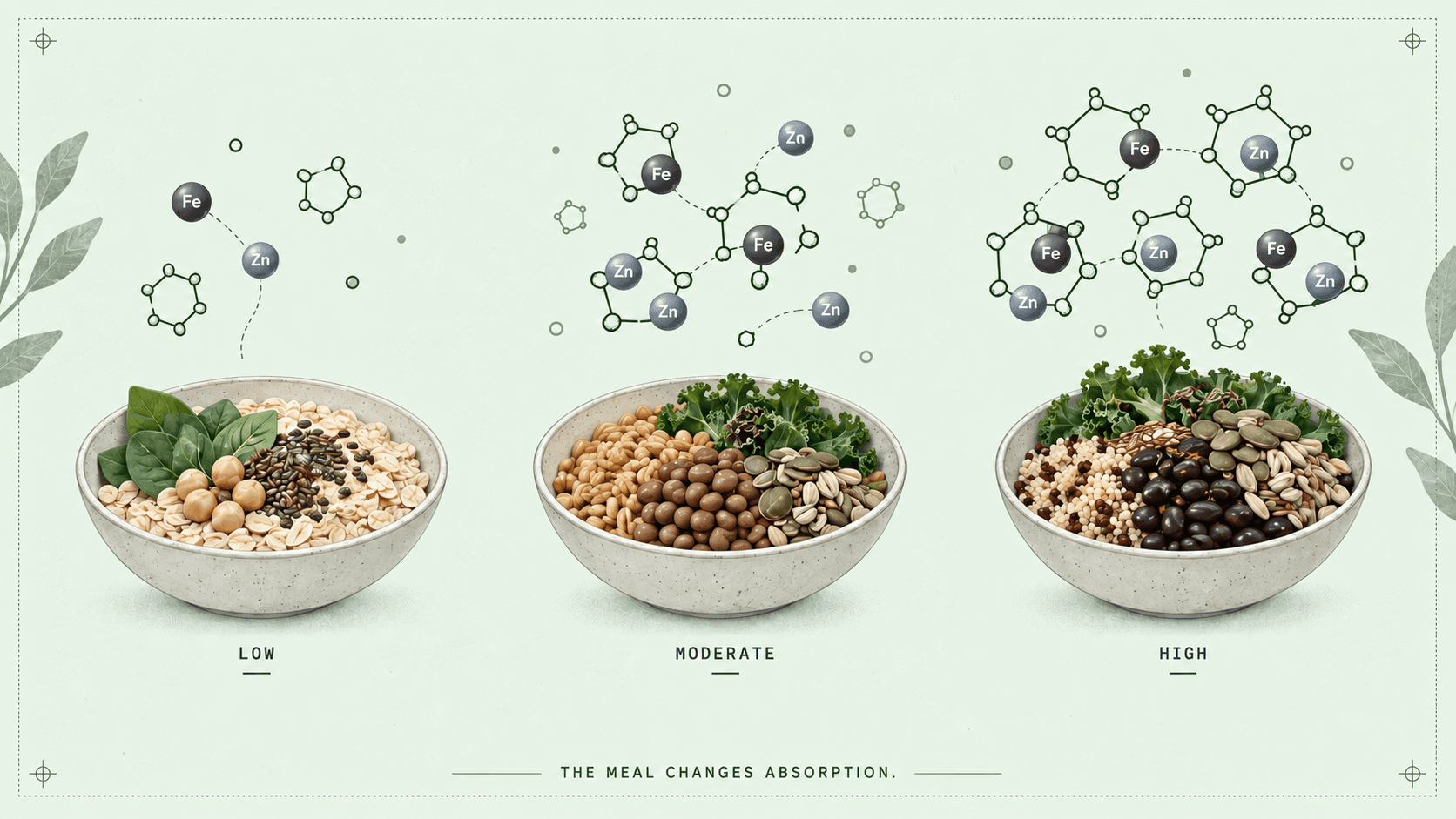
Hurrell, Reddy, Juillerat, and Cook then stripped phytate out of water porridges with added phytase. Oat iron absorption rose from 0.33% to 2.79%. Wheat rose from 0.99% to 11.54%. Rice rose from 1.73% to 5.34%. Maize rose from 1.80% to 8.92%. Reconstituting wheat porridge with milk wiped out that gain, likely because milk calcium bound the newly available iron. High-tannin sorghum did not improve.10 Those jumps came from near-complete dephytinization in a controlled porridge experiment. The study did not test overnight oats, ferritin change, or a household soaking protocol.
Zinc follows the same meal. Fredlund's rolls held 3.1 mg of zinc. Absorption was 22% with no phytate-P, 16% at 25 mg, 14% at 50 mg, and 6 to 7% once the dose reached 100 mg.3 Bel-Serrat's meta-analysis of meals and diets with a phytate-to-zinc molar ratio above 15 lowered fractional zinc absorption by 0.14, 45% of control values.11 WHO and IZiNCG use different ratio brackets but land in the same place: once the phytate-to-zinc molar ratio passes about 15, fractional zinc absorption drops to roughly half of what a low-phytate meal delivers. WHO classes a ratio under 5 as about 50% absorption, 5 to 15 as about 30%, and above 15 as about 15%. IZiNCG, which splits by sex, puts unrefined cereal diets above a ratio of 18 at 18% in men and 25% in women.12
An 8-week whole diet still shows the hit. Hunt's work used separate subsamples. In the iron subsample (n=10), women absorbed 1.1% of non-heme iron on a lacto-ovo vegetarian menu versus 3.8% on a nonvegetarian menu. In the zinc subsample (n=11), absorption was 26% versus 33%, with phytate-to-zinc ratios of 14 versus 5. Hemoglobin and ferritin did not move over eight weeks.1314 Gibson, Raboy, and King note that single-meal studies exaggerate phytate's iron effect against a whole diet.15 The meal effect is still real. Status just takes longer than a labeled roll.
NIH ODS puts mixed-diet iron bioavailability at about 14 to 18% and vegetarian diets at about 5 to 12%. Vegetarians may need up to 1.8 times the iron RDA.16 The National Academies says dietary zinc requirements may be as much as 50% higher for strict vegetarians whose staples are grains and legumes and whose phytate-to-zinc ratio exceeds 15:1. That is a diet-planning estimate, not a universal supplement prescription.26
| Study | Setting | What moved |
|---|---|---|
| Hallberg 1989 | Wheat rolls, phytate-P 2 / 25 / 250 mg | Iron absorption cut 18% / 64% / 82%1 |
| Fredlund 2006 | 40 people, 105 meals, 3.1 mg Zn | Zn absorption 22% at 0 phytate-P, 14% at 50 mg, 6 to 7% at ≥100 mg3 |
| Hunt 1998 and 1999 | Separate 8-week lacto-ovo vs nonvegetarian subsamples | Fe n=10, 1.1% vs 3.8%. Zn n=11, 26% vs 33%. Ferritin unchanged over eight weeks1314 |
02Whole-grain patterns still track with lower disease risk
Keep the oats. Aune's dose-response review of 45 studies put 90 g of whole grain a day, about two slices of bread plus a bowl of cereal, at RR 0.81 for coronary heart disease, 0.78 for cardiovascular disease, 0.83 for all-cause mortality, and 0.85 for total cancer. Risk kept falling up to about 210 to 225 g/day. Refined grain did not show the same pattern.2 That is observational. It is also the eating pattern that carries most of the phytate in a Western diet, plus the fiber those foods deliver.
Hunt's review is the honest limit on the mineral scare. Vegetarians have lower iron stores. Adverse health effects from that lower absorption have not been demonstrated on varied diets in developed countries.14 A low-ferritin plant-only eater is a specific case. The general reader who drops beans and whole grains to chase mineral binding is trading a meal-level absorption number for a worse food pattern.
Plant-based protein still has to be planned. The legumes and grains that make that math work are phytate foods. Pair them. Do not delete them.
03Spinach is a poor calcium source and a real oxalate load
Heaney, Weaver, and Recker gave 13 adults 200 mg of calcium from spinach or from milk. Every person absorbed more from milk. Means were 5.1% from spinach and 27.6% from milk. The spinach had a slight stoichiometric excess of oxalate, so the calcium was effectively bound.4 Spinach is a poor calcium absorption food. Count yogurt, fortified milk, tofu set with calcium, or a low-oxalate green toward the calcium target. Count spinach toward oxalate.
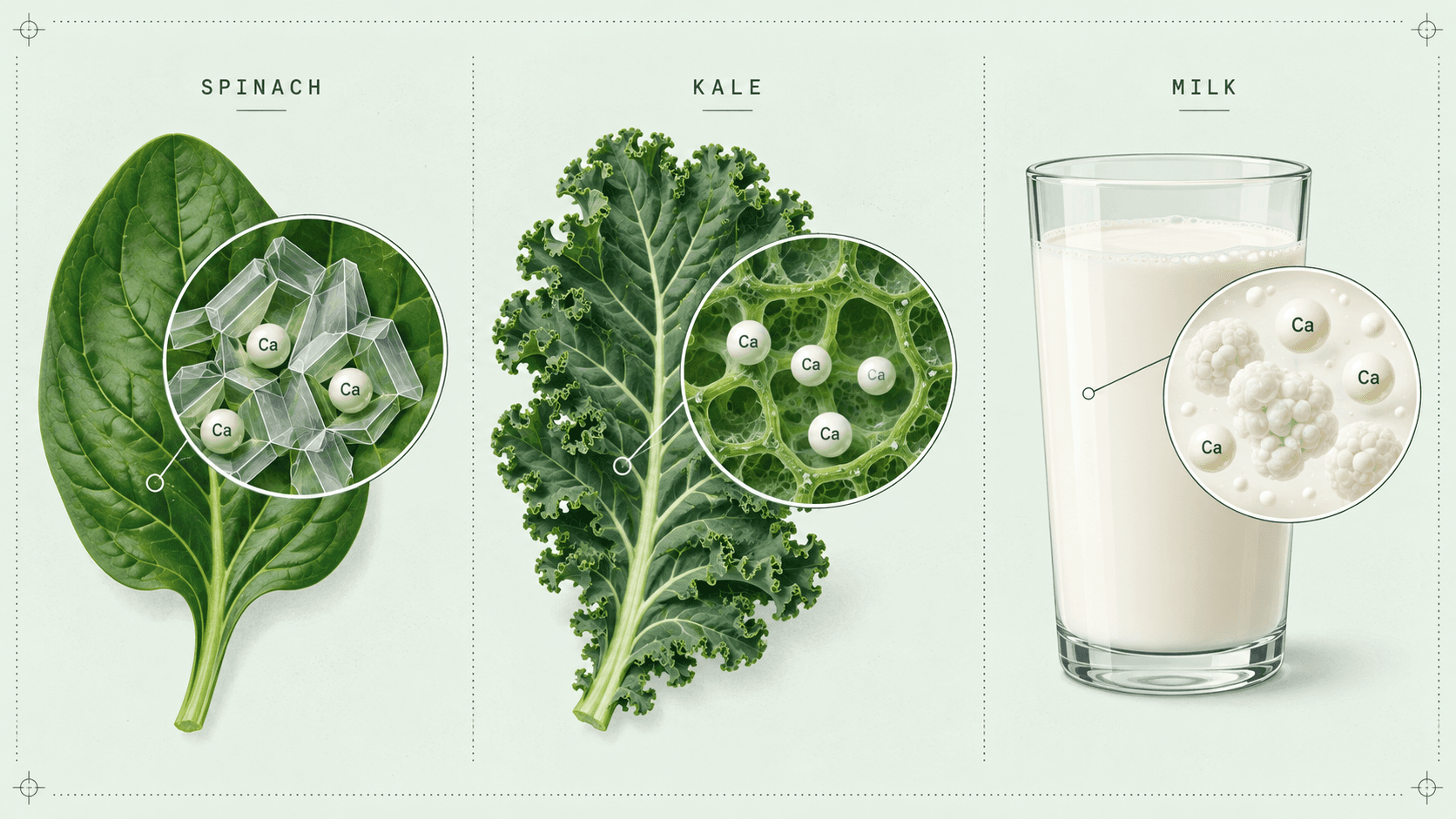
Kale is the other green. In 11 women at a 300 mg load, fractional absorption from kale was 0.409 against 0.321 from milk.5 Heaney's later brassica series in 15 women at about 83 mg put broccoli at 0.478, bok choy at about 0.52, and kale at 0.527, against milk at 0.463.17 Kale is a calcium food.
| Food | Fractional calcium absorption | Load |
|---|---|---|
| Spinach | 5.1% | 200 mg, n=134 |
| Milk | 27.6% | Same people, same load4 |
| Kale | 40.9% | 300 mg, n=11 women5 |
| Milk | 32.1% | Same kale study5 |
| Broccoli | 47.8% | ~83 mg, n=1517 |
| Bok choy | 52% | Same brassica series17 |
| Milk at 83 mg | 46.3% | Prior milk data at that load17 |
Taylor and Curhan followed the Health Professionals Follow-Up Study and both Nurses' Health Study cohorts. Spinach accounted for more than 40% of oxalate intake. Highest versus lowest oxalate quintile sat at RR 1.22 in men and 1.21 in older women. Eight or more spinach servings a month versus fewer than one sat at RR 1.30 in men and 1.34 in older women. The association was null in younger women. The authors wrote that the data do not implicate dietary oxalate as a major population risk factor.18 If you form calcium-oxalate stones and your urine oxalate is high, spinach is a food to limit. The general reader does not need an almond, chocolate, or sweet-potato ban.
04Calcium with oxalate meals beats a low-calcium diet
Oxalate in the gut binds calcium. Leave the calcium off the plate and more oxalate reaches urine. Holmes, Goodman, and Assimos fed 12 healthy adults controlled oxalate loads. Diet contributed 24.4% of urinary oxalate at 10 mg per 2,500 kcal and 41.5% at 250 mg. Dropping calcium from 1,002 mg to 391 mg on the 250 mg oxalate diet raised urinary oxalate 28.2% and the diet’s contribution to 52.6%.19
Borghi randomized 120 men with recurrent calcium-oxalate stones and hypercalciuria for five years. The normal-calcium arm ate 30 mmol of calcium a day, 1,200 mg, with animal protein cut to 52 g and salt to 50 mmol of sodium chloride. The low-calcium arm ate 10 mmol, 400 mg. Relapses were 12 of 60 versus 23 of 60. Urinary oxalate rose 5.4 mg/day on low calcium and fell 7.2 mg/day on normal calcium.6 The trial did not isolate calcium from the protein and salt changes, but it shows why lowering dietary calcium should not be the default for these patients.
The 2026 AUA medical-management guideline is the clinical rule cited here. Fluids to a urine volume of at least 2.5 L/day. Calcium stones with high urine calcium get 1,000 to 1,200 mg of dietary calcium a day, and a sodium limit. Calcium-oxalate stones with relatively high urine oxalate get a limit on oxalate-rich foods and normal calcium. Keep dietary calcium on the plate.7
High-dose supplemental vitamin C is a separate stone story in men. That evidence already lives on the vitamin C, iron, and kidney stone page.
05Tea with the iron meal is a timing problem
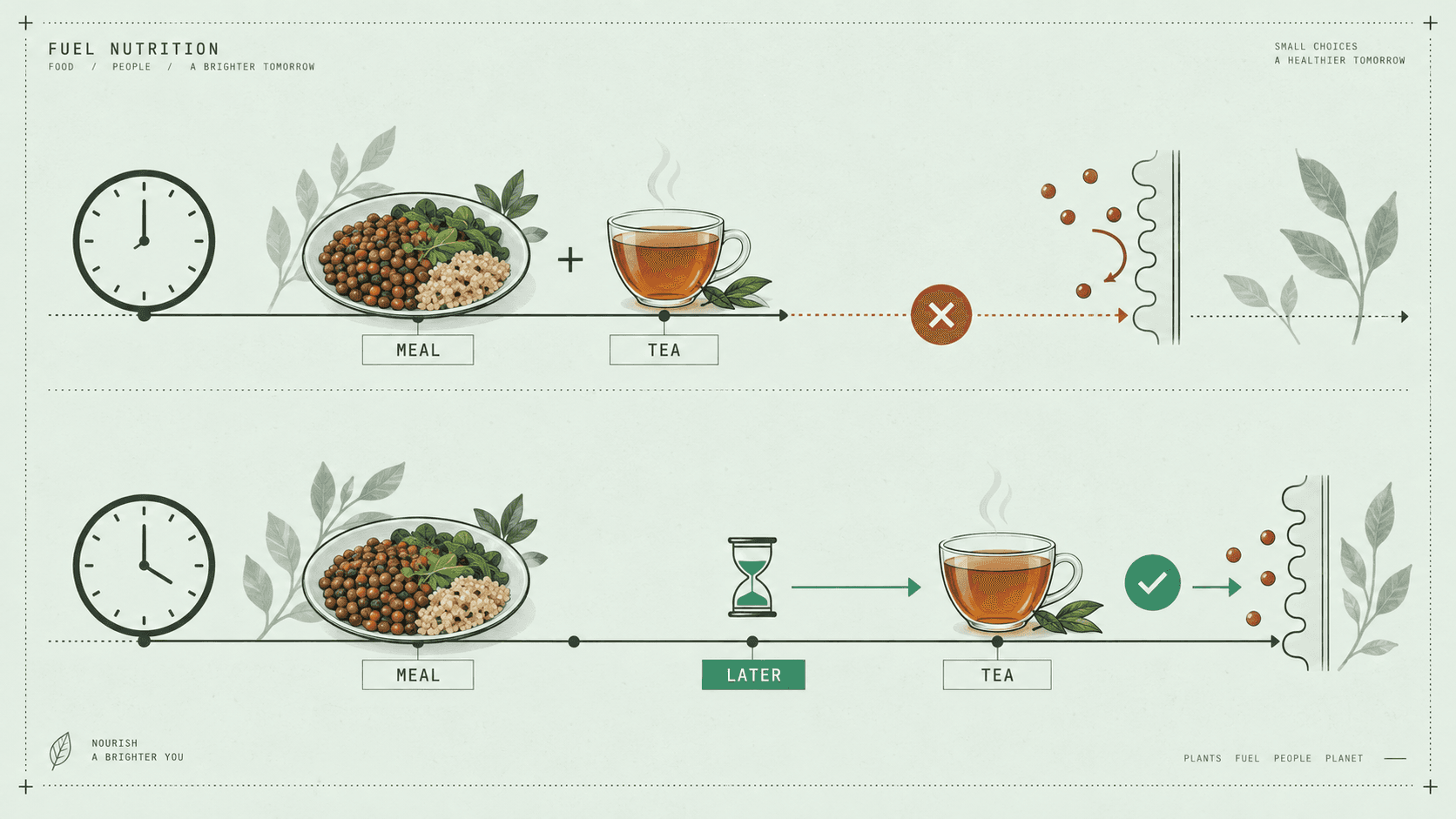
Polyphenols bind non-heme iron in the same sip. Hurrell, Reddy, and Cook served polyphenol drinks with a bread meal. Black tea cut iron absorption 79 to 94%. Servings with 20 to 50 mg of polyphenols cut it 50 to 70%. Milk in the tea did not rescue it. Peppermint tea cut it 84%, cocoa 71%.8
Morck, Lynch, and Cook put a cup of coffee on a hamburger meal and cut iron 39%. Tea cut it 64%. Coffee one hour before the meal left absorption alone. Coffee one hour after the meal produced the same inhibition as drinking it with the food.9 A separate controlled trial in 12 women found that tea one hour after an iron-containing porridge meal reduced the inhibitory effect by about half compared with tea served with the meal.25 For an iron-centered meal, moving tea at least one hour after the meal is the timing tested in that trial.
Vitamin C is the pairing on the other side of the plate. Hallberg, Brune, and Rossander put the practical target at about 50 mg of ascorbic acid in each main meal.20 Siegenberg's bread-meal series overcame maize-bran phytate with 30 mg.21 Cook and Reddy then ran a whole-diet test in 12 people across daily vitamin C intakes of 51 to 247 mg and found no significant difference in mean iron absorption.22 The whole-diet effect is smaller than the labeled-meal effect. Pairing still belongs on the iron-centered meal, which is the same 50 mg habit already on the vegan diet page. Pepper, kiwi, or an orange next to the lentils is the move. A high-dose vitamin C pill with every meal is a different exposure.
06Raw kidney beans are a food-safety issue
Lectin in cooked food is a different problem from lectin in raw red kidney beans. FDA's Bad Bug Book puts phytohaemagglutinin in raw kidney beans at 20,000 to 70,000 hemagglutinating units, and in fully cooked beans at 200 to 400. As few as four or five raw beans can trigger vomiting, then diarrhea. Onset is 1 to 3 hours.23
Soak dry beans at least 5 hours. Discard the water. Boil briskly in fresh water for at least 30 minutes. Do not use a slow cooker for dry red kidney beans. Canned beans are already processed. This is a cooking rule for dry red kidney beans.23
07Lectin-avoidance claims do not hold for cooked food
Petroski and Minich’s 2020 narrative review found no strong human-trial evidence that lectin-rich cooked foods consistently cause inflammation, intestinal permeability, or nutrient malabsorption in the general population. The animal and cell work uses raw flours or isolated lectins.24 Cooked beans, oats, and tomatoes are food. Isolated kidney-bean lectin in a dish of raw flour is a toxin assay. Do not run your grocery list off the assay.
08Pair the iron meal and keep the plants
If ferritin is low and the diet is plant-only, the iron meal needs a plan. About 50 mg of vitamin C on the plate.20 Tea and coffee an hour away.925 Alternate-day iron, if a clinician starts a pill, is covered in the iron repletion guide. Zinc absorption from a high-phytate plate is a separate issue. Follow the zinc guidance there rather than treating vitamin C as a zinc rescue or automatically increasing a supplement dose.11 Athletes comparing sweat losses to a pill can use the zinc for athletes page.
| Who | What changes | What stays |
|---|---|---|
| Plant-only eater with low ferritin, especially if you menstruate | Pair ~50 mg vitamin C with the iron meal. Move tea and coffee. Recheck ferritin. Iron intake may need to be 1.8 times the mixed-diet RDA1620 | Beans, oats, and greens stay |
| Recurrent calcium-oxalate stones with high urine oxalate | Keep 1,000 to 1,200 mg dietary calcium with oxalate meals. Limit spinach and other oxalate-rich foods. Fluids to urine volume ≥2.5 L/day67 | Do not drop dietary calcium |
| Anyone cooking dry red kidney beans | Soak ≥5 h, discard water, boil hard ≥30 min. Skip the slow cooker for dry beans23 | Canned beans are already processed |
| Everyone else | Time tea off the iron meal if you want the extra absorption825 | Keep the plants |
If ferritin is low and you eat plants only, put about 50 mg of vitamin C on the iron meal and move the tea.2025 If you form calcium-oxalate stones, keep 1,000 to 1,200 mg of dietary calcium on the plate with the oxalate food.67 If you cook dry red kidney beans, soak them, throw the water out, and boil hard for at least 30 minutes.23 Everyone else can eat the beans.
Footnotes
Hallberg L, Brune M, Rossander L. Iron absorption in man: ascorbic acid and dose-dependent inhibition by phytate. Am J Clin Nutr. 1989. PubMed
Back to textBack to text 2Back to text 3Back to text 4Aune D, Keum N, Giovannucci E, et al. Whole grain consumption and risk of cardiovascular disease, cancer, and all cause and cause specific mortality: systematic review and dose-response meta-analysis of prospective studies. BMJ. 2016. PubMed BMJ
Back to textBack to text 2Back to text 3Fredlund K, Isaksson M, Rossander-Hulthén L, Almgren A, Sandberg AS. Absorption of zinc and retention of calcium: dose-dependent inhibition by phytate. J Trace Elem Med Biol. 2006. PubMed
Back to textBack to text 2Back to text 3Back to text 4Heaney RP, Weaver CM, Recker RR. Calcium absorbability from spinach. Am J Clin Nutr. 1988. PubMed
Back to textBack to text 2Back to text 3Back to text 4Heaney RP, Weaver CM. Calcium absorption from kale. Am J Clin Nutr. 1990. PubMed
Back to textBack to text 2Back to text 3Back to text 4Borghi L, Schianchi T, Meschi T, et al. Comparison of two diets for the prevention of recurrent stones in idiopathic hypercalciuria. N Engl J Med. 2002. PubMed
Back to textBack to text 2Back to text 3Back to text 4Pearle MS, Matlaga BR, Antonelli JA, et al. Medical management of kidney stones: AUA guideline (2026), Part I. J Urol. 2026. PubMed
Back to textBack to text 2Back to text 3Back to text 4Hurrell RF, Reddy M, Cook JD. Inhibition of non-haem iron absorption in man by polyphenolic-containing beverages. Br J Nutr. 1999. PubMed
Back to textBack to text 2Back to text 3Morck TA, Lynch SR, Cook JD. Inhibition of food iron absorption by coffee. Am J Clin Nutr. 1983. PubMed
Back to textBack to text 2Back to text 3Hurrell RF, Reddy MB, Juillerat MA, Cook JD. Degradation of phytic acid in cereal porridges improves iron absorption by human subjects. Am J Clin Nutr. 2003. PubMed
Back to textBel-Serrat S, Stammers AL, Warthon-Medina M, et al. Factors that affect zinc bioavailability and losses in adult and elderly populations. Nutr Rev. 2014. PubMed
Back to textBack to text 2Hotz C, Brown KH, eds. International Zinc Nutrition Consultative Group (IZiNCG) technical document #1. Assessment of the risk of zinc deficiency in populations and options for its control. Food Nutr Bull. 2004. WHO classes of phytate-to-zinc molar ratio are tabulated in this document. IZiNCG technical document
Back to textHunt JR, Roughead ZK. Nonheme-iron absorption, fecal ferritin excretion, and blood indexes of iron status in women consuming controlled lactoovovegetarian diets for 8 wk. Am J Clin Nutr. 1999. PubMed
Back to textBack to text 2Hunt JR. Bioavailability of iron, zinc, and other trace minerals from vegetarian diets. Am J Clin Nutr. 2003. Zinc percentages 26% vs 33% and phytate-to-zinc 14 vs 5 are from Hunt, Matthys, and Johnson 1998, PMID 9497185, summarized here. PubMed
Back to textBack to text 2Back to text 3Gibson RS, Raboy V, King JC. Implications of phytate in plant-based foods for iron and zinc bioavailability, setting dietary requirements, and formulating programs and policies. Nutr Rev. 2018. PubMed
Back to textNational Institutes of Health Office of Dietary Supplements. Iron. Fact sheet for health professionals. Mixed-diet bioavailability about 14 to 18%, vegetarian about 5 to 12%, vegetarian iron requirement 1.8 times. NIH ODS
Back to textBack to text 2Heaney RP, Weaver CM, Hinders SM, Martin B, Packard PT. Absorbability of calcium from Brassica vegetables: broccoli, bok choy, and kale. J Food Sci. 1993. Wiley
Back to textBack to text 2Back to text 3Back to text 4Back to text 5Taylor EN, Curhan GC. Oxalate intake and the risk for nephrolithiasis. J Am Soc Nephrol. 2007. PubMed
Back to textHolmes RP, Goodman HO, Assimos DG. Contribution of dietary oxalate to urinary oxalate excretion. Kidney Int. 2001. PubMed
Back to textHallberg L, Brune M, Rossander L. Effect of ascorbic acid on iron absorption from different types of meals. Hum Nutr Appl Nutr. 1986. PubMed
Back to textBack to text 2Back to text 3Back to text 4Siegenberg D, Baynes RD, Bothwell TH, et al. Ascorbic acid prevents the dose-dependent inhibitory effects of polyphenols and phytates on nonheme-iron absorption. Am J Clin Nutr. 1991. PubMed
Back to textCook JD, Reddy MB. Effect of ascorbic acid intake on nonheme-iron absorption from a complete diet. Am J Clin Nutr. 2001. PubMed
Back to textU.S. Food and Drug Administration. Natural toxins in food and the Bad Bug Book. The consumer guidance for red kidney beans says to soak for at least 5 hours, discard the soaking water, and boil in fresh water for at least 30 minutes. The Bad Bug Book gives the 20,000 to 70,000 hemagglutinating-unit range, 4 to 5 raw beans, and 1 to 3 hour onset. FDA consumer guidance Bad Bug Book
Back to textBack to text 2Back to text 3Back to text 4Petroski W, Minich DM. Is there such a thing as “anti-nutrients”? A narrative review of perceived problematic plant compounds. Nutrients. 2020. PMC
Back to textAhmad Fuzi SF, Koller D, Bruggraber S, et al. A 1-h time interval between a meal containing iron and consumption of tea attenuates the inhibitory effects on iron absorption. Am J Clin Nutr. 2017. PubMed
Back to textBack to text 2Back to text 3Back to text 4Institute of Medicine. Dietary reference intakes for zinc. National Academies. 2001. The report states that dietary zinc requirements may be as much as 50% greater for strict vegetarians whose major staples are grains and legumes and whose phytate-to-zinc molar ratio exceeds 15:1. National Academies
Back to text