Two boxes get treated as the same product in most marketing, and the evidence does not support the equivalence. Finnish sauna sits on decades of population-level cohort work and randomized heat-acclimation trials at 80 to 100 degrees C. Infrared sauna sits on a much shorter stack of small trials, most of them in heart failure, and a long list of claims that do not survive the RCT filter. The buying decision is real. The framing should track the evidence, not the showroom.
For the broader case on what heat exposure does to body composition, sleep, and cardiovascular outcomes, the sauna pillar is the spine of this conversation. The passive heat therapy glossary covers the wider category of Finnish sauna, infrared sauna, Waon therapy, and hot-water immersion.
01Two devices, two heat-transfer mechanisms
A traditional Finnish sauna uses a stove and hot stones to heat a dry room. Cohort and review papers usually describe the room at 80 to 100 degrees C near the bather's head with relative humidity around 10 to 20 percent, and water thrown on the stones temporarily raises humidity and perceived heat.213 Convective and radiant heat from the hot air, room surfaces, and stones drives the response.
An infrared sauna uses radiant elements to deliver heat without pushing the cabin air as high as a Finnish sauna. Beever's review describes far-infrared sauna elements as radiant heat sources, and the Hussain crossover trial found that 45 minutes of infrared sauna raised tympanic temperature in healthy women.38 Most infrared cabins also lack steam or löyly, so humidity is less central to the experience than radiant exposure, cabin temperature, session length, and panel placement.38
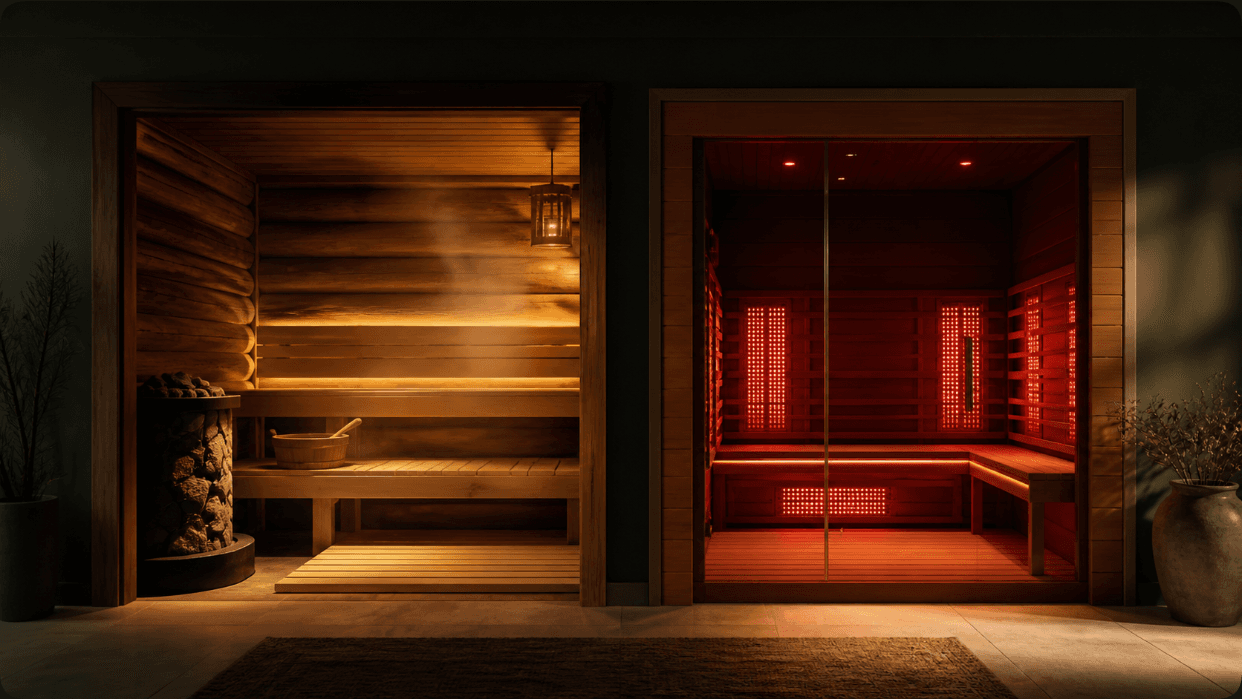
The temperature gap is real, and the heat-load gap is real. Hussain and colleagues compared 45 minutes of infrared sauna with 45 minutes of indoor cycling in healthy women in a randomized crossover. Tympanic temperature rose more in the sauna arm than in the exercise arm. Blood pressure, arterial stiffness, and heart-rate variability did not differ across conditions.8 The total thermal load is what drives the response. The radiant pathway changes the comfort profile and the temperature dial without rewriting the physiology.
02Heat load is the variable that matters
How much core-temperature rise each device produces in a real session is what drives the physiological response. Finnish sauna exposure can raise core temperature by about 0.5 to 1.5 degrees C in 20 to 30 minutes, with sweat rates often reported around 0.5 to 1.5 L per session and heart rates commonly rising into the 100 to 150 bpm range.12 Controlled heat exposure can also shift catecholamines, cytokines, and heat-shock proteins, but those molecular responses depend heavily on the exact heat and exercise protocol.210
Infrared sauna outside the clinical Waon protocol is harder to compare because cabin temperature, panel output, body position, and session length vary across devices. The Waon protocol is structured to produce a defined thermal dose. Patients sit in a 60 degrees C far-infrared cabin for 15 minutes, then rest under warm blankets for 30 minutes, with published Waon methods reporting a core-temperature increase of about 1.0 to 1.2 degrees C.514 That extended hold is the reason Waon protocol data should not be treated as interchangeable with a generic 30-minute infrared session.

For an endurance athlete chasing plasma volume, the dose response is what matters. Scoon and colleagues produced a 7.1 percent plasma-volume expansion and a 32 percent treadmill time-to-exhaustion gain with post-exercise sauna at 80 to 100 degrees C, three to four times per week, for three weeks.7 No infrared sauna trial of comparable size has reproduced that result. If the goal is heat acclimation for a hot race, the Finnish-style protocol is the one with the data.
03Finnish vs infrared heat side by side
| Variable | Finnish sauna | Infrared sauna |
|---|---|---|
| Air temperature | Commonly 80 to 100 degrees C213 | Lower than Finnish sauna in most trial and home-cabin contexts3 |
| Humidity | About 10 to 20 percent, with temporary löyly rises13 | Usually not a steam-driven exposure |
| Heat transfer | Convective and radiant from hot air, walls, stones | Radiant from infrared elements |
| Core temp rise, 20 to 30 min | About 0.5 to 1.5 degrees C12 | Device-specific outside Waon, about 1.0 to 1.2 degrees C with Waon hold514 |
| Sweat rate | Often reported around 0.5 to 1.5 L per session1 | Variable across sparse trials and cabin designs38 |
| Heart rate | Commonly rises into the 100 to 150 bpm range1 | Cardiovascular responses vary by protocol and population389 |
| Long-term cohort data | KIHD, 2,315 men, 20.7 years41112 | None of comparable size |
| Heat acclimation RCTs | Plasma volume up 7.1 percent, TTE up 32 percent7 | None of comparable scale |
| Heart failure trial cluster | Limited | Waon multicenter trial, 188 enrolled, BNP and EF improvements56 |
| Blood pressure RCTs | Several, mixed pooled effects9 | Beever review, small coronary-risk trials with BP reductions3 |
| Comfort for heat-naive users | Harder, especially with löyly | Easier, lower air temperature |
| Operating cost and footprint | Often requires a dedicated heater and room build | Home cabinets and plug-in formats are widely available |
04Cardiovascular data favors Finnish sauna
The Kuopio Ischaemic Heart Disease cohort is what carries the long-term cardiovascular case for sauna. Laukkanen and colleagues followed 2,315 middle-aged Finnish men for an average of 20.7 years and reported a 50 percent lower risk of fatal cardiovascular disease in the 4-to-7-sessions-per-week group, with adjustment for the usual confounders.4 Stroke risk and dementia risk replicated in the same cohort.1112 Every one of those sauna sessions was Finnish-style. Inferring an infrared equivalent from this dataset is not a defensible reading.

The infrared signal is much narrower. Beever's 2009 review of nine clinical trials found small protocols, with blood pressure reductions in coronary-risk studies but enough heterogeneity to avoid treating the point estimate as settled.3 The Waon multicenter case-control study in chronic heart failure patients reported significant improvements in left-ventricular dimensions, ejection fraction, and brain natriuretic peptide versus controls.5 These are real effects in a specific clinical population and do not generalize to healthy adults using a home cabin three nights a week.

The 2025 Cheng and MacDonald systematic review pooled 20 RCTs of passive heating, including 8 dry sauna trials (mostly Waon), 3 Finnish sauna trials, 5 hot water bathing trials, and a hot yoga trial.9 Pooled systolic blood pressure dropped 2.46 mmHg, which did not reach statistical significance. Subgroup analysis showed a 4.11 mmHg drop with systemic heating and 2.52 mmHg in coronary-risk populations. Heterogeneity was high. The honest read is that passive heating moves blood pressure a small amount in higher-risk adults, and the device choice within that umbrella is a second-order question.
05Where infrared marketing claims need skepticism
The trouble with infrared sauna content online is that the trial base is small and the claim list is long.
The first is the exercise-mimetic claim. Hussain and colleagues tested it head-on. Forty-five minutes in an infrared sauna and forty-five minutes of indoor cycling produced different respiratory rates and different tympanic temperature changes, with no equivalent change in blood pressure, arterial stiffness, or heart-rate variability.8 The infrared session acted as a thermal stimulus in healthy women. Use infrared sessions as recovery work in the training plan, not as a cardio session in a box.
The second is the cholesterol or lipid claim. Beever's 2009 review concluded that the available trials provided fair evidence to refute the claim that far-infrared sauna improves total cholesterol, HDL, or triglycerides.3 The lipid story belongs to diet, training, and pharmacology.
The third is the detox claim. Sweat carries water and small amounts of trace minerals. Heavy metals and organic toxins move through the liver and kidneys, not the eccrine ducts. The claim that sweating in an infrared cabin removes meaningful body burden of metals or chemicals is not supported by mass-balance studies and is already covered in the sauna pillar.
The heart failure data are real and clinically meaningful. The blood pressure data are small and broadly consistent with passive heating in general. The exercise-mimetic and detox claims do not survive the trial filter.
06Comfort and adherence are the honest infrared advantage
Adherence is what most readers actually buy. An 85 degrees C Finnish sauna is not a casual environment for a heat-naive adult, and the perceptual load can be a real barrier early on. A lower-temperature infrared cabin may be easier on the first ten sessions and easier to install in a residential bathroom or garage. That practical fit can support consistent use even when the physiological dose is not identical.
Within the integrated performance system frame, that adherence advantage matters. Three infrared sessions per week that actually happen are more useful than four Finnish sessions that get skipped because the gym sauna is broken or the home build-out stalled. The right device is the one that fits the schedule, the budget, and the physiology of the user.
The trade-off runs the other direction as well. If the goal is plasma-volume expansion for a hot race or a meaningful contribution to the long-term cardiovascular load picture, the Finnish-style protocol carries the data. The user who picks an infrared cabin for adherence should not also expect to inherit the Kuopio mortality numbers.
07Hydration, sodium, and sleep apply equally to both
The fluid and sodium losses scale with sweat rate, not with the heat-transfer mechanism. A 30-minute infrared session that drives a 0.6 to 0.8 L sweat loss requires the same replacement plan as a shorter Finnish session at the same sweat output. Drink to thirst during, replace 1.0 to 1.5 L of fluid per kg of body mass lost over the next 4 to 6 hours, and pair it with 500 to 1,500 mg of sodium across the next two meals, depending on the saltiness of the sweat. The hydration plan and the sodium loading guide cover the structure.
Sleep timing also applies to both. Finishing the heat session 1 to 2 hours before bed produces faster sleep onset and more slow-wave sleep. Stacking either modality into the last 30 minutes before bed raises core temperature at the wrong moment and undermines the sleep that is doing the actual recovery work. The full picture sits in Sleep and Fat Loss.
08Choose Finnish heat load or infrared adherence
The first is what the goal is. Heat acclimation for a hot race or a structured cardiovascular conditioning block points to Finnish-style sessions at 80 to 100 degrees C. Sleep and recovery support points to either device, with infrared often the more comfortable starting point. Adjunct support for stable hypertension or stable heart failure with clinician oversight points toward a Waon-style infrared protocol with the published structure of 15 minutes at 60 degrees C plus a 30-minute warm rest.
The second is what the user can tolerate. Adults with a flat, calm response to high heat can run Finnish sessions with no penalty. Adults with sensitive blood pressure responses, low heat tolerance, or a history of fainting in heat will get further with a 55 to 60 degrees C infrared cabin and a longer ramp-in.
The third is what the user will actually do. The best protocol is the one that survives a busy month. Five infrared sessions in the basement beat four Finnish sessions at the gym that turn into one because the schedule slipped. Treat the device as a delivery system for thermal load, then choose the one that puts a stable load on the calendar.
Finnish sauna carries the deeper trial and cohort base, infrared sauna carries a smaller but real base in heart failure and a comfort advantage that helps adherence, and both belong in the recovery and conditioning column, not the body-composition column.
Footnotes
Hannuksela ML, Ellahham S. Benefits and risks of sauna bathing. Am J Med. 2001. PubMed
Back to textBack to text 2Back to text 3Back to text 4Back to text 5Laukkanen JA, Laukkanen T, Kunutsor SK. Cardiovascular and other health benefits of sauna bathing, a review of the evidence. Mayo Clin Proc. 2018. Mayo Clinic Proceedings
Back to textBack to text 2Back to text 3Back to text 4Back to text 5Back to text 6Beever R. Far-infrared saunas for treatment of cardiovascular risk factors, summary of published evidence. Can Fam Physician. 2009. PMC
Back to textBack to text 2Back to text 3Back to text 4Back to text 5Back to text 6Back to text 7Back to text 8Back to text 9Back to text 10Laukkanen T, Khan H, Zaccardi F, Laukkanen JA. Association between sauna bathing and fatal cardiovascular and all-cause mortality events. JAMA Intern Med. 2015. PubMed
Back to textBack to text 2Back to text 3Miyata M, Kihara T, Kubozono T, et al. Beneficial effects of Waon therapy on patients with chronic heart failure, results of a prospective multicenter study. J Cardiol. 2008. PubMed
Back to textBack to text 2Back to text 3Back to text 4Back to text 5Miyata M, Tei C. Waon therapy for cardiovascular disease, innovative therapy for the 21st century. Circ J. 2010. PubMed
Back to textBack to text 2Scoon GSM, Hopkins WG, Mayhew S, Cotter JD. Effect of post-exercise sauna bathing on the endurance performance of competitive male runners. J Sci Med Sport. 2007. ScienceDirect
Back to textBack to text 2Back to text 3Hussain JN, Greaves RF, Cohen MM. Infrared sauna as exercise-mimetic, physiological responses to infrared sauna versus exercise in healthy women, a randomized controlled crossover trial. Complement Ther Med. 2022. PubMed
Back to textBack to text 2Back to text 3Back to text 4Back to text 5Back to text 6Back to text 7Back to text 8Cheng JL, MacDonald MJ. Non-acute effects of passive heating interventions on cardiometabolic risk and vascular health, a systematic review and meta-analysis of RCTs. Curr Res Physiol. 2025. PMC
Back to textBack to text 2Back to text 3Back to text 4Kuennen M, Gillum T, Dokladny K, et al. Thermotolerance and heat acclimation may share a common mechanism in humans. Am J Physiol Regul Integr Comp Physiol. 2011. PubMed PMC
Back to textLaukkanen T, Kunutsor S, Kauhanen J, Laukkanen JA. Sauna bathing is inversely associated with dementia and Alzheimer's disease in middle-aged Finnish men. Age Ageing. 2017. PubMed
Back to textBack to text 2Kunutsor SK, Khan H, Zaccardi F, Laukkanen T, Willeit P, Laukkanen JA. Sauna bathing reduces the risk of stroke in Finnish men and women. Neurology. 2018. Neurology
Back to textBack to text 2Laukkanen T, Kunutsor SK, Khan H, et al. Sauna bathing is associated with reduced cardiovascular mortality and improves risk prediction in men and women, a prospective cohort study. BMC Med. 2018. BMC Medicine
Back to textBack to text 2Back to text 3Back to text 4Sobajima M, Nozawa T, Fukui Y, et al. Waon therapy improves quality of life as well as cardiac function and exercise capacity in patients with chronic heart failure. Int Heart J. 2015. J-STAGE
Back to textBack to text 2