HYROX schedules can span early morning to evening, so race-day meals should follow your confirmed individual start time, not the division's first-wave slot.1 Plan for travel, venue check-in, and schedule changes, then time the last full meal and top-up around the wave you will actually race.2
Brandt's simulated Open race had a median finish of 86.5 minutes, with about 80 percent of the race spent in the very hard heart-rate zone.3 That puts HYROX in the over-60-minute bracket of the ACSM joint position, so the carbohydrate and fluid numbers here come from that stand, and the rest come from caffeine and gut research in other sports.4 The venue timings come from HYROX regional FAQs and help pages, and they differ by region. Where a recommendation is my own planning judgment, the text says so.
01Why your confirmed start time sets the meal plan
You do not pick your wave. HYROX North America places athletes by the finish time they estimate at signup, with the fastest estimates in the first waves, and anyone who skips the estimate lands in a wave at random.1 Starting in an earlier or later wave without organiser approval is a disqualification under the rulebook, so you cannot move to a slot that suits your stomach.5

The schedule firms up in stages. The APAC help centre says tentative schedules are provisional, show only the first wave of each division, and can change with event logistics and registration numbers. Divisions run several waves 10 minutes apart, and placements are finalised about a week out.2 APAC then emails each athlete's exact start time on the Wednesday before the event, usually around 6 PM.6 North America publishes division wave times two weeks before the event and individual start times three days before.1 The rulebook adds that your start time is confirmed again at check-in.5
The gap between the first wave and yours can be large. On the provisional schedule for HYROX Boston 2026, the Thursday Women's block runs from 3.40 to 6.10 PM.7 An athlete who plans from 3.40 and draws a 6.10 start eats their last meal two and a half hours earlier than they need to, then waits hungry in a warm-up area.
Treat the tentative time as a rough guide to your part of the day. Write the meal plan the evening your confirmed time arrives.
02How venue arrival and bag drop move your last meal earlier
The official arrival guidance is consistent across the regions I checked, with small differences in wording. HYROX North America recommends arriving 90 minutes before your "division start time" to register, warm up, and attend a technical briefing, and dropping bags 45 to 60 minutes before your race because there may be queues.1 HYROX Middle East says to arrive 90 minutes before your start time, bring one cabin-size bag, and seal all liquids tightly.8 APAC strongly recommends arriving at least 90 minutes before your scheduled start.6 The rulebook requires you in the start tunnel 10 minutes before your start and confirms that every event has check-in, a changing room with bag drop, and a warm-up area.5

The North America page says "division start time" in one place and describes individual start times elsewhere. Anchor on your own time and check your event page. Some events add their own rules. At Boston, on-site registration opens 90 minutes before the first start time of the day, and spectator check-in with a ticket and ID allows earlier entry.7 That applies to Boston, and your event may differ.
Put those steps on a clock and the meal window shrinks fast. You arrive at start minus 90 minutes, your bag goes in by minus 45, and you stand in the tunnel at minus 10. Travel sits on top of that. My planning estimate is that the last full meal usually falls 2.5 to 4 hours before your start, and anything you eat after arriving comes out of your own bag. After bag drop, it has to be in your pocket or your hand.
I found no official HYROX page on food sold at venues or on bringing outside food in. Pack everything you plan to eat and check your event page for local rules.
03What the evidence says about eating in the hours before a race
The ACSM joint position sets pre-event carbohydrate at 1 to 4 g/kg eaten 1 to 4 hours before exercise longer than 60 minutes, with timing, amount, and type matched to the athlete's experience.4 At 70 kg that is 70 to 280 g. The small end suits a short gap between meal and start, and the large end needs time to digest. The same stand says foods high in fat, protein, or fibre may need to be limited to reduce gut problems.
Evidence from other sports favors eating before prolonged aerobic exercise. A 2018 meta-analysis of 46 studies found that eating before exercise improved prolonged aerobic performance but did not change shorter aerobic performance. The abstract does not give the duration cut-off, so applying that result to an 86-minute HYROX is an extrapolation.9 Rothschild's 2020 review reached the same split and found little long-term fat-burning benefit from fasted training.10 Fasted sessions are a training choice. Race morning is a different decision.
A meal eaten early still helps. In Sherman's 1989 cycling trial, a 312 g liquid carbohydrate feed taken 4 hours before exercise left insulin 84 percent higher at the start and still improved performance by 15 percent over placebo.11 The trial was small, used liquid feeds, and ran longer than a HYROX. It still tells a midday or late starter that a meal 4 hours out is not wasted.
Carbohydrate close to the start is safe for most people. Jeukendrup and Killer's review found that carbohydrate eaten 30 to 60 minutes before exercise can cause a brief blood-sugar dip, and performance across the studies was almost always unchanged or better. A minority of athletes still get symptoms, so test the snack in training.12
Gut comfort sets the menu. Between 30 and 50 percent of athletes report gut complaints during exercise, mostly mild, and reduced blood flow to the gut during hard work is a main suspect.13 In a 1992 survey of 55 half-Ironman triathletes, everyone who ate within 30 minutes of the start vomited during the swim, and every athlete with intestinal cramps had eaten a fibre-rich pre-race meal, compared with 10 percent of those without cramps.14 That is association from a swim start, and it still points the last meal toward low-fibre, lower-fat food. The gut adapts to what you practise, so rehearse the meal at the time of day you will race.15
Your last meal can move an hour either way without much cost. What it contains makes the bigger difference. Pick food you have eaten before hard sessions and keep fibre and fat low.
04Early wave breakfast when you race before 9 AM
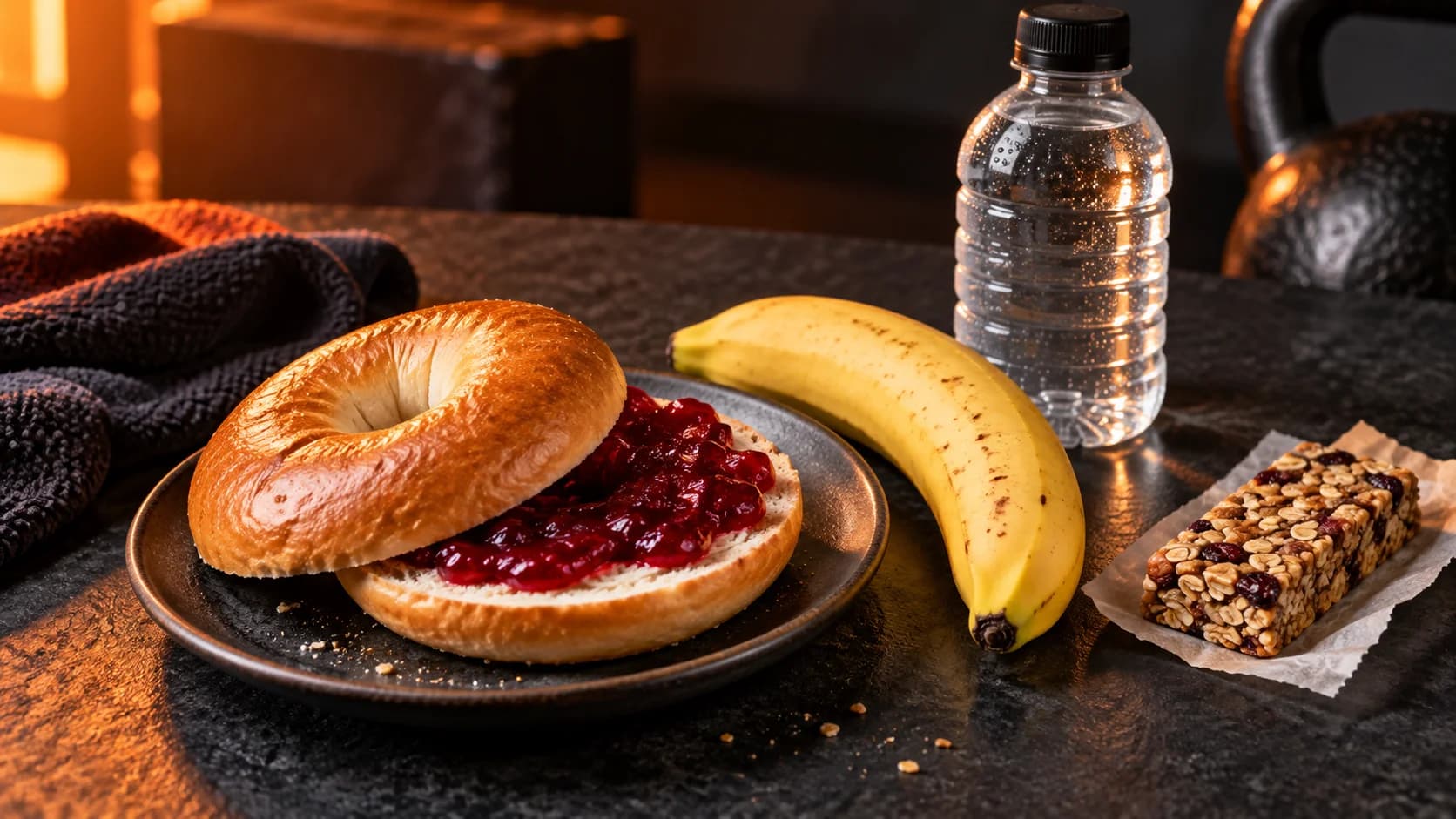
A 3 to 4 hour meal before an 8.30 AM start means eating before 5 AM. Most athletes would give up sleep for that meal and gain little. A smaller breakfast 2 to 3 hours out is the realistic trade. Aim toward the low end of the ACSM range, around 1 g/kg, which is about 70 g of carbohydrate at 70 kg.4 Toast with jam and a banana, a bowl of the cereal you usually eat, or white rice if that is your normal breakfast all work. Check grams on the label or in your tracking app.
| Time before your start | Example for an 8.30 AM start | What to do |
|---|---|---|
| 3 hours | 5.30 AM | Wake and start sipping water. |
| 2.5 to 2 hours | 6.00 to 6.30 AM | Familiar low-fibre breakfast, around 1 g/kg carbohydrate. |
| 2 to 1.5 hours | 6.30 to 7.00 AM | Travel. Finish your pre-race fluid. |
| 90 minutes | 7.00 AM | Arrive and check in. |
| 60 to 45 minutes | 7.30 to 7.45 AM | Drop your bag. Keep the snack and water on you. |
| 45 to 30 minutes | 7.45 to 8.00 AM | Optional 15 to 30 g top-up, such as a banana or a gel, if breakfast was small. |
| 10 minutes | 8.20 AM | Start tunnel. |
Some early starters wake and leave within minutes, often because of a long drive. Eat in the car. A banana, toast with jam wrapped in foil, or a carbohydrate drink you have tested all travel well. Then use the on-site top-up. The fasted-versus-fed meta-analysis supports eating something over nothing, and the pre-exercise feeding review supports a small snack in the final hour for most athletes.9 12
If you normally train fasted in the morning, this breakfast is new food at a new time. Eat it before your early training sessions in the weeks before the race so your gut has practised it.15
05Midday wave meals for a late-morning or early-afternoon start
A midday start is the easiest slot to fuel. You eat your usual breakfast, then a lighter carbohydrate meal before you leave for the venue. That second meal falls inside the ACSM 1 to 4 hour window, and together the two meals reach the middle of the 1 to 4 g/kg range without either one being large.4
| Time before your start | Example for a 12.30 PM start | What to do |
|---|---|---|
| 5.5 to 5 hours | 7.00 to 7.30 AM | Your normal breakfast, carbohydrate-forward. |
| 3.5 to 3 hours | 9.00 to 9.30 AM | Pre-race meal. A bagel or toast with jam, white rice, a banana. Low fibre and fat. |
| 2 hours | 10.30 AM | Travel. No more full meals. |
| 90 minutes | 11.00 AM | Arrive and check in. |
| 60 to 45 minutes | 11.30 to 11.45 AM | Drop your bag. Keep the snack and water on you. |
| 45 to 30 minutes | 11.45 AM to 12.00 PM | Top-up of 15 to 30 g only if you are hungry or the wait has stretched. |
| 10 minutes | 12.20 PM | Start tunnel. |
The top-up is optional here. A pre-race meal 3 hours out already covers the start, and Sherman's trial suggests a meal 4 hours out still performs.11 Eat the snack when the gap since your last meal is growing or your stomach is empty. Skip it if you feel full.
06Late wave meals and why skipping breakfast backfires
Late starters often skip breakfast to save their appetite for the race. The best trial I found points the other way. Clayton and colleagues had 10 men who normally eat breakfast either eat or skip a breakfast of about 733 kcal, then eat lunch freely. Nine hours after breakfast they cycled for 30 minutes at moderate intensity and then did a 30-minute maximal test. Work was 4.5 percent higher after breakfast, 314 kJ against 300 kJ, even though both groups ate lunch.16 The trial was small, all male, and on a bike. It still makes skipping breakfast a poor default for an evening wave. Lunch did not make up for the missing breakfast.
Eat normal meals through the day. Put the last meal 3 to 4 hours before your start, and make it the low-fibre, lower-fat carbohydrate meal. Rice, pasta with a light sauce, or a bagel with jam all fit. If lunch and the last meal fall within about 3 hours of each other, lunch can be smaller.
| Time before your start | Example for a 6.30 PM start | What to do |
|---|---|---|
| Your usual time | 8.00 AM | Normal breakfast. |
| About 6 hours | 12.30 PM | Normal lunch. |
| 4 to 3 hours | 2.30 to 3.30 PM | Last meal. Rice, pasta with a light sauce, or a bagel with jam. Low fibre and fat. |
| 2 hours | 4.30 PM | Travel. |
| 90 minutes | 5.00 PM | Arrive and check in. |
| 60 to 45 minutes | 5.30 to 5.45 PM | Drop your bag. Decide on caffeine now. |
| 45 to 30 minutes | 5.45 to 6.00 PM | Optional 15 to 30 g top-up. |
| 10 minutes | 6.20 PM | Start tunnel. |
A late start also means a long day of waiting and nerves. Keep meals familiar and on schedule so the race is the only unusual thing you do that day.
07A packing and delay plan for a schedule that can move
I found no universal HYROX policy on race-day delays, how late waves can run, or venue food. The rulebook, the regional FAQs, the APAC help centre, and the event pages I read say nothing on it.5 1 8 2 7 Event schedules carry the label "Provisional, subject to change."7 So plan for a start that goes off at your confirmed time, and pack enough to cover a later one.

My own packing list for the venue bag and your pockets looks like this.
- A 15 to 30 g familiar carbohydrate snack for the top-up, such as a banana, a gel, or a few chews. The gram range is my planning figure, backed by the evidence that small carbohydrate intakes close to the start are safe for most athletes.12
- A second snack of the same size in case your start runs later.
- A water bottle, sealed if your region asks for it.
- Your caffeine, in a form you have tested, if you use it.
- Any gel you plan to take on course, since it must be on you from the start.
Move the snack, the spare, and the water to your pockets or hands at bag drop. Your bag stays in the changing room once it goes in.
If a delay pushes the last meal well beyond the window you planned and you are hungry, the spare snack can be a practical top-up about 30 to 45 minutes before the revised start. That timing is a planning choice based on evidence that carbohydrate in the final hour is not harmful for most athletes, not an official HYROX rule.12 Sip to thirst. Do not start a new meal in the warm-up area. You also cannot fix a delay by joining an earlier wave, because racing outside your wave without approval is a disqualification.5
08Hydration before the start without overdrinking
The ACSM stand recommends 5 to 10 mL/kg of fluid in the 2 to 4 hours before exercise, which is 350 to 700 mL at 70 kg. Aim for pale yellow urine, with enough time left to pass the excess. Sodium in the pre-race food or drink helps you keep the fluid.4 A salted meal or a sports drink does that job.
Finish most of that fluid before you arrive. Avoid forcing extra water if you already feel hydrated. A long venue wait can add toilet time, so follow your normal routine rather than chugging at the door. Going in dry is a mistake too, since hypohydration makes the drop in gut blood flow during hard work worse.13 The rulebook requires water at least once during, before, or after each Roxzone pass, so plan around that aid-station access instead of overdrinking before the start.5
Early starters drink on waking and in the car. Midday and late starters drink normally through the day and hit the 5 to 10 mL/kg target in the 2 to 4 hours before the start.
09Caffeine timing for evening waves and the sleep you still need
The ISSN position stand finds that 3 to 6 mg/kg of caffeine consistently improves performance, and the lowest effective dose may be as low as 2 mg/kg. Around 9 mg/kg brings frequent side effects without extra benefit. The most common timing is 60 minutes before exercise, and faster forms such as gum act sooner than capsules. Responses vary with genetics and habitual intake, including effects on sleep and anxiety.17 Several of the stand's authors disclose supplement-industry ties. At 70 kg, 3 to 6 mg/kg is 210 to 420 mg.
Evening waves pay for that dose at night. Drake's trial gave 400 mg of caffeine at bedtime, 3 hours before, or 6 hours before, and all three disturbed sleep compared with placebo. The authors advise avoiding substantial caffeine for at least 6 hours before bed.18 A 6.30 PM start with a dose at 5.30 PM and bed at 11 PM leaves 5.5 hours. The study tested 400 mg, so it cannot predict the sleep effect of lower doses. For a late wave, consider skipping caffeine or using only a familiar lower dose, and decide based on how soon you need to sleep.
A delay also moves caffeine timing. If you take caffeine at a fixed clock time and your start slips, the dose lands earlier than you intended. A practical fix is to take it when you drop your bag, about 45 to 60 minutes before your start, rather than at a set clock time. No study has tested that idea, so treat it as planning and use a form you have tried in training.
10What the rulebook lets you carry on course
The 26/27 rulebook sets the limits. Any nutrition you want must be carried on your person from the start. Taking food or drink from anyone other than the aid stations counts as outside assistance and costs a 2-minute penalty for each infringement. Hydration packs are permitted. Water is available at least once during, before, or after each pass through the Roxzone, and a sports drink may be available. Pouring aid-station fluid over yourself is a 2-minute penalty.5 The Middle East FAQ says the same about water and gels.8 A friend cannot hand you the snack from your bag once you are racing.
For 45 to 75 minute efforts, the ACSM stand supports small amounts of carbohydrate or a mouth rinse during exercise. Longer efforts have different targets, and I found no HYROX-specific trial that sets an exact on-course amount.4 19 Jeukendrup's duration review moves toward 60 g/h for 2 to 3 hour efforts, so that figure does not transfer directly to most HYROX finishes.20 If you want to carry nutrition, practise with it and put it on your person before the start. The HYROX finish-time nutrition guide discusses how expected race duration can change the choice.
11Write the plan the night your start time arrives
When the confirmed time lands in your inbox, write four times on paper. Your start. Your arrival, which is the start minus 90 minutes. The moment you leave home, which is arrival minus travel. And your last full meal, 2.5 to 4 hours before the start. Pack the snack, the spare, the water, and the caffeine that night.
Your division's first wave is someone else's race. Eat for yours.
Footnotes
HYROX North America. FAQ. Wave allocation by estimated finish time, division wave times two weeks before the event, individual start times three days before, 90-minute arrival, bag drop 45 to 60 minutes before racing, racing from about 8 AM to 9 PM. Regional guidance. Accessed 24 September 2026. hyroxus.com.
Back to textBack to text 2Back to text 3Back to text 4Back to text 5HYROX APAC Help Centre. How do I know when the start time is for my race? Updated 13 March 2026. Tentative schedules are provisional, show the first wave of each division, and can change. Waves run 10 minutes apart. Regional guidance. hyroxapac.zendesk.com.
Back to textBack to text 2Back to text 3Brandt T, Ebel C, Lebahn C, Schmidt A. Acute physiological responses and performance determinants in Hyrox. A new running-focused high intensity functional fitness trend. Front Physiol. 2025, 16, 1519240. Simulated Open race, 11 recreational athletes. PMC.
Back to textThomas DT, Erdman KA, Burke LM. Nutrition and athletic performance. Joint position of the Academy of Nutrition and Dietetics, Dietitians of Canada, and the American College of Sports Medicine. 2016. Pre-event carbohydrate of 1 to 4 g/kg in the 1 to 4 hours before, limits on fat, protein, and fibre, carbohydrate during 45 to 75 minute efforts, and prehydration of 5 to 10 mL/kg. Dietitians of Canada PDF.
Back to textBack to text 2Back to text 3Back to text 4Back to text 5Back to text 6HYROX. Singles Rulebook, Season 26/27. Wave starts and disqualification for racing in another wave (section 7), pouring fluids (7.1), hydration packs (10.1), carried nutrition, outside assistance, and Roxzone water (10.5), check-in, bag drop, warm-up, and the start tunnel 10 minutes before the start (11.1 to 11.4). HYROX rulebook PDF.
Back to textBack to text 2Back to text 3Back to text 4Back to text 5Back to text 6Back to text 7HYROX APAC Help Centre. When and where do I get my confirmed start time? Updated 17 July 2026. Start time emailed on the Wednesday before the event, usually around 6 PM, and arrival at least 90 minutes before the scheduled start. Regional guidance. hyroxapac.zendesk.com.
Back to textBack to text 2HYROX. HWPO HYROX Boston 26/27 event page, 8 to 11 October 2026. Schedule labelled "Provisional, subject to change," with on-site registration opening 90 minutes before the first start time. Event-specific. The HYROX Vancouver 2026 page uses the same label and states that start time changes are not permitted. Boston, Vancouver.
Back to textBack to text 2Back to text 3Back to text 4HYROX Middle East. FAQ. Individual start times about three days before, 90-minute arrival, bag drop 45 to 60 minutes before racing, one cabin-size bag with sealed liquids, and water or gels only if carried from the start. Regional guidance. hyroxme.com.
Back to textBack to text 2Back to text 3Aird TP, Davies RW, Carson BP. Effects of fasted vs fed-state exercise on performance and post-exercise metabolism. A systematic review and meta-analysis. Scand J Med Sci Sports. 2018, 28(5), 1476-1493. PubMed.
Back to textBack to text 2Rothschild JA, Kilding AE, Plews DJ. What should I eat before exercise? Nutrients. 2020, 12(11), 3473. Narrative review. PMC.
Back to textSherman WM, Brodowicz G, Wright DA, Allen WK, Simonsen J, Dernbach A. Effects of 4 h preexercise carbohydrate feedings on cycling performance. Med Sci Sports Exerc. 1989, 21(5), 598-604. PubMed.
Back to textBack to text 2Jeukendrup AE, Killer SC. The myths surrounding pre-exercise carbohydrate feeding. Ann Nutr Metab. 2010, 57 Suppl 2, 18-25. Narrative review. PubMed.
Back to textBack to text 2Back to text 3Back to text 4de Oliveira EP, Burini RC, Jeukendrup A. Gastrointestinal complaints during exercise. Prevalence, etiology, and nutritional recommendations. Sports Med. 2014, 44 Suppl 1, S79-S85. Narrative review. PMC.
Back to textBack to text 2Rehrer NJ, van Kemenade M, Meester W, Brouns F, Saris WH. Gastrointestinal complaints in relation to dietary intake in triathletes. Int J Sport Nutr. 1992, 2(1), 48-59. Retrospective survey of 55 male half-Ironman triathletes. PubMed.
Back to textJeukendrup AE. Training the gut for athletes. Sports Med. 2017, 47 Suppl 1, 101-110. Narrative review. PMC.
Back to textBack to text 2Clayton DJ, Barutcu A, Machin C, Stensel DJ, James LJ. Effect of breakfast omission on energy intake and evening exercise performance. Med Sci Sports Exerc. 2015, 47(12), 2645-2652. Randomised crossover trial in 10 men. PubMed.
Back to textGuest NS, VanDusseldorp TA, Nelson MT, et al. International society of sports nutrition position stand. Caffeine and exercise performance. J Int Soc Sports Nutr. 2021, 18(1), 1. Several authors and the ISSN disclose supplement-industry ties. PMC.
Back to textDrake C, Roehrs T, Shambroom J, Roth T. Caffeine effects on sleep taken 0, 3, or 6 hours before going to bed. J Clin Sleep Med. 2013, 9(11), 1195-1200. Randomised placebo-controlled trial of a 400 mg dose. PMC.
Back to textBurke LM, Hawley JA, Wong SH, Jeukendrup AE. Carbohydrates for training and competition. J Sports Sci. 2011, 29 Suppl 1, S17-S27. IOC consensus review. PubMed.
Back to textJeukendrup A. A step towards personalized sports nutrition. Carbohydrate intake during exercise. Sports Med. 2014, 44 Suppl 1, S25-S33. PMC.
Back to text