A deload week is a planned drop in training stress so fatigue can fall faster than fitness. The training side of that idea is well covered. The nutrition side gets handled by reflex. Most lifters either eat exactly the same and gain a kilo of mystery weight, or panic-cut calories and walk into the next block under-fueled. Both approaches misunderstand the purpose of a deload.
The deload changes your training first, and the food log only reflects it afterward. Volume falls by 30 to 50 percent or load falls by 10 to 20 percent. Recovery debt clears. Stress markers may settle. Glycogen restores. Each of those changes touches body weight and appetite in a way that looks like a nutrition problem but is mostly a training-load echo. The job of this week is to support that recovery while treating the temporary calorie change as part of the training plan.
This guide is for trained lifters and hybrid athletes running structured blocks. If your problem is rising hunger after a long cut, diet breaks and refeed days are the better frame. If your cut just ended, the post-cut maintenance phase covers the longer transition. Deload nutrition is narrower than either of those. Dr. Mike Israetel's guidance uses maintenance intake as the general target during a deload. Raise calories to maintenance if you come from a deficit, and lower them to maintenance if you come from a surplus.
01Deload week physiology for lifters
Deload weeks reduce training stress so accumulated fatigue can drop while fitness holds. That is the same broad logic used in taper research: reduce the training load enough to lower physiological and psychological stress, while preserving the fitness signal that the next block or event needs.12 The mechanisms that matter for nutrition are all knock-on effects of that lower stress.
| System | Direction during a deload | Nutritional consequence |
|---|---|---|
| Training expenditure | Down according to the cut in volume, load, and conditioning | Total energy needs may fall across the week |
| Muscle glycogen | Restores toward the upper end of personal range | Bound water rises, scale weight rises, performance feel improves |
| Stress hormones and inflammation | Often ease as training stress falls, though single markers are noisy | Water retained from heavy training may release, sometimes producing a whoosh |
| Hunger and appetite | Often slightly lower for trained lifters, sometimes higher | Logging quality matters more than usual because cues are shifting |
| Sleep | Frequently improves, especially if late hard sessions were a problem | Lower sleep debt makes hunger and adherence easier to manage |
The combined effect is that the scale can move up or down by 1 to 2 kg in either direction during a deload without that movement reflecting fat balance. That is the single most useful thing to know before reading the week's data.
02Keep deload calories near maintenance
The most common question is whether to eat less because training is lighter. Renaissance Periodization's general answer is to use maintenance intake during the deload. The direction of the adjustment depends on the phase you entered from.
| Phase you came from | Default calorie move during the deload |
|---|---|
| Maintenance block | Hold the same maintenance target |
| Lean bulk or surplus block | Reduce intake to maintenance for the deload, then resume the surplus |
| Deficit cut | Increase intake to maintenance for the deload, then resume the deficit |
| Post-cut maintenance | Hold maintenance. The deload often coincides with the most volatile week of scale data |
| Race taper | Different rules. Use carbohydrate periodization and taper protocols |
Use maintenance as the default for the deload. Increase calories when you enter from a deficit. Reduce calories when you enter from a surplus. Resume the prior phase when the next training block begins.
Exact expenditure changes are difficult to estimate over a single recovery week. Use maintenance as the practical target. When you enter the deload from a deficit or surplus, move to maintenance and resume the prior phase after the deload.
03Protein stays where it was
The protein target does not change during a deload. The recovery you are running this week is exactly the kind that protein supports. Per-meal protein dose and distribution can shape the acute MPS response, but the daily protein target still matters most in practice. Trained lifters should hold the same 1.6 to 2.2 g/kg/day target they were running, with 0.3 to 0.4 g/kg per meal across three to four meals. Larger dieting or physique-prep targets should be individualized.
If you are deloading at the end of a cut, this is the worst time to drop protein. A deload is not a vacation from muscle protein turnover. The whole reason the deload protects the next block is that fatigue clears while lean mass stays put. Dropping protein in this window makes it easier to compromise recovery and lean-mass retention.
04Should you cut carbs on a deload week
Carbohydrate is the macronutrient most tied to training volume, so its timing can move when sessions change. Keep the daily calorie target aligned with maintenance. On rest days, move carbohydrate that previously sat around training into regular meals rather than removing it from the daily total.
| Training profile during the deload | Carbohydrate adjustment |
|---|---|
| 4 lifts at reduced volume | Hold calories at maintenance. Keep pre and post-lift carbs the same. Fueled sessions still need fuel |
| 4 lifts at reduced load | Hold calories at maintenance. Loads dropped, sets did not, glycogen demand barely changes |
| 2 to 3 lifts plus skipped conditioning | Hold calories at maintenance. Move unused training fuel into regular meals |
| Full reset week, almost no training | Hold the maintenance calorie target and distribute carbohydrate across regular meals |
A common mistake is to slash carbohydrate intake on the assumption that lower training equals lower need. Glycogen restoration is a real job for the deload week, especially after a high-volume block. Modern sports nutrition guidelines commonly use 7 to 12 g/kg/day during taper or carbohydrate-loading contexts, with about 24 hours often enough to normalize glycogen and about 48 hours used for supercompensation.34 Cutting carbohydrate too hard during the deload defeats one of the recoveries you came for.
05Track hunger swings on deload weeks
Trained lifters often report lower hunger during a deload. Sleep improves, training stress drops, and the appetite signal from hard sessions can fade. Other lifters experience the opposite, especially after a long block of hard endurance work, where the appetite catch-up happens during the easy week rather than the hard one. The overreaching literature supports the broader fatigue-management frame, but cortisol by itself is too variable to treat as a clean dashboard metric.5
| Pattern in the first 3 days | Likely read | Practical move |
|---|---|---|
| Hunger flat or down | Recovery is settling, sleep improved | Hold the plan. Do not deepen any cut to chase a faster trend |
| Hunger sharply up | Catch-up appetite from the prior block, especially after long sessions | Stay on the plan, add structured carbohydrate at meals, avoid free snacking |
| Hunger normal but cravings up | Diet fatigue showing through, often on cuts | Consider whether the deload is really the right tool, or if a diet break is what you need |
| Hunger pattern shifted later | Lower morning training drive, more evening appetite | Move calories later in the day rather than adding total intake |
The food log matters more during a deload than during a normal week because the cues are unstable. Same plan, more attention to the log.
06Water weight is the loudest signal and the least useful one
The first three to five days of a deload are when the scale lies the most. Two mechanisms produce most of the noise.
The first is glycogen restoration. Murray and Rosenbloom's 2018 review places typical whole-body glycogen around 600 g, with a wide range driven by body size, diet, fitness, and recent exercise.3 A hard block does not empty every store, but a trained athlete may still restore 150 to 400 g across muscle and liver during the easy week. Each gram of glycogen is commonly stored with at least 3 g of water, so that restoration can plausibly add about 600 g to 1.6 kg of acute mass before gut content and sodium are even considered. None of that is fat.
The second is stress and inflammation settling. Hard training can increase local tissue stress and alter endocrine markers, both of which may affect fluid balance, but the evidence is cleaner for accumulated fatigue than for any single cortisol reading.5 When training stress falls, some athletes see water weight drop, but the timing is individual. This is the so-called whoosh, and it is more common at the end of a deload than the start.
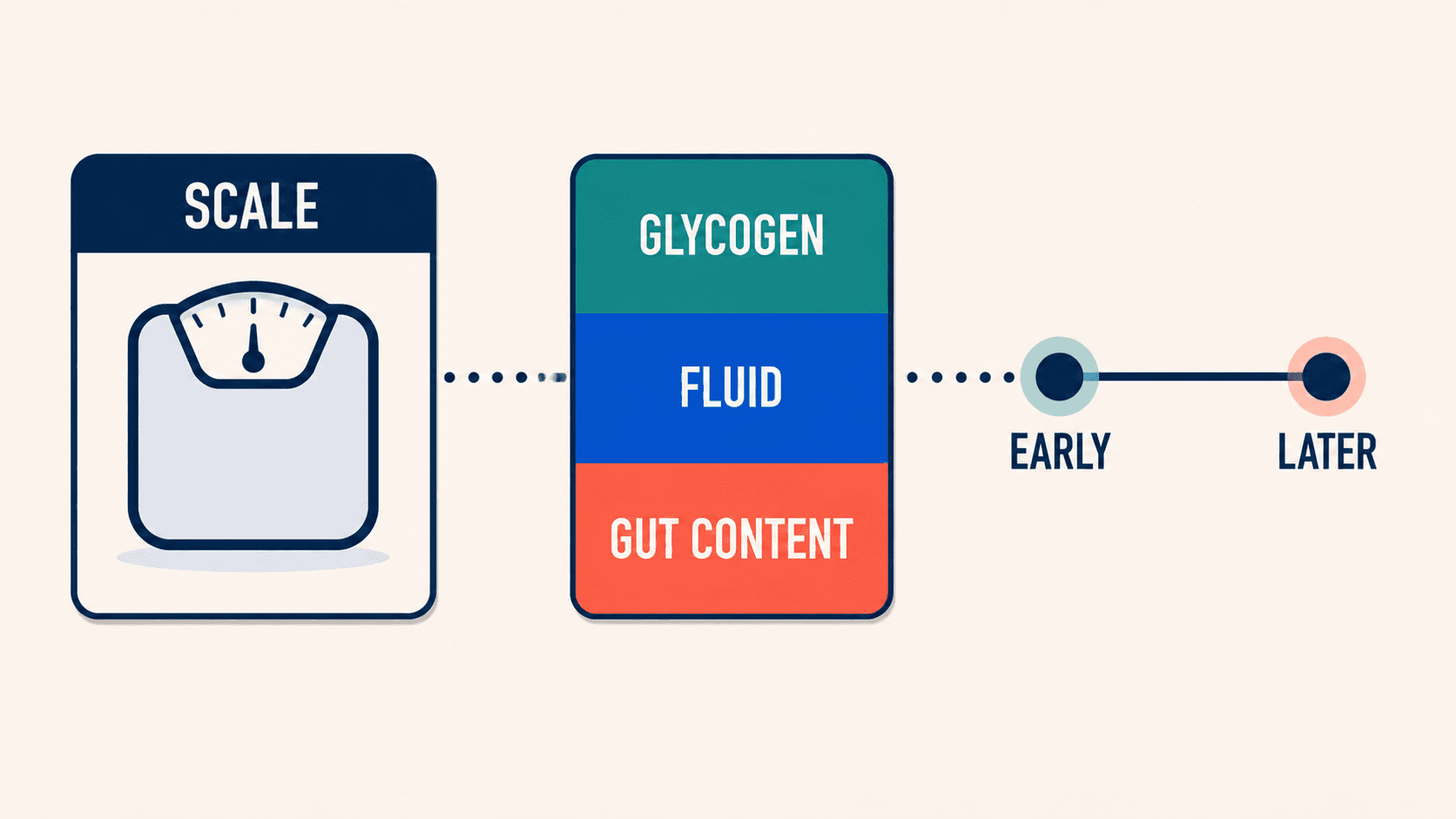
| Day window in the deload | Most likely scale story |
|---|---|
| Day 1 to 3 | Glycogen and water rising, scale up by 0.5 to 1.5 kg, no actual fat change |
| Day 4 to 6 | Stress-related water shifting, gut content normalizing, sometimes a sharp drop |
| Day 7 | Most useful single weight of the week, used as input to the next block's planning |
The practical rule is the one already used elsewhere in diet breaks and refeed days. Judge the week on the 7 to 14 day trend, not on day three. If waist is moving down and lifts are stable while scale weight stalls, read The Recomp Plateau That Is Actually Progress before treating a glycogen swing like failed fat loss.
07The accidental surplus that erases the deload
The most common nutritional mistake during a deload is adding unplanned food on top of the maintenance target. Training drops, snacks creep, and restaurant decisions get looser. The planned maintenance intake already accounts for the recovery week. Extra food sits above that target.
| Behavior | Effect during a deload week |
|---|---|
| Same calorie target plus unplanned snacks | Intake rises above the maintenance target |
| Adding extra carbohydrate to feel recovered | Glycogen fills first, then any further surplus shows up as fat over weeks |
| Treating the easier week like a reward | Repeated weekend overshoots that ruin the surrounding cut or maintenance trend |
| Holding plate sizes but moving snacks earlier | Neutral, sometimes useful for sleep |
The fix is structural, not motivational. Keep the same maintenance calorie target. If your plan included a 60 g pre-lift carbohydrate snack, use it on training days and move those calories into regular meals on rest days. Keep the daily total stable.
08When the deload coincides with other phases
Most real-world calendars stack phases on top of each other. The deload often lines up with the end of a cut, the start of a surplus, a travel week, or a holiday. Each combination changes the call.
| Overlap | Adjusted move |
|---|---|
| Deload ending a cut | Increase intake to maintenance for the deload, hold protein, then make the post-cut transition explicit |
| Deload starting a surplus | Hold maintenance for the deload week, then begin the surplus the following week with the new training block |
| Deload during travel | Pre-plan two anchor protein meals per day, leave carbohydrate flexible, treat the week as adherence over precision |
| Deload during a holiday or family event | Use restaurant and weekend tracking strategies before the week starts |
| Deload while on a GLP-1 | Hold protein floor, prioritize satiety, do not let the lighter training week become a missed protein week |
| Deload after a long endurance block | Expect catch-up appetite, hold protein, allow some carbohydrate flexibility for two to three days |
A deload already absorbs training stress, so it should not also absorb the stress of travel or a holiday. Stack them and the deload usually turns into a maintenance week with extra structure instead of a true recovery window.
09Sample deload macros by body weight
The same structural pattern travels across phases, but the absolute targets and the scale story shift with the phase the deload sits inside. The three examples below cover the most common cases. Numbers are illustrative.
Maintenance block, 80 kg lifter. Normal week runs 2,800 kcal with 180 g protein, 90 g fat, and 320 g carbohydrate, across four lifts plus two short conditioning sessions.
| Variable | Normal week | Deload week (volume cut by 40%) |
|---|---|---|
| Calories | 2,800 kcal/day | 2,800 kcal/day, hold flat |
| Protein | 180 g across 4 meals at 40 to 50 g | 180 g across 4 meals at 40 to 50 g |
| Carbohydrate | 320 g, with 80 to 100 g around training | About 320 g, with more distributed across meals on rest days |
| Fat | 90 g | 90 g |
| Training fuel snack | Pre-session 40 g carbohydrate, 20 g protein | Hold on training days, move those calories into meals on full-rest days |
| Sodium and fluid | Standard intake | Hold standard, expect a sharper water-weight swing |
| Expected scale move | Flat over 14 days | Up 0.5 to 1.5 kg in days 1 to 3 from glycogen and water, settling later |
Fat loss block, 78 kg lifter on a roughly 500 kcal deficit. Normal week runs 2,000 kcal with 170 g protein (about 2.2 g/kg), 65 g fat, and 200 g carbohydrate. Maintenance estimate sits near 2,500 kcal.
| Variable | Normal week | Deload week (volume cut by 40%) |
|---|---|---|
| Calories | 2,000 kcal/day | About 2,500 kcal/day, move to maintenance |
| Protein | 170 g across 4 meals at 40 to 45 g | 170 g across 4 meals, do not drop |
| Carbohydrate | 200 g, with 60 to 80 g around training | About 285 g, distributed around training and regular meals |
| Fat | 65 g | About 75 g |
| Training fuel snack | Pre-session 30 g carbohydrate, 15 g protein | Hold on training days, move those calories into meals on full-rest days |
| Expected scale move | Down 0.3 to 0.5 kg per week | Often flat or up in days 1 to 3 from glycogen, then a sharper drop later |
The calorie increase pauses the deficit for the deload. Resume the planned deficit when the next training block begins. If the cut itself needs a cleaner 12-week structure, use The First 12 Weeks of a Men's Cut to set the rate of loss and review cadence.
Lean gain block, 82 kg lifter on a roughly 300 kcal surplus. Normal week runs 3,100 kcal with 180 g protein, 95 g fat, and 380 g carbohydrate, across four lifts plus light conditioning. Estimated maintenance is about 2,800 kcal.
| Variable | Normal week | Deload week (volume cut by 40%) |
|---|---|---|
| Calories | 3,100 kcal/day | About 2,800 kcal/day, move to maintenance |
| Protein | 180 g across 4 meals at 45 g | 180 g across 4 meals at 45 g |
| Carbohydrate | 380 g, with 100 to 120 g around training | About 315 g, distributed around training and regular meals |
| Fat | 95 g | About 90 g |
| Training fuel snack | Pre-session 50 g carbohydrate, 20 g protein | Hold on training days, move those calories into meals on rest days |
| Expected scale move | Up roughly 0.2 to 0.3 kg per week | Often flat after moving from surplus intake to maintenance |
The expected result in a lean-gain deload is no weekly scale gain once calories move to maintenance. Resume the planned surplus when the next training block starts.
The structural pattern across all three uses maintenance calories for the deload. Hold protein. Adjust carbohydrate and fat to reach maintenance from the prior deficit or surplus. Resume the prior phase when the next training block begins. The 14-day trend, not the deload week itself, tells you whether the underlying plan is working.
10Use deload data to set the next block
The output of a good deload is two pieces of information. The first is whether fatigue actually cleared, which shows up in session quality, sleep, and resting heart rate trend rather than the scale. The second is a usable body-weight average for the start of the next block.
| Signal at end of deload | What it tells you |
|---|---|
| Bar speed and confidence return on a light test session | Fatigue cleared, the next block can start at planned intensity |
| Sleep stabilized and resting heart rate trending back toward baseline | Recovery debt cleared, training stress can climb again |
| Hunger settled into a normal pattern | Energy availability is fine, no calorie change needed for the new block |
| Scale up by 1 kg with waist unchanged | Glycogen and water, not fat. Plan from the new average |
| Scale up by 1 kg with waist up by 1 cm and food log loose | Probable accidental surplus. Tighten the structure for the new block |
| Scale flat or down with hunger high | Either the deload was too aggressive or the prior cut had real fatigue debt the deload could not fully clear. Consider a diet break before continuing |
A deload is one of the simplest training interventions and one of the most commonly mishandled at the dinner table. The week works when it stays narrow. Same protein. Maintenance calories. Carbohydrate and fat adjusted to reach that target. Same plate structure. A 14-day trend window. The recovery you bought with the easier week is exactly the recovery you take into the next block, as long as the food plan does not undo it.
<!--
Proposed inbound links:
- /glossary/deload-week
- /blog/diet-breaks-vs-refeed-days-fat-loss
- /blog/post-cut-maintenance-phase
- /blog/strength-training-minimum-effective-dose-during-a-cut
- /blog/recovery-nutrition-when-your-watch-says-you-are-not-ready
-->
Footnotes
Mujika I, Padilla S. Scientific bases for precompetition tapering strategies. Med Sci Sports Exerc. 2003,35(7):1182-1187. doi:10.1249/01.MSS.0000074448.73931.11
Back to textMujika I. Intense training: the key to optimal performance before and during the taper. Scand J Med Sci Sports. 2010,20 Suppl 2:24-31. doi:10.1111/j.1600-0838.2010.01189.x
Back to textMurray B, Rosenbloom C. Fundamentals of glycogen metabolism for coaches and athletes. Nutr Rev. 2018,76(4):243-259. doi:10.1093/nutrit/nuy001
Back to textBack to text 2Thomas DT, Erdman KA, Burke LM. Position of the Academy of Nutrition and Dietetics, Dietitians of Canada, and the American College of Sports Medicine: Nutrition and athletic performance. J Acad Nutr Diet. 2016,116(3):501-528. doi:10.1016/j.jand.2015.12.006
Back to textMeeusen R, Duclos M, Foster C, Fry A, Gleeson M, Nieman D, Raglin J, Rietjens G, Steinacker J, Urhausen A. Prevention, diagnosis, and treatment of the overtraining syndrome: joint consensus statement of the European College of Sport Science and the American College of Sports Medicine. Med Sci Sports Exerc. 2013,45(1):186-205. doi:10.1249/MSS.0b013e318279a10a
Back to textBack to text 2