In a 2026 trial, 46 resistance-trained men took omega-3s or a placebo through 14 weeks of supervised leg training. The omega-3s moved into their muscle tissue. No extra muscle showed up in the measurements.1
That gap between what enters a muscle and what the muscle does over months is the whole story of fish oil and hypertrophy. Fish oil has a plausible mechanism, a few eye-catching results in older adults, and a strong reputation in gyms. For a younger lifter who already trains hard and eats enough protein, the best direct evidence so far finds no added growth.
If you want to know your omega-3 status, how fish and supplements move it, or when to retest, the Omega-3 Index guide covers that ground. This article asks a narrower question. Does fish oil make a trained lifter's muscles bigger?
01Fish oil in trained men
Santo André and colleagues designed the trial to answer the question lifters actually ask.1 They recruited 46 healthy men with resistance-training experience, a mean age of 28, and a habitual protein intake that averaged 1.8 g/kg/day. The trial set a floor of 1.6 g/kg/day for habitual protein, so it asked whether fish oil adds anything once protein is covered.
The design was double-blind and placebo-controlled. One group took 6.3 g/day of total n-3 PUFA for 14 weeks. The other took a placebo. Both groups trained their lower body twice a week under supervision. Adherence was high, above 94% for supplements and above 96% for training sessions.

Progressive resistance training, adequate protein, and enough energy remain the foundations. The supplement question concerns what fish oil adds to those conditions.
The researchers measured almost everything a hypertrophy question could want. They tracked body composition, cross-sectional area of the rectus femoris and vastus lateralis, muscle fiber size from biopsies, 1RM strength, muscle fatty acid composition, and phosphorylation of mTOR, p70S6K, and 4E-BP1 at rest and four hours after exercise.
The supplement did its first job. Omega-3 content in skeletal muscle rose markedly in the fish-oil group. Both groups then gained lean mass, strength, whole-muscle cross-sectional area, and fiber size over the 14 weeks, with no differences between them. Anabolic signaling showed no effect of the supplement, and no change over time in either group.
The 6.3 g/day figure is total n-3 PUFA, and the abstract does not report it as EPA plus DHA, so reading it as 6.3 g of EPA and DHA overstates what anyone took. The trial was also small. With 46 men, a modest benefit could hide inside the noise, and the study was not designed to prove the two groups were equivalent. What it does show is that a large, well-absorbed omega-3 intake produced no detectable extra growth in young trained men eating enough protein on this program. The authors themselves pointed future work toward people with impaired anabolic responses, disuse, or calorie restriction, which leaves women, older adults, lower-protein diets, and cutting phases untested by this trial.
02Protein synthesis versus muscle growth
Most of the enthusiasm for fish oil as a muscle builder traces back to muscle protein synthesis studies. The mechanism is easy to like. EPA and DHA incorporate into muscle cell membranes, and membrane composition can plausibly change how a muscle responds to amino acids and insulin.
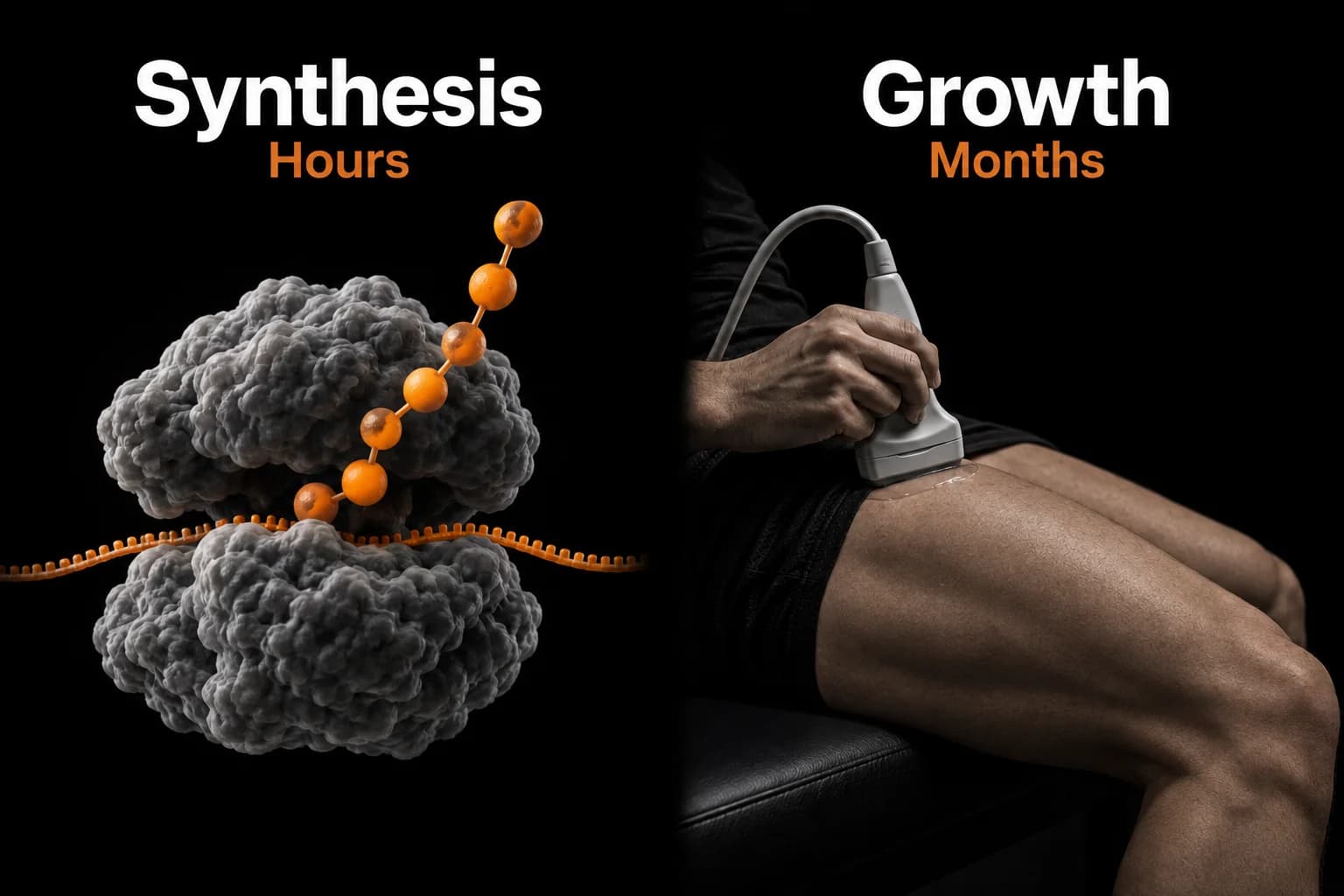
A short-term protein-synthesis measurement and long-term muscle growth answer different questions. Evidence for one endpoint cannot establish the other.134
The study that launched that idea was small and specific. Smith and colleagues randomized 16 healthy, sedentary adults aged 65 and older to 4 g/day of Lovaza, which supplied 1.86 g of EPA and 1.50 g of DHA, or corn oil for eight weeks.3 Basal muscle protein synthesis did not change. The rise in synthesis during a hyperaminoacidemic-hyperinsulinemic clamp, an intravenous infusion that floods the blood with amino acids and insulin, grew larger after omega-3 supplementation. That is an interesting physiological finding in older adults under laboratory conditions. It tells you nothing yet about ordinary meals, training, or muscle size months later.
McGlory and colleagues then tested the setting lifters care about.4 Twenty healthy young men took 5 g/day of fish oil, providing about 3.5 g of EPA, 0.9 g of DHA, and 100 mg of DPA, or coconut oil for eight weeks. They then performed a bout of resistance exercise and drank 30 g of whey protein. Myofibrillar protein synthesis rose in both groups, and fish oil added nothing. Some kinase signaling responses were actually smaller in the fish-oil group.
A 2025 meta-analysis by Therdyothin and colleagues pooled six studies with 188 participants and found no effect of omega-3 supplementation on muscle protein synthesis rates, with a standardized mean difference of 0.03 and a 95% confidence interval from -0.35 to 0.40.5 The same review reported a whole-body protein synthesis signal from three studies, a pool that included people with COPD or kidney disease. Whole-body synthesis counts protein made across every tissue, so that signal says little about skeletal muscle growth in healthy lifters.
Even a clean synthesis result would only cover a window of hours. Hypertrophy is measured in weeks and months with imaging, biopsies, and body composition scans. The 2026 trial measured anabolic signaling and long-term growth in the same men, and found no supplement benefit for either. It did not measure muscle protein synthesis rates.
03Size and strength in training trials
Strength gains are the other half of the fish-oil sales pitch, and they measure something different from size. A lifter can add to a 1RM without adding measurable muscle, and the one training trial with a positive strength result in younger adults shows exactly that split.
Heileson and colleagues ran a 10-week trial in recreationally trained young men and women who lifted three times a week.6 The fish-oil group took 4.5 g/day of fish oil containing 2.275 g of EPA and 1.575 g of DHA. Of 28 people who started, 21 finished, with four withdrawals in the fish-oil group and three in the placebo group. Blood EPA plus DHA roughly doubled in the fish-oil group. Lean body mass rose 3.4% with fish oil and 2.4% with placebo, a difference that was not statistically significant. Bench press 1RM improved more with fish oil, 17.7% compared with 9.7%, and relative squat strength improved more as well. Absolute squat 1RM did not differ.
That is a qualified strength signal from a small completer sample with several outcomes tested. It is not evidence that fish oil built more muscle, because lean mass did not separate between groups. The 2026 trial was larger, measured muscle and fiber size directly, and found no strength difference either.
| Study and population | Dose and duration | Training and protein context | Size, strength, or synthesis outcome | Interpretation and limitation |
|---|---|---|---|---|
| Santo André 2026, 46 resistance-trained men, mean age 281 | 6.3 g/day total n-3 PUFA, 14 weeks | Supervised leg training twice weekly, habitual protein about 1.8 g/kg/day | Muscle omega-3 rose, with no added lean mass, muscle or fiber size, strength, or signaling | Best direct test for trained lifters, small and all male |
| Heileson 2023, 21 recreationally trained adults completed6 | 4.5 g/day fish oil with 3.85 g EPA plus DHA, 10 weeks | Resistance training three times weekly | Larger gains in some 1RM measures, no difference in lean mass | Small strength signal with withdrawals and multiple outcomes |
| McGlory 2016, 20 young men4 | 5 g/day fish oil, 8 weeks | One lifting bout plus 30 g whey after supplementation | No added myofibrillar protein synthesis | Acute measure, says nothing about months of growth |
| Smith 2011, 16 sedentary adults 65 and older3 | 4 g/day Lovaza with 3.36 g EPA plus DHA, 8 weeks | No training, amino acid and insulin infusion | Larger clamp synthesis response, no change in basal synthesis | Laboratory endpoint in older adults |
| Smith 2015, 60 healthy adults aged 60 to 858 | 4 g/day fish oil with 3.36 g EPA plus DHA, 6 months | No structured resistance training | More thigh muscle volume, grip strength, and 1RM than control | Older adults without training, 44 completers |
| Da Boit 2017, 50 adults around age 709 | 3 g/day fish oil with about 2.7 g EPA plus DHA, 18 weeks | Supervised leg training twice weekly | Greater isometric torque and muscle quality gains in women only, no group difference in muscle area | Sex-split result, no size benefit |
04Meta-analyses on muscle growth
Two reviews try to pool the scattered trials, and neither finds a muscle-mass effect.
Silva and colleagues published the newest one in September 2026.2 They included randomized, placebo-controlled trials of isolated omega-3 supplementation in healthy adults without obesity. Four studies fed the fat-free mass analysis and showed no clear effect, with a standardized mean difference of 0.26 and a confidence interval from -1.14 to 1.66. Eight studies with 22 dependent effects fed the strength analysis, and it also showed no clear effect, -0.02 with an interval from -0.38 to 0.34. The authors rated the certainty of evidence very low because of risk of bias and imprecision. Their literature search ended on February 25, 2026, so the July 2026 trial in trained men is not part of this analysis.
Santo André and colleagues, the same group behind the 2026 trial, published an earlier review in 2023.7 Across 14 studies and 1,443 participants of varied ages, omega-3 supplementation had no significant effect on muscle mass or muscle function. Strength showed a very small positive effect, a standardized mean difference of 0.12 with an interval from 0.006 to 0.24. The included studies carried a high overall risk of bias, and subgroup analyses by age, dose, and whether people also lifted did not change the picture. The team then ran a direct trial to test the question in trained men, and found no added hypertrophy.
05Fish oil in older adults
The most cited positive muscle result comes from a population that looks nothing like a 28-year-old lifter. Smith and colleagues randomized 60 healthy adults aged 60 to 85 to 4 g/day of fish oil, with 1.86 g of EPA and 1.50 g of DHA, or corn oil for six months.8 No one followed a structured lifting program. Among the 44 who completed the study, the fish-oil group gained more thigh muscle volume than control, 3.6% with a confidence interval from 0.2% to 7.0%. Grip strength and 1RM strength also improved more. The authors described the effect as slowing the normal age-related decline in muscle mass and function.
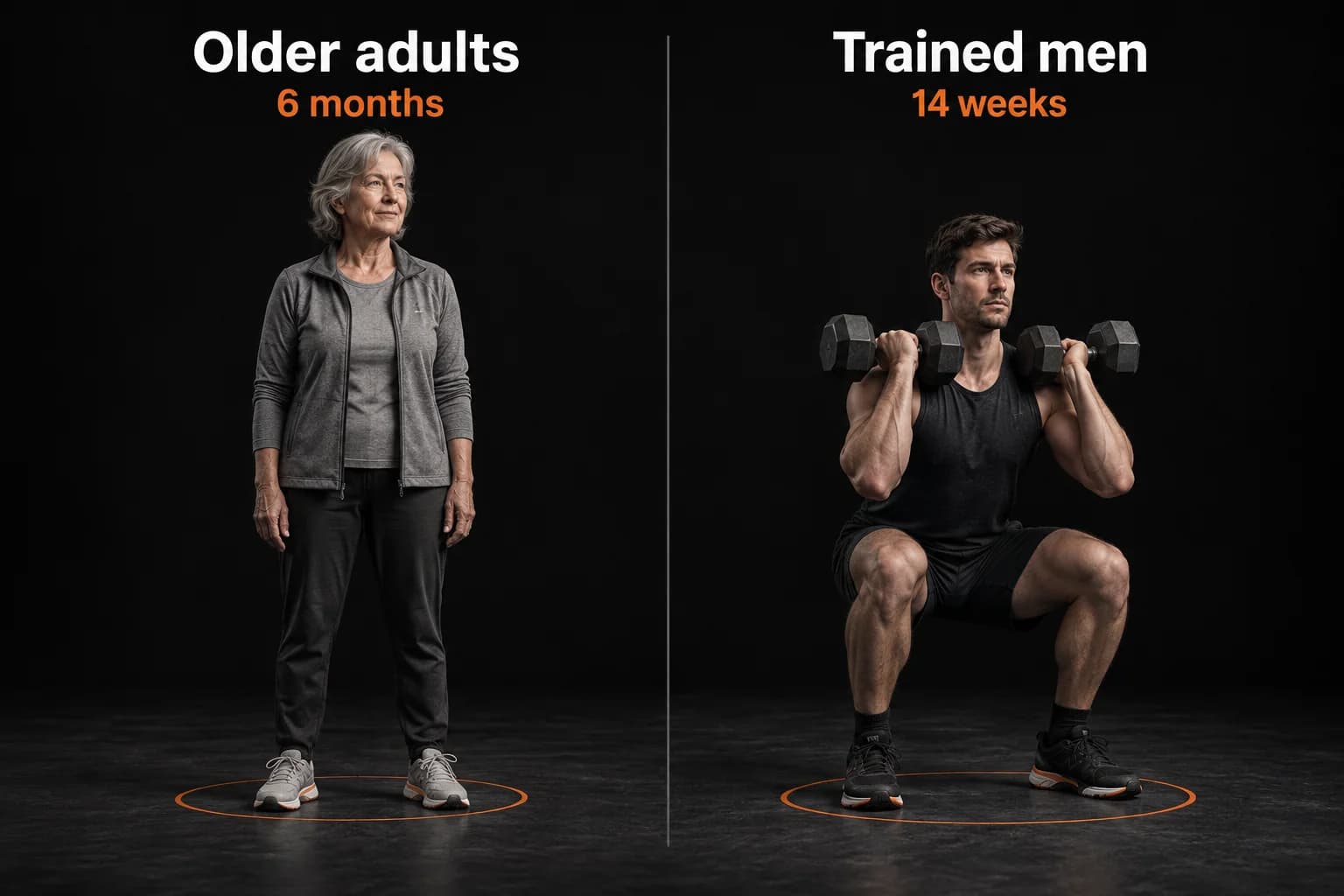
These were separate trials: six months in adults aged 60 to 85 without structured training, and 14 weeks in trained younger men eating adequate protein. The participants and protocols differed.81
Da Boit and colleagues then added training.9 Fifty older adults, 27 men and 23 women with a mean age near 70, did supervised lower-body resistance training twice a week for 18 weeks while taking 3 g/day of fish oil or safflower oil. Maximal isometric torque and muscle quality rose more with fish oil in women and showed no difference in men. Muscle cross-sectional area did not differ between groups in either sex.
Neither study settles the question for younger lifters. Older muscle often responds less to protein and training, a pattern called anabolic resistance. The 2026 trial authors named people with impaired anabolic responses as a group worth studying next, which is a research question and no recommendation.1 The 2015 trial never tested fish oil alongside lifting, and the 2017 trial found a function benefit in one sex with no size benefit in either. For an older adult worried about sarcopenia, these results are worth a conversation with a clinician. The foundations still come first, and the protein guide for adults over 65 covers the intake targets with stronger evidence behind them.
06No established growth dose for trained lifters
No dose of EPA and DHA has been established to improve muscle growth in trained lifters. The doses in the table were study conditions, chosen by investigators, and the best direct trial in trained men found no added growth at a large total omega-3 intake. A six-month trial did find more thigh muscle volume in older adults without structured training.8
Label arithmetic also trips people up. Fish oil weight and EPA plus DHA content are different numbers. Heileson's 4.5 g of fish oil held 3.85 g of EPA plus DHA, and the 2026 trial reported its dose as total n-3 PUFA without an EPA and DHA split in the abstract.61 Comparing studies by capsule weight alone mixes unlike doses.
The NIH Office of Dietary Supplements notes that experts have not established recommended amounts for EPA and DHA.10 The FDA advises keeping combined EPA and DHA from supplements at or below 5 g/day. That ceiling marks the upper end of what regulators consider safe to take. It is no efficacy target and no suggestion that more fish oil means more muscle.
07Soreness and recovery
Many lifters take fish oil because they hope to feel less sore or bounce back faster between sessions. Soreness, markers of muscle damage, inflammation, and long-term growth are separate outcomes, and less soreness would not by itself mean more hypertrophy. The evidence on recovery is its own question, covered in fish oil and post-exercise recovery.
08Fish oil in a lifting plan
| Your situation | What the evidence addresses | Where to go next |
|---|---|---|
| Younger trained lifter chasing size | The best direct trial found no added hypertrophy or strength with adequate protein | Training progression, protein intake, and creatine |
| Older adult worried about muscle loss | Small trials suggest possible benefits for muscle volume or function, with mixed results alongside training | Protein for older adults and a clinician conversation |
| Trying to meet omega-3 needs from diet | Status and heart-health questions, separate from muscle growth | Omega-3 Index guide |
| Hoping for less soreness | Recovery outcomes, which do not stand in for growth | Fish oil and post-exercise recovery |
For the lifter chasing size, the priorities have not changed. Progressive training, enough total protein, and enough energy to grow do the heavy work, and peri-workout nutrition for hypertrophy covers how to organize meals around sessions. Creatine has more direct evidence for muscle performance in lifters, and the creatine guide walks through it.
Eating fish is a separate decision. The American Heart Association recommends two servings of fish a week, especially fatty fish, as part of a heart-healthy eating pattern.11 Salmon can earn a place in your week on those grounds alone. Its case rests on diet quality, and the muscle claim adds nothing to it.
If fish oil landed in your cart because of your quads, the 2026 trial is the closest anyone has come to testing that exact bet. The omega-3s arrived in the muscle, and the muscle gained no measurable edge from them.
Footnotes
Santo Andre H, Pereira WR, Custoias GB, et al. Effects of n-3 PUFA supplementation during resistance training on muscle outcomes in healthy adult men: a randomised clinical trial. Br J Nutr. 2026. PubMed
Back to textBack to text 2Back to text 3Back to text 4Back to text 5Back to text 6Back to text 7Back to text 8Silva AMF, Simões MO, Artioli GG. Omega-3 supplementation shows no clear benefit for fat-free mass or muscle strength in healthy adults: a systematic review and meta-analysis of randomized controlled trials. Nutrition. 2026;153:113378. PubMed
Back to textBack to text 2Smith GI, Atherton P, Reeds DN, et al. Dietary omega-3 fatty acid supplementation increases the rate of muscle protein synthesis in older adults: a randomized controlled trial. Am J Clin Nutr. 2011;93(2):402-412. PMC
Back to textBack to text 2Back to text 3Back to text 4McGlory C, Wardle SL, Macnaughton LS, et al. Fish oil supplementation suppresses resistance exercise and feeding-induced increases in anabolic signaling without affecting myofibrillar protein synthesis in young men. Physiol Rep. 2016;4(6):e12715. PMC
Back to textBack to text 2Back to text 3Back to text 4Therdyothin A, Prokopidis K, Galli F, Witard OC, Isanejad M. The effects of omega-3 polyunsaturated fatty acids on muscle and whole-body protein synthesis: a systematic review and meta-analysis. Nutr Rev. 2025;83(2):e131. Nutrition Reviews
Back to textBack to text 2Heileson JL, Machek SB, Harris DR, et al. The effect of fish oil supplementation on resistance training-induced adaptations. J Int Soc Sports Nutr. 2023;20(1):2174704. PMC
Back to textBack to text 2Back to text 3Back to text 4Santo André HC, Esteves GP, Barreto GHC, Longhini F, Dolan E, Benatti FB. The influence of n-3PUFA supplementation on muscle strength, mass, and function: a systematic review and meta-analysis. Adv Nutr. 2023;14(1):115-127. PMC
Back to textBack to text 2Smith GI, Julliand S, Reeds DN, et al. Fish oil-derived n-3 PUFA therapy increases muscle mass and function in healthy older adults. Am J Clin Nutr. 2015;102(1):115-122. PMC
Back to textBack to text 2Back to text 3Back to text 4Back to text 5Da Boit M, Sibson R, Sivasubramaniam S, et al. Sex differences in the effect of fish-oil supplementation on the adaptive response to resistance exercise training in older people: a randomized controlled trial. Am J Clin Nutr. 2017;105(1):151-158. PubMed
Back to textBack to text 2Back to text 3NIH Office of Dietary Supplements. Omega-3 Fatty Acids, fact sheet for consumers. NIH ODS
Back to textBack to text 2American Heart Association. Fish and omega-3 fatty acids. AHA
Back to text