A 2023 meta-analysis of 13 placebo-controlled trials in trained athletes found no average endurance benefit from creatine monohydrate.1 Creatine has better support for repeated short sprints, and in a separate meta-analysis those sprint gains came with about 0.8 kg of added body mass.2 Whether that trade pays off depends on the event you race, the course you race on, and what your current training block is meant to build.
Most endurance athletes asking about creatine already know it helps lifters. Their question is whether a possible gain in surges, sprints, or gym work outweighs carrying extra mass for two, four, or ten hours. The trials answer part of that question, and the answer shifts between a flat marathon, a criterium, and a mountain trail race.
01Endurance performance in 13 trials
Fernández-Landa and colleagues searched three databases through May 2022 for placebo-controlled trials of creatine monohydrate in trained people. Thirteen trials qualified. The pooled standardized mean difference for endurance performance was -0.07, with a 95% confidence interval from -0.32 to 0.18 and a p value of 0.47.1 That is a trivial, nonsignificant effect that leans slightly negative. The result barely moved when the authors removed studies that sat unevenly on the funnel plot.
The included trials used different doses, durations, sports, and performance tests. That spread makes the pooled number an answer to a broad question about endurance tests in general. It cannot prove that no endurance athlete benefits. It also offers no evidence that a particular subgroup does. For a runner or cyclist whose goal is a faster steady effort, it is the best available estimate, and that estimate sits close to zero.
02Creatine and race surges
Phosphocreatine rebuilds ATP within seconds during hard efforts, and supplementing raises how much of it muscle can store. The benefit shows up most clearly when hard efforts repeat with short recoveries. Long races are mostly aerobic, and they still contain hard moments. A road race has attacks and a sprint. A trail race has steep pitches. A cross-country ski race or a mountain bike race has repeated surges from start to finish. Energy systems overlap, so creatine is relevant to more than the first ten seconds of an effort.

Orange marks hard efforts on this illustrative course. Evidence for repeated-sprint performance does not establish a faster overall race.23
Forbes and colleagues built a 2023 narrative review in the Journal of the International Society of Sports Nutrition around this idea. They argued that creatine may help the surges and end spurts that often decide races.6 A narrative review selects and interprets studies without pooling them, and one author disclosed creatine research grants, industry-sponsored work, donated product, and travel support. The paper is a reasonable hypothesis. The mechanism explains why a surge could go better. Whether the whole race ends faster is a separate question that needs a race-like trial.
03Race times versus sprint tests
Creatine coverage for endurance athletes often cites a sprint result and then writes as if the race got faster. The trials measure four different outcomes, and each answers its own question.
Whole-event result. A time trial, race time, or placing. This is the outcome athletes care about, and it is the rarest one in the creatine literature.
Sprint or end-spurt output. Power or work in a 10- to 15-second sprint, a repeated-sprint set, or a sprint segment inside a longer ride. Creatine has its strongest endurance-adjacent evidence here.
Training quality and adaptation. More reps, more interval work, or more lean mass across weeks of training. For endurance athletes this is a plausible pathway to better racing. No trial in this evidence base has shown that pathway producing a faster endurance race.
Biomarkers. Blood markers of muscle damage or inflammation after hard exercise. A lower creatine kinase reading tells you about a blood value. It does not tell you the athlete felt less sore or trained better the next day.
When you read a claim about creatine and endurance, check which of the four it measured. A gain in one category does not stand in for another.
04Key endurance trials
The closest thing to a race simulation comes from Tomcik and colleagues in 2018. Eighteen well-trained men with a VO2peak near 65 mL/kg/min rode a 120-km time trial with alternating 1-km and 4-km sprints every 10 km, followed by an uphill ride to fatigue. Nine took 20 g of creatine a day for 5 days and then 3 g a day for 9 days. Nine took placebo. Everyone completed both a moderate-carbohydrate and a high-carbohydrate condition. The creatine conditions raised power above baseline in the final 4-km sprint. Placebo with carbohydrate loading raised power in the final 1-km sprint. Total time trial time and time on the uphill ride did not differ between groups. Creatine also raised pre-trial body mass by 1.54% from baseline, compared with 0.99% for placebo.3
That study gets cited as proof that creatine helps cyclists finish races. It showed higher late-sprint power than baseline in a small group of men, and no faster 120 km.
A 2024 trial in 23 male U23 professional cyclists is the most direct null result in high-level endurance athletes. Riders with a mean VO2max of about 73 mL/kg/min took 20 g of creatine a day for 7 days during a training camp, or a placebo. The authors found no group-by-time effect on any outcome, including body composition, 10-second sprint power, 3-, 6-, and 12-minute efforts, critical power, W′, jump height, and a wellness questionnaire.7 The trial was short and small. It still tested creatine in the athletes most likely to profit from a sprint edge, and it found no effect.
Running has one old warning sign. In a 1993 trial of 18 well-trained men, 20 g a day for 6 days was followed by a 6-km run about 26 seconds slower and about 0.9 kg more body mass, according to a later review of the study. Treadmill time to exhaustion at 120% of the speed at VO2max did not change.86 The trial was small, male-only, and did not separate the effect of the extra mass from the effect of the supplement. It cannot predict what happens to every runner. It is also the only whole-event running result in this set, and it went the wrong way.
| Study | Who and what | Outcome type | Result | What it does not show |
|---|---|---|---|---|
| Fernández-Landa 2023 meta-analysis1 | 13 placebo-controlled trials in trained participants | Mixed endurance tests | Pooled effect -0.07, 95% CI -0.32 to 0.18, not significant | That no subgroup benefits, or that any subgroup does |
| Glaister and Rhodes 2022 meta-analysis2 | 14 double-blind RCTs, about 20 g/day for 3 to 7 days | Lab repeated sprints | Mean power up (SMD 0.61), body mass up 0.79 kg, no change in peak power or fatigue | Any whole-event endurance result |
| Tomcik 20183 | 18 well-trained men, 120-km cycling time trial with sprints | Race-like time trial and sprints | Late 4-km sprint power rose, overall time unchanged | A faster overall ride |
| Balsom 19938 | 18 well-trained men, 20 g/day for 6 days | Whole-event run | 6-km run about 26 s slower with about 0.9 kg more mass, as summarized by Forbes 20236 | That mass caused the slowdown, or that all runners slow down |
| Barranco-Gil 20247 | 23 male U23 professional cyclists, 20 g/day for 7 days | Sprint, time trials, recovery | No effect on any measured outcome | Effects of longer use or in other groups |
| Meixner 20259 | 25 trained cyclists (5 women), 20 g/day for 5 days, fixed-order crossover | Lab 15-second sprint | Work rose about 3% over placebo, fat-free mass rose, lactate unchanged | Race performance or adaptation, and the fixed order limits causal confidence |
| Santos 200410 | 34 experienced male marathoners, 20 g/day for 5 days before a 30-km race | Biomarkers at 24 hours | Smaller rises in CK, PGE2, and TNF-alpha, no LDH rise | Less soreness, faster recovery, or a faster race |
| Gras 2023 meta-analysis11 | 19 RCTs, 424 people, 82% men | VO2max | VO2max rose less with creatine than placebo | A slower race or a damaged aerobic system |
The VO2max result from Gras and colleagues is a lab measure. When VO2max is expressed per kilogram, added body mass alone can lower it, and the trials were mixed and mostly male.11 The Santos result is a blood-marker result. Every runner in that study finished within 5.8% of their personal best, and the paper did not compare race times between groups.10
A 2026 scoping review by Wesołowski and colleagues mapped 38 randomized trials published between 1996 and 2025. Repeated-sprint and power outcomes were the most often favorable, though not consistently better than placebo. Recovery markers were mixed, and the evidence on body composition and aerobic outcomes was limited or inconsistent.12 The review did not pool an effect, rate study quality, or weight studies by risk of bias, so it cannot grade the evidence.
05Body mass and race performance
Creatine usually adds some weight, and the amount varies. The repeated-sprint meta-analysis found 0.79 kg more than placebo after a short loading phase.2 A handball trial found 0.6 kg.13 The IOC consensus on supplements puts the possible gain after loading at 1 to 2 kg, mostly water, and names the downside for athletes who must move their mass against gravity.4 In the professional cyclists, both groups gained a little mass during camp and creatine made no difference.7 The 1 to 2 kg figure is a possible range. Some athletes will gain less, and some will see no clear change.
The early gain is mostly water held inside muscle cells. It is not fat. Over longer training blocks, creatine can also support lean-mass gains, which is extra tissue the athlete then carries.
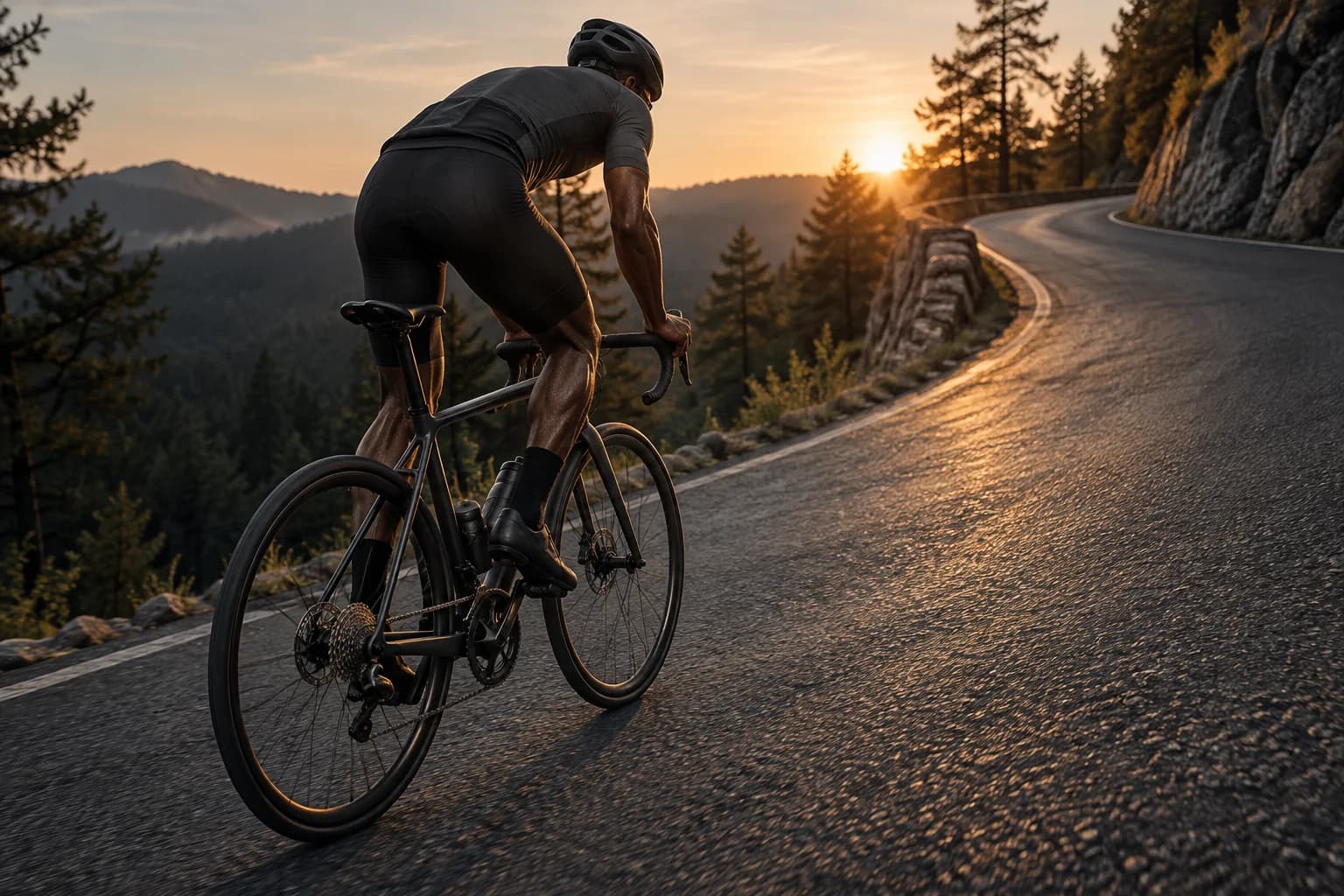
Extra mass matters when an athlete repeatedly carries it uphill. The trade-off depends on the course and the athlete's response.4
No study has turned a creatine-related kilogram into a predicted race-time cost. Any calculator that does so is guessing. What the evidence does support is direction. Mass costs the most when every stride or pedal stroke lifts the body, which describes running, trail running, and climbing on the bike. On flat roads a cyclist pays a smaller price for the same mass, though it still counts.
06Creatine by event and course
Endurance sport covers a wide range of races. A flat marathon asks for one steady output for hours. A criterium asks for dozens of accelerations. The table below is an evidence-informed heuristic built from the trials above. No trial has tested these event categories head to head.
| Event or training context | Plausible upside | Mass sensitivity | Verdict |
|---|---|---|---|
| Flat marathon or long steady block | Possible indirect help with strength training, no shown steady-race advantage | High, since every stride carries the mass | Lower priority unless the block has a clear strength goal |
| Hilly or technical trail running | Repeated climbs and accelerations make short power more relevant | High, since mass is carried uphill again and again | Possible but individual, judge it by a race-like climb session and mass trend |
| Flat road cycling or long time trial | Sprint segments may improve, the 120-km trial found no faster overall time | Lower than running on flat ground, still relevant | Weak case for a steady time trial goal |
| Criterium, track, mountain bike, punchy road race | Repeated accelerations and finishing efforts match the better-supported outcomes | Climbing and power per kilogram still matter by course | Most plausible endurance fit, with no guarantee of a better result |
| Triathlon | Could suit a bike-focused or strength block | The run leg keeps mass relevant, course profile matters | Decide by race format and your main limiter |
| Team or hybrid sport | Repeated sprints and power match the evidence best | Depends on sport and position | Strongest case, kept separate from claims about continuous endurance |
The handball trial shows how specific the effects are. In 19 trained men, a 5-day load improved repeated high-power lifting work and the first 5 meters of repeated 15-meter sprints. Performance on an incremental endurance run did not change.13 Creatine helped the parts of the sport built on short, hard efforts and left the aerobic test alone.
07Decide whether creatine fits your event
Do repeated hard surges decide my event? A criterium rider who loses races in the final sprint answers yes. A marathoner who races at an even pace answers no.
Will extra mass cost me on this course? A trail runner facing 2,000 meters of climbing answers yes. A rider in a flat criterium answers probably not.
Am I building strength or power right now, or looking for a faster race? A strength block in the off-season is a different goal from shaving time off a race in eight weeks.
If only the third answer points toward creatine, treat it as a training-support experiment and judge it on the training it supports. If the first answer is yes and the second is no, creatine is a reasonable test. If the first is no and the second is yes, the current evidence gives you little reason to start.
08Test creatine in training
Start in a block where race performance does not matter, such as an off-season strength phase or an early base period. Creatine works through stored muscle creatine built over days to weeks. A dose on race morning does nothing as fuel. Muscle stores need to rise beforehand, which takes about five days with loading or four weeks without it.14
The Australian Institute of Sport describes two routes. The loading route is about 0.3 g/kg a day, split into 3 or 4 doses, for 5 days, followed by about 0.03 g/kg a day. The slower route is 3 to 5 g a day with no loading, which reaches saturation in about four weeks.14 Both end in the same place. Avoiding loading and taking doses with meals may help reduce GI upset.5 For forms, safety, and who should check with a clinician first, see The Ultimate Guide to Creatine.
Measure two things. The first is a rolling 7-day average of morning body mass, started at least two weeks before the first dose and continued for at least four weeks after. The second is one repeatable session that looks like your race, such as hill repeats at a fixed effort, a set of sprints inside a steady ride, or a race-pace run over a known loop. Hold carbohydrate, sodium, and training load as steady as you can during the test, since each one moves the scale on its own.
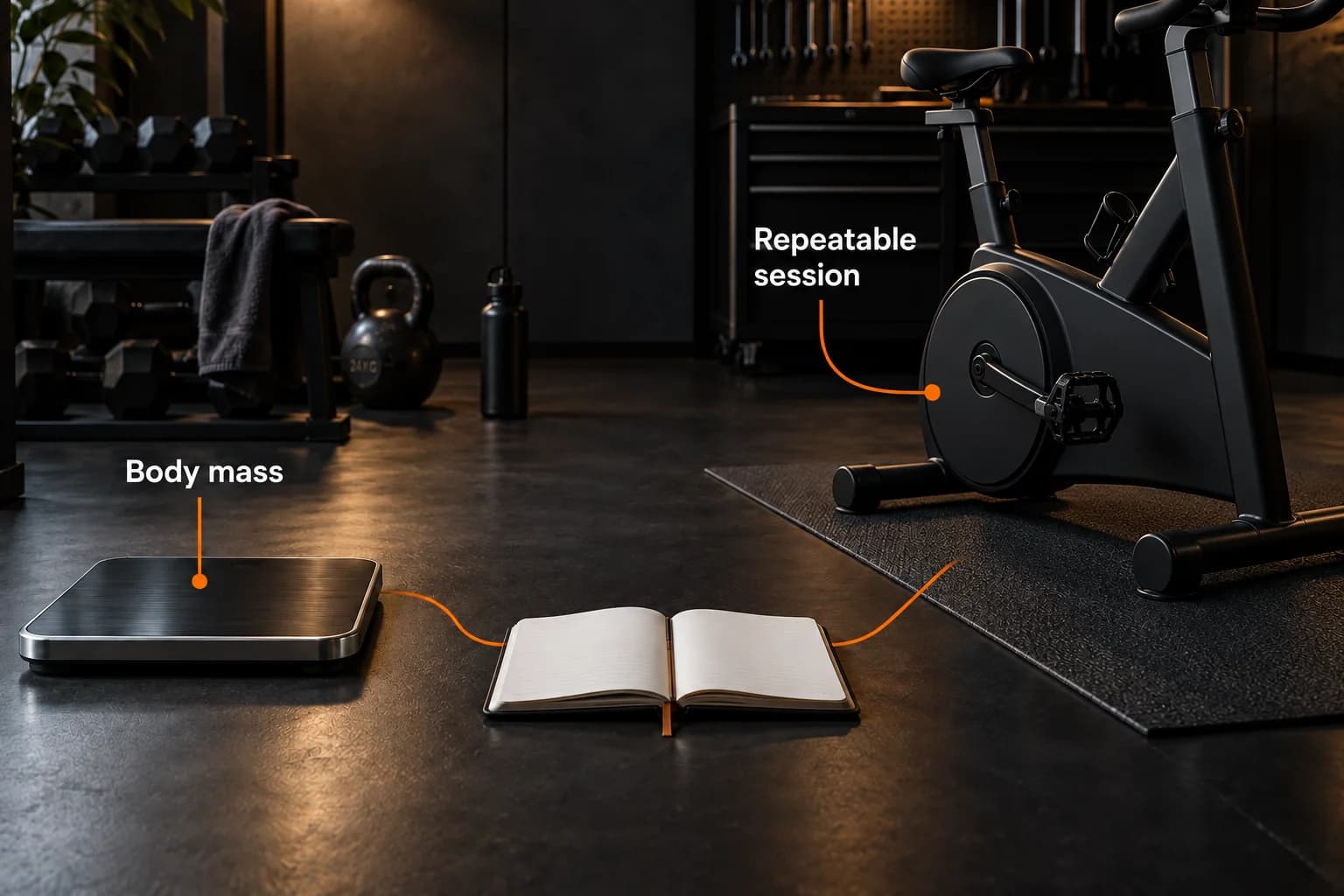
Track a rolling morning body-mass average alongside a repeatable session. Judge the training result together with the change in mass.
A heavier squat or a better gym session is a real result. It does not show that you race faster. The decision should rest on whether the race-like session improved enough to justify the change in the mass trend.
Healthy athletes do not need to force extra water on creatine. In the 30-km race study, the authors reported no cramping, dehydration, or diarrhea during a 5-day loading phase and the race.10 That was 34 men in one study, so it offers some reassurance and falls short of proof for every athlete in every climate.
09Stopping creatine before a race
A common coaching idea says to stop creatine two or three weeks before a goal race so the water leaves while muscle stores stay high. The Australian Institute of Sport describes both muscle creatine and body mass declining gradually after you stop, returning to normal over about 4 to 6 weeks.5 No trial in this evidence base shows mass falling faster than stores, and no trial has measured the race result of a pre-race stop.
That leaves no validated way to keep the performance effect and shed the mass for race day. The same gap applies to cycling creatine on and off across a season. If the mass trend during your test block makes you uneasy about a goal race, that is information about whether creatine fits your event. Decide on continued use from the test block result.
10Gaps in endurance trials
Most of the trials above enrolled only men. The cycling crossover study included 5 women among 25 riders.9 The VO2max meta-analysis population was 82% men.11 Nobody has shown that women respond differently in endurance events, and nobody has shown that they respond the same. Creatine for Women covers the female-specific evidence, which is thin and scattered for endurance outcomes in particular.
Vegetarian and vegan athletes often start with lower muscle creatine, and masters athletes may have strength-retention reasons to use it. Lower baseline stores may change the response. No trial here shows larger endurance-race gains in either group.
11Creatine's place in endurance nutrition
The NIH Office of Dietary Supplements summarizes creatine as having little value for distance running or swimming performance, while noting benefits for high-intensity intermittent work and the chance of weight gain.15 That fits the trials. For long events, adequate total energy, carbohydrate scaled to training, enough protein, sleep, and consistent training all come first. Endurance Athlete Fueling covers those targets, and Protein for Endurance Athletes covers the protein side of recovery and adaptation. Creatine cannot cover a shortfall in any of them.
If your races are won or lost in the final sprint of a criterium or on repeated short climbs, creatine is worth a careful test in the off-season. If your race is a flat marathon, the 13-trial average is your answer until someone runs a trial that says otherwise.
12References
Footnotes
Fernández-Landa J, Santibañez-Gutierrez A, Todorovic N, Stajer V, Ostojic SM. Effects of creatine monohydrate on endurance performance in a trained population: A systematic review and meta-analysis. Sports Med. 2023, 53(5):1017-1027. PubMed DOI
Back to textBack to text 2Back to text 3Back to text 4Glaister M, Rhodes L. Short-term creatine supplementation and repeated sprint ability-A systematic review and meta-analysis. Int J Sport Nutr Exerc Metab. 2022, 32(6):491-500. PubMed DOI
Back to textBack to text 2Back to text 3Back to text 4Back to text 5Tomcik KA, Camera DM, Bone JL, et al. Effects of creatine and carbohydrate loading on cycling time trial performance. Med Sci Sports Exerc. 2018, 50(1):141-150. PubMed DOI
Back to textBack to text 2Back to text 3Back to text 4Maughan RJ, Burke LM, Dvorak J, et al. IOC consensus statement: dietary supplements and the high-performance athlete. Br J Sports Med. 2018, 52(7):439-455. PMC DOI
Back to textBack to text 2Back to text 3Australian Institute of Sport. Creatine. Are there any concerns or considerations. AIS
Back to textBack to text 2Back to text 3Forbes SC, Candow DG, Neto JHF, et al. Creatine supplementation and endurance performance: surges and sprints to win the race. J Int Soc Sports Nutr. 2023, 20(1):2204071. PMC DOI
Back to textBack to text 2Back to text 3Barranco-Gil D, Alejo LB, Revuelta C, et al. High-dose short-term creatine supplementation without beneficial effects in professional cyclists: a randomized controlled trial. J Int Soc Sports Nutr. 2024, 21(1):2340574. PMC DOI
Back to textBack to text 2Back to text 3Balsom PD, Harridge SD, Söderlund K, Sjödin B, Ekblom B. Creatine supplementation per se does not enhance endurance exercise performance. Acta Physiol Scand. 1993, 149(4):521-523. PubMed DOI
Back to textBack to text 2Meixner B, Stegmaier J, Renner P, Koehler K, Yang WH, Sperlich B. Supplementation of creatine monohydrate improves sprint performance but has no effect on glycolytic contribution: a nonrandomized, placebo-controlled crossover trial in trained cyclists. Curr Dev Nutr. 2025, 9(2):104561. PMC DOI
Back to textBack to text 2Santos RV, Bassit RA, Caperuto EC, Costa Rosa LF. The effect of creatine supplementation upon inflammatory and muscle soreness markers after a 30km race. Life Sci. 2004, 75(16):1917-1924. ScienceDirect PubMed
Back to textBack to text 2Back to text 3Gras D, Lanhers C, Bagheri R, et al. Creatine supplementation and VO2max: a systematic review and meta-analysis. Crit Rev Food Sci Nutr. 2023, 63(21):4855-4866. PubMed DOI
Back to textBack to text 2Back to text 3Wesołowski I, Dzienisiewicz J, Langa D, Ziółkowski W, Karbowska J, Kochan Z. Creatine supplementation in endurance and mixed-sport contexts: a scoping review of performance, recovery, and body composition. Nutrients. 2026, 18(11):1677. PMC DOI
Back to textIzquierdo M, Ibañez J, González-Badillo JJ, Gorostiaga EM. Effects of creatine supplementation on muscle power, endurance, and sprint performance. Med Sci Sports Exerc. 2002, 34(2):332-343. PubMed DOI
Back to textBack to text 2Australian Institute of Sport. Creatine. How and when do I use it. AIS
Back to textBack to text 2National Institutes of Health Office of Dietary Supplements. Dietary supplements for exercise and athletic performance. Fact sheet for health professionals. NIH ODS
Back to text