Trained cyclists who took a ketone monoester through an eight-week training block were producing about 4% more power over 30 minutes by week 7 than riders on placebo. In the 2026 trial of 28 men, the ketone group averaged 302 W in a week-7 time trial against 291 W, and their relative VO2peak rose 12% against 6%.1
It is the strongest endurance result among the 2026 ketone trials, and it came from a specific protocol. The riders took 25 g of monoester after each session and again before bed, trained under supervision, and ate plenty of carbohydrate and protein. A linked report from the same research programme found that REM sleep rose 3% with the monoester and fell 2% with the control as training load climbed, although the riders did not feel they slept better.12
Ketone-IQ is a different molecule. Its product page lists R-1,3-butanediol as the ketone ingredient, an alcohol the liver turns into BHB.610 At the 2025 Absa Cape Epic, 18 mountain bikers finished a trial taking it or a placebo after each stage and before bed. It raised blood BHB to about 1.0 to 1.1 mmol/L and did not improve the recovery, sleep or reaction-time measures the researchers tracked.11 Three other 2026 monoester trials found no clear performance gain in a long laboratory ride, an eight-day race simulation or a month of running.234 Before buying, check which ingredient produced the result you want and how it was taken.
01Ketone esters, salts and precursors
Ketone supplements can temporarily raise blood beta-hydroxybutyrate (BHB). That rise is a separate state from the nutritional ketosis of a ketogenic diet, where low carbohydrate intake keeps the liver making ketones day after day. A shot does not put anyone on a ketogenic diet or recreate its metabolic conditions. The keto diet guide covers the dietary route.5
The ingredient determines the route to circulating BHB. Stubbs and colleagues compared a monoester with mineral salts in humans in 2017.5 A ketone monoester such as (R)-3-hydroxybutyl (R)-3-hydroxybutyrate is broken apart in the gut into BHB and (R)-1,3-butanediol, and the liver then converts the butanediol into more BHB. A ketone salt is BHB bound to a mineral, and it dissociates into the two after ingestion. The salt Stubbs tested contained both the D and L forms of BHB, so its results describe that product rather than every salt on the market.5
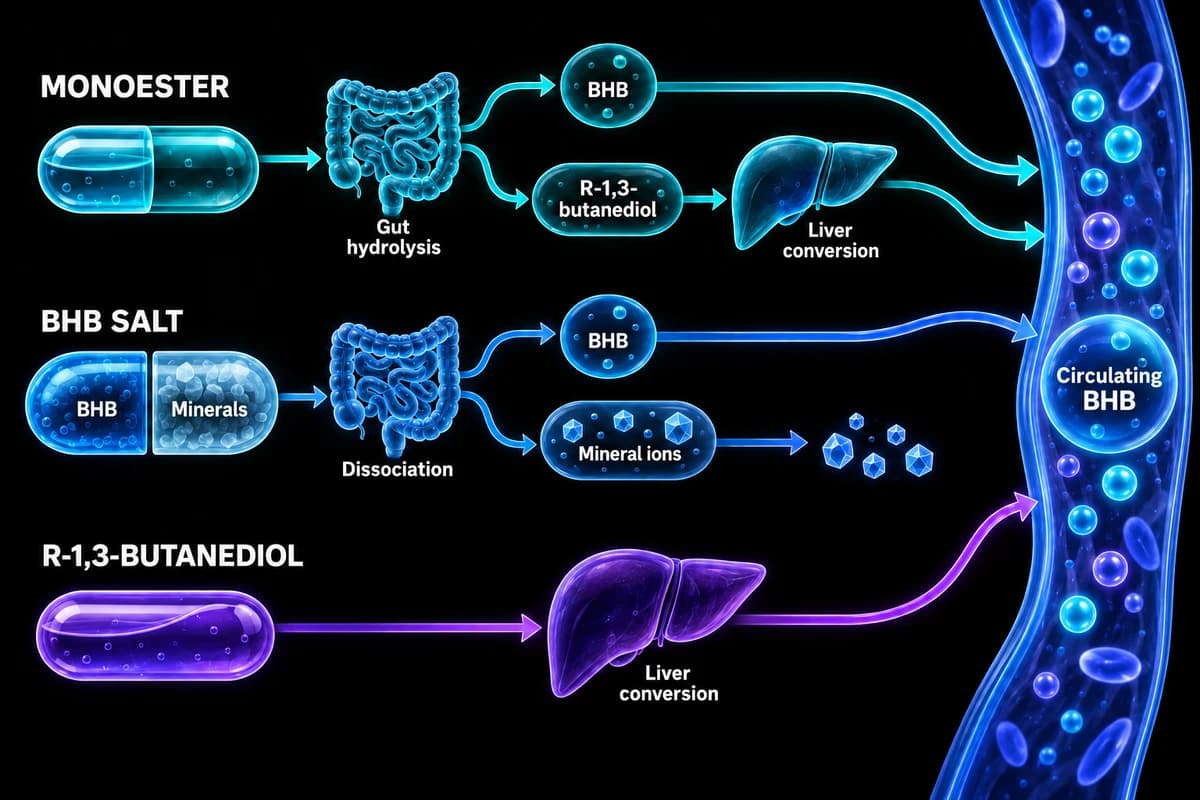
Three routes to circulating BHB. Arrows show chemical pathways, not equal ketone exposure or equal performance effects.5710
R-1,3-butanediol taken on its own is the third route. It is an alcohol that the liver converts into BHB, and it is not itself a ketone body.10 The Ketone-IQ No Caffeine Shot product page lists R-1,3-butanediol as its ketone ingredient and calls it a ketone diol.6 The training and REM results in this article come from the monoester. The Cape Epic trial tested the diol. Each result tells you about the ingredient that was in the bottle.11112
Salt products also carry minerals, and the Australian Institute of Sport notes that salt-based ketone products can deliver a high salt load.7 If a label lists a salt, count that sodium or potassium alongside the rest of your intake, and look for a trial of that form before expecting a result from the monoester studies.
02Ketones during a race
Martyn and colleagues tested what happens when a ketone goes into the bottle alongside a full race-day carbohydrate plan.2 They carbohydrate-loaded eight trained male cyclists for 36 hours and fed them before exercise. The riders then rode three hours at 95% of lactate threshold, followed by a ride to exhaustion at 150% of threshold. Each rider completed three conditions in random order. One was placebo with no carbohydrate, one was 120 g of carbohydrate per hour, and one was the same 120 g per hour plus a total of 75 g of ketone monoester taken before and during exercise. The ketone was added on top of the carbohydrate and replaced none of it.
With the ketone added, the riders burned less of the carbohydrate they drank. Oxidation of the ingested carbohydrate fell from 1.50 to 1.35 g per minute, about 10% lower. The share of ingested carbohydrate oxidized dropped from 75% to 67%, a fall of 8 percentage points. Average blood glucose fell from 4.9 to 4.4 mmol/L. Time to exhaustion was 349 seconds with carbohydrate alone and 319 seconds with the ketone added, a gap the study did not find statistically significant in eight riders. Both carbohydrate conditions outlasted placebo. Science in Sport Ltd is listed among the funders.2
These numbers describe where the fuel came from during the ride. They do not demonstrate glycogen sparing, and the lower ingested carbohydrate oxidation did not produce a significant exercise-capacity benefit over carbohydrate alone. It also did not test whether riders could eat less carbohydrate with a ketone on board. The part of the plan with a clear performance effect was the carbohydrate, which beat placebo. For riders working at 90 to 120 g per hour, the high-carbohydrate fueling plan has the stronger race-day evidence.
03Recovery and training adaptation
The positive 2026 result comes from Robberechts and colleagues.1 Thirty trained men entered a double-blind, placebo-controlled study, and 28 finished, 14 per group. The supervised, periodized training program lasted eight weeks, and each of its two four-week training cycles ended with a taper week. On training days, riders took 25 g of the monoester immediately after each training session and again 30 minutes before bed. They also received doses for rest days, and the methods do not specify when those were taken. Sessions longer than an hour included about 60 g of carbohydrate per hour, and both groups drank a recovery shake with 64 g of carbohydrate and 30 g of protein. The researchers bought the monoester from KetoneAid.
At week 7, mean power in a 30-minute time trial was 302 W in the ketone group and 291 W in the placebo group. The difference was 11 W, about 4%, with a plausible range of 4 to 18 W (95% CI). After the taper week the gap was 9 W, with a range of 2 to 15 W. Relative VO2peak rose 12% with ketones and 6% with placebo. Muscle biopsies pointed the same way, with a 25% rise in mitochondrial complex II content in the ketone group and citrate synthase activity 14% higher at the post-training test. Peak cardiac output showed no ketone advantage.1
An 11 W gain over 30 minutes is a meaningful margin for a trained rider, and a 9 W advantage persisted after the taper week. The VO2peak and mitochondrial changes suggest the monoester helped the riders adapt more to the same training. They did not report feeling more recovered, since stress and recovery questionnaires showed no difference from placebo.1 The result fits one situation closely, a trained male cyclist in a structured, well-fueled block who is willing to take a monoester after every session and before bed. Runners, women and under-fueled athletes were not studied, and this is one programme of 28 men waiting on an independent repeat.
Engelbrecht and colleagues used the same dose and timing during a stage race rather than a training block.3 Eighteen well-trained cyclists completed an eight-day simulated race. Eight took 25 g of monoester immediately after each stage and 30 minutes before sleep, and ten took placebo. The race lowered peak heart rate by about 11 beats per minute and cut 30-minute time-trial performance by about 3% in both groups. The ketone group showed no clear benefit for performance, recovery, sleep or cognition. Within the ketone group, fat oxidation rose 120% and mechanical efficiency at 200 W fell. Lower efficiency means riders spent more energy to hold the same 200 W, so burning more fat did not translate into more power. The result describes fuel use on the bike and says nothing about body-fat loss.
The commercial diol drink now has its own field test. Engelbrecht and colleagues enrolled 20 riders from ten teams in the 2025 Absa Cape Epic, a multi-stage mountain bike race, and randomized riders within each team to Ketone-IQ or placebo.11 Riders took 87.5 mL of the drink after each stage and again before bed. Two riders in the butanediol group withdrew, one with an injury and one after Stage 3, which left 18 finishers in the analysis, 8 on butanediol and 10 on placebo, 15 men and 3 women. HVMN supplied the drinks, LifeQ supplied the sleep-tracking watches, and the authors declared no conflicts of interest.11
Blood BHB reached about 1.0 to 1.1 mmol/L, a mild ketosis. That confirms the drink was absorbed and converted, and a higher blood ketone level on its own is not a performance or recovery benefit. Both groups showed similar race-related changes in exercise and resting heart rate, and the drink did not improve energy or carbohydrate intake, reaction time or subjective recovery. On the wearable, sleep did not change differently between groups as the race went on. Deep sleep was higher overall in the placebo group, and that gap did not change measurably from stage to stage.11
The field setting brings its own limits. Riders managed their own food and drink. The placebo matched taste and viscosity but not calories, and the researchers counted the supplement's 175 kcal a day in the butanediol group's recorded intake, which accounts for that energy without matching it. Riders were asked to wait 30 minutes after a dose before eating or drinking, and the researchers could not control that wait after stages. Sleep came from a wrist wearable whose manufacturer reported moderate agreement with polysomnography, using validation data that had not been published. Stage times were reported descriptively, so the trial cannot say whether the drink made riders faster or slower, and three women are too few for a women-specific conclusion.11
For anyone holding a Ketone-IQ order, this is the closest match yet between product, dose schedule and real use, and that protocol did not improve the recovery outcomes measured during the race. It did not test the monoester protocol from the eight-week study.111 Recovery between stages still runs on carbohydrate, protein and sleep opportunity, and the guide to fueling two hard days in a row covers the refueling window the Cape Epic riders were managing on their own.
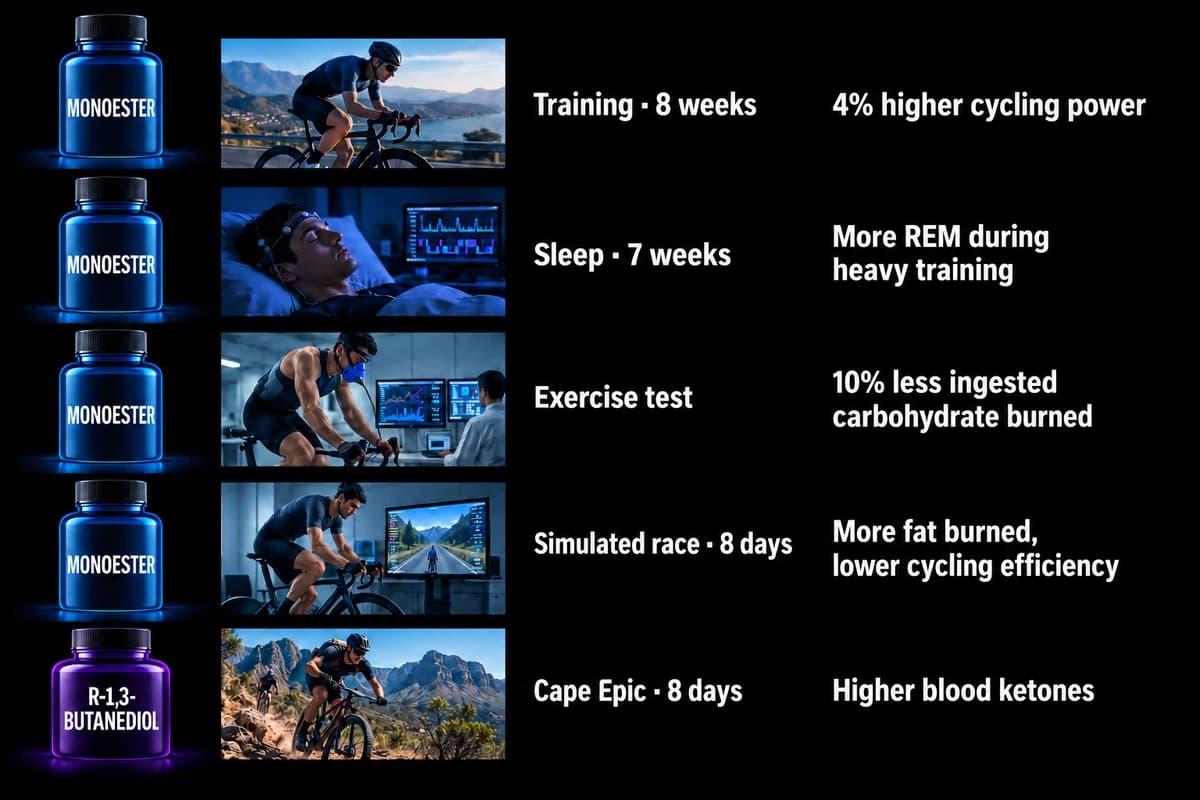
Illustrative scenes. Each row pairs one study with the main result it measured.1231112
Four of the five studies tested a monoester. The two results that point to a benefit, the power gain and the REM change, come from one research programme in which riders took the drink after every session and before bed for weeks. The race-day and stage-race studies used the same molecule over a single ride or eight days of racing and found shifts in fuel use with no clear gain in performance or recovery. The Cape Epic row is the only study of Ketone-IQ itself. A reader weighing a monoester for a training block should look hardest at the first two rows, and a reader holding a diol shot should look at the last.
| Study | Molecule and setting | Participants | Dose and timing | What was measured and found |
|---|---|---|---|---|
| Robberechts 20261 | Monoester, eight-week supervised cycling block ending in a taper week | 28 trained men, parallel groups | 25 g per dose after each training session and 30 minutes before bed on training days | 11 W higher 30-minute time-trial power at week 7, 9 W higher after the taper, relative VO2peak up 12% against 6% |
| Poffé 202612 | Monoester, seven weeks of rising training load, linked report from the same programme | 24 trained men, 12 per group | 25 g per dose after each training session and 30 minutes before bed | Polysomnography REM change of +3% versus −2% in controls, with no difference in perceived sleep quality |
| Martyn 20262 | Monoester, laboratory three-hour ride then exhaustion test | 8 trained men, crossover | 75 g in total before and during exercise, added to 120 g carbohydrate per hour | About 10% less ingested carbohydrate burned and lower glucose, with no significant difference in time to exhaustion |
| Engelbrecht August 20263 | Monoester, eight-day simulated stage race | 18 well-trained cyclists, 8 ketone and 10 placebo | 25 g after each stage and 30 minutes before sleep | About 3% time-trial decline in both groups, more fat burned and lower efficiency with ketones, no clear recovery or sleep benefit |
| Engelbrecht October 202611 | Ketone-IQ R-1,3-butanediol, 2025 Absa Cape Epic | 18 finishers, 8 butanediol and 10 placebo | 87.5 mL after each stage and before bed | Blood BHB about 1.0 to 1.1 mmol/L, with no recovery, cognitive or sleep improvement |
If your bottle says R-1,3-butanediol, the bottom row is the evidence for it. If it says monoester, the first four rows apply, each to the setting it tested.
04Athlete experiences with ketones
Forum posts show what athletes notice when they try ketones, and the posts here keep returning to focus, sleep and cost. These are self-reports, the dose in grams is often unknown, and nothing in them shows whether the writer has a connection to a brand.
On September 14, 2023, a TrainerRoad forum user posting as Stevie_Dee described testing KetoneAid samples and Delta G, taking 5 to 10 mL before and during rides.8 They described better focus without a noticeable increase in power. They reported symptoms they attributed to low blood sugar while using the products, took calories alongside to try to avoid them, and stopped regular use because of the cost. Their next plan was 5 mL before bed after hard sessions, close in timing to the 2026 training study, though the post gives no dose in grams.8
The same day in the same thread, AceLT described using HVMN and Delta G in training and races. They preferred Delta G and felt fresher and mentally sharper when dosing mid-race than at the start.8 They said they had no data and that the products were expensive.8
In a December 2024 r/AdvancedRunning discussion, a user posting as cutzen described taking what they reported as 5 g of ketone ester after workouts or long runs about three times a week for months.9 They noticed little change apart from a possible effect on sleep. A different product they called "ketohol" felt more energizing. They speculated that a higher dose could cost close to €100 a week.9
These accounts suggest useful things to track: focus during a session, sleep after hard training and the cost of repeated use. They are personal impressions, not estimates of how often a supplement works.
05Sleep and mental focus
The clearest sleep finding is a REM effect during heavy training. Poffé and colleagues followed 24 trained men, 12 per group, through seven weeks of gradually rising training load in a double-blind study.12 One group took 25 g of ketone monoester after each training session and 30 minutes before bed, and the other received a control. Polysomnography at baseline, week 3 and the end showed REM sleep falling 2% in controls and rising 3% with the monoester, a between-group difference with p = .002. Perceived sleep quality did not differ between groups, and perceived stress and recovery worsened in both. The full paper was not accessible, so these figures come from the published abstract.12
The REM result is a polysomnography-measured change in sleep stages during hard training. It does not show that riders felt better rested, and it was not a test of insomnia treatment. The study comes from the same research programme as the eight-week performance trial, which reserved its first day for a baseline sleep measurement reported in a separate manuscript, with matching investigators, protocol and dosing.112 The performance paper had 28 completers and the sleep abstract reports 24, so how many riders appear in both is unconfirmed. Read the two as linked results from one programme rather than as two independent confirmations.
Both stage-race trials dosed before sleep and found no sleep improvement. Engelbrecht's simulated-race cyclists took a monoester 30 minutes before sleep for eight days and showed no sleep or clear cognitive benefit.3 The Cape Epic riders taking Ketone-IQ before bed had no treatment-related sleep improvement or reaction-time advantage.11
Prins and colleagues gave 18 recreational runners 30 g of ketone monoester three times a day, 90 g in total, or an isocaloric placebo for 31 days, in a single-blind trial with nine per group.4 The ketone group did not run a faster 5 km time trial. Their responses on the incongruent Stroop task and a task-switching test were faster, and mood and quality-of-life scores did not change. The abstract also reports that the ketone group kept its mean absolute oxygen uptake during graded exercise after supplementation stopped. KetoneAid is listed among the study's funders.4
Faster responses on two cognitive tasks are a lead worth a larger trial, and they came at 90 g of monoester a day, a heavy intake that did not speed up the runners' 5 km. For sleep, the evidence supports one specific use. A monoester during a hard training block kept REM from falling in one programme, and the Cape Epic diol trial found no sleep improvement during a real race.1112
06Cost and practical value
On October 8, 2026, Bangkok time, the manufacturer's US site listed a 24-pack of the Ketone-IQ No Caffeine Shot at $119.95, about $5.00 per shot, or an introductory subscription price of $83.95, about $3.50 per shot. At that check, the page offered 30% off the first order and 10% off ongoing subscriptions.6 It suggested one to three servings a day. That is the company's usage guidance, and no trial here tested that regimen for recovery, sleep or performance.
The price buys a ketone diol. The 2026 cycling trials tested 25 g or 75 g of a monoester, and none of these studies established a diol dose that matches either, so a shot cannot be priced as the equivalent of the dose that worked.12 The Cape Epic trial is the one study here that tested Ketone-IQ itself, at two 87.5 mL doses a day.11 The trial drink and dose may not match every current bottle and serving, so compare the label with that schedule before treating the result as a test of your product.
Practical value depends on where the money would otherwise go. For a cyclist who has not yet rehearsed 90 g of carbohydrate per hour, prioritize a gut training block and a rehearsed carbohydrate plan before spending on diol shots. Daily carbohydrate and protein targets from the complete guide to macronutrients come first as well, since the strongest monoester result came from riders whose fueling was already in order.
07Testing a personal benefit
If you choose to try a product, define one outcome before buying it, such as perceived recovery, sleep or a repeatable training effort. Record the ingredient, dose and timing. Keep carbohydrate, caffeine, training load and sleep opportunity as consistent as practical, and use comparable sessions without the product as a reference. A food log can show whether fueling changed alongside the supplement.
Normal training gains and expectation can explain a better result. A personal comparison can tell you whether a product feels worth the money, and it cannot prove the product caused the change. Decide in advance how much improvement would justify the cost, and stop spending if that benefit does not appear consistently.
Buying a shot mainly for sleep. None of the trials reviewed here supports a diol shot for better sleep. Ketone-IQ before bed did not improve sleep at the Cape Epic, and the monoester REM gain came without riders feeling they slept better.1112 If you buy one anyway, track the same sleep measure every night for several weeks, since a one-week trial cannot separate the shot from an easier training week.
Adding a supplement to a heavy training block. This is the case with the best evidence, and it is specific. The 11 W gain came from 25 g of monoester after every session and before bed, in trained male cyclists on a supervised, well-fueled program.1 A diol shot is a different product, and its field trial found no recovery advantage.11 Get your own carbohydrate, protein and refueling in place first, because that was the starting point for the riders who improved.
Rehearsing race fueling. Build the plan around carbohydrate. Adding a monoester to 120 g of carbohydrate per hour changed how much of that carbohydrate was burned without a significant capacity gain, and neither stage-race study found better recovery between days.2311 Spend rehearsal sessions on carbohydrate rate, timing and gut tolerance.
A monoester has one supporting trial in a well-fueled training block. A ketone of any kind belongs in a race bottle only after you have used it in training, at the dose and timing you plan to race with, alongside the carbohydrate plan that does the main work.
Footnotes
Robberechts R, et al. Post-exercise ketone supplementation improves endurance performance and mitochondrial adaptations during an 8-week endurance training intervention. The Journal of Physiology. 2026. PMID 41757674. DOI
Back to textBack to text 2Back to text 3Back to text 4Back to text 5Back to text 6Back to text 7Back to text 8Back to text 9Back to text 10Back to text 11Back to text 12Martyn HJ, et al. Ketone monoester reduces blood glucose, exogenous CHO oxidation, and oxidation efficiency in trained male cyclists when fed 120 g/h of CHO during exercise. Journal of Applied Physiology. 2026. PMID 41962970. DOI
Back to textBack to text 2Back to text 3Back to text 4Back to text 5Back to text 6Back to text 7Back to text 8Engelbrecht L, et al. Ketone Ester Intake Did Not Improve Performance, Neither Cognitive Function or Sleep, During an 8-Day Simulated Cycling Race. Medicine & Science in Sports & Exercise. 2026. PMID 42658808. DOI
Back to textBack to text 2Back to text 3Back to text 4Back to text 5Back to text 6Prins PJ, et al. The Effects of 31-Day Exogenous Ketone Consumption on Running Performance, Cognitive Function, Metabolism, Body Composition, Hemodynamics, and Mood in Recreational Runners: A Randomized-Control Trial. Journal of the American Nutrition Association. 2026. PMID 41773904. DOI
Back to textBack to text 2Back to text 3Stubbs BJ, et al. On the metabolism of exogenous ketones in humans. Frontiers in Physiology. 2017, 8, 848. DOI
Back to textBack to text 2Back to text 3Back to text 4Back to text 5Ketone-IQ. No Caffeine Shot product page describing ingredients and US prices. Accessed October 8, 2026, Bangkok time. Product page
Back to textBack to text 2Back to text 3Australian Institute of Sport. AIS Sports Supplement Framework, Ketone Supplements practitioner fact sheet, linked from Group B. AIS Group B
Back to textBack to text 2TrainerRoad forum. Let's Talk Ketones. Posts by Stevie_Dee and AceLT, September 14, 2023. Thread
Back to textBack to text 2Back to text 3Back to text 4r/AdvancedRunning. Post-Exercise Ketones: Anyone trying this out or experimenting? Account by cutzen, December 2024. Thread
Back to textBack to text 2Lowder J, et al. An open-label, acute clinical trial in adults to assess ketone levels, gastrointestinal tolerability, and sleepiness following consumption of (R)-1,3-butanediol (Avela™). Frontiers in Physiology. 2023, 14, 1195702. PMID 37457035. DOI
Back to textBack to text 2Back to text 3Back to text 4Engelbrecht L, Poffé C, Koppo K, Terblanche E. Post-Exercise R-1,3-Butanediol did not Improve Markers of Fatigue or Recovery During a Multi-Stage Mountain Bike Race. European Journal of Sport Science. 2026, 26(11), e70260. PMID 42852530. DOI
Back to textBack to text 2Back to text 3Back to text 4Back to text 5Back to text 6Back to text 7Back to text 8Back to text 9Back to text 10Back to text 11Back to text 12Back to text 13Back to text 14Back to text 15Back to text 16Poffé C, Lauriks W, Stalmans M, Robberechts R. An Intensified Training Period Reduces REM Sleep but this Decline Can Be Mitigated by Ketone Ester Supplementation. Medicine & Science in Sports & Exercise. 2026. PMID 42841497. DOI
Back to textBack to text 2Back to text 3Back to text 4Back to text 5Back to text 6Back to text 7Back to text 8Back to text 9Back to text 10