People on GLP-1 medications for weight loss develop gallstones and gallbladder inflammation more often than people on placebo. In a 2022 meta-analysis of 76 randomized trials, the relative risk of gallbladder or biliary disease more than doubled in the weight-loss trials.1 The absolute increase is small, and the warning on your prescription label is no diagnosis. It is also no reason to stop your medication on your own.
What the warning does ask of you is simple. Learn which symptoms need a call to a clinician the same day, and stop assuming every stomach complaint on a GLP-1 is routine nausea. Nutrition has a narrower role. General dieting guidance links rapid loss and long periods without eating to gallstone risk. No GLP-1 study has established a food protocol that prevents stones.5
01The risk comes from the drug and the weight loss
Two things raise gallstone risk during GLP-1 treatment, and they overlap.
The first is rapid weight loss and long stretches without food. According to the National Institute of Diabetes and Digestive and Kidney Diseases (NIDDK), these patterns can increase cholesterol in bile and interfere with gallbladder emptying.5 Both changes raise the chance that stones will form. The guidance comes from dieting and bariatric-surgery evidence, long before semaglutide existed.
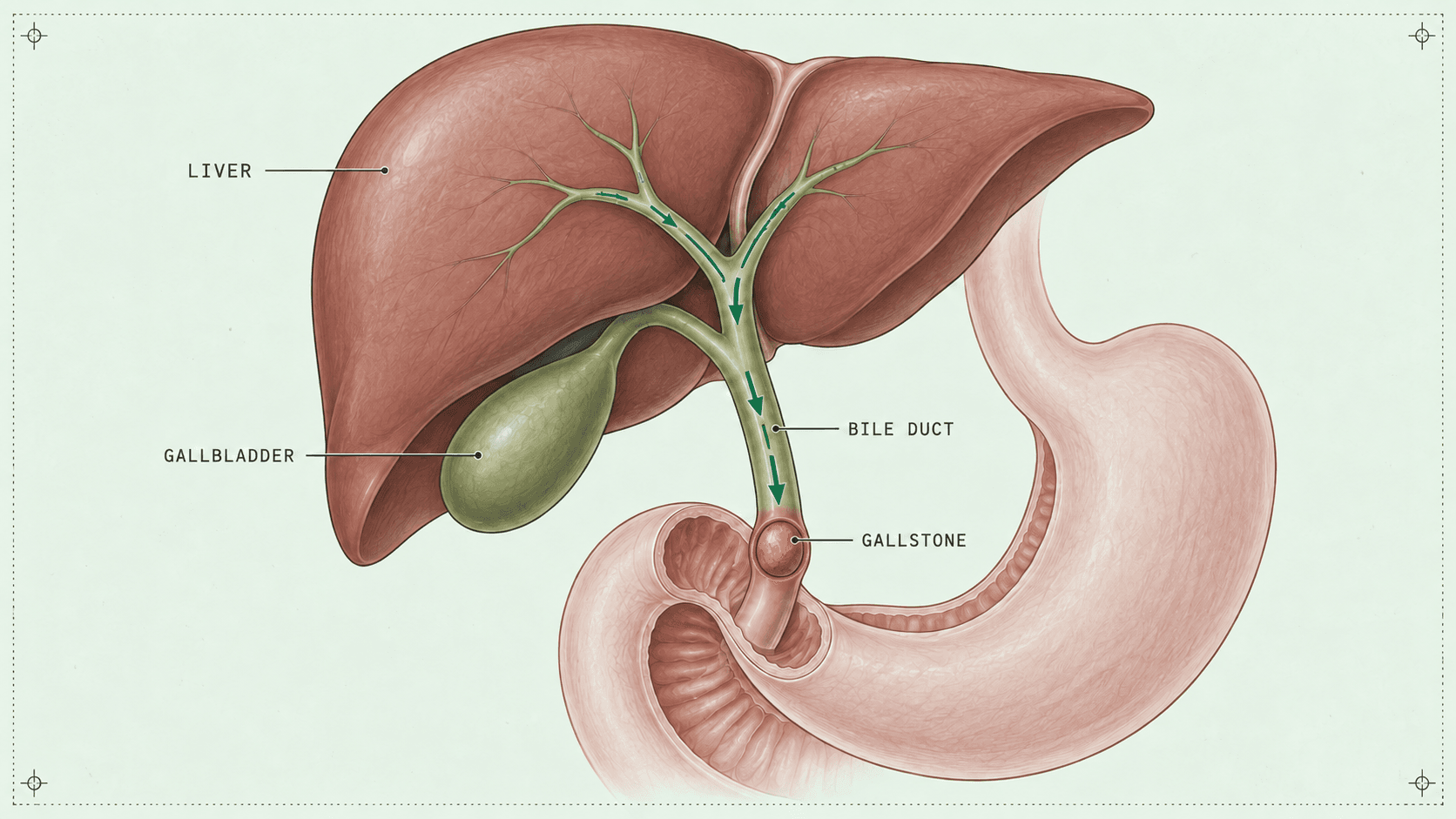
The second is the medication trial signal. The current Wegovy label says substantial or rapid weight loss can increase the risk of gallstones. It then adds that acute gallbladder disease was more common on Wegovy than on placebo "even after accounting for the degree of weight loss."3 That label language leaves room for factors beyond weight loss. The Zepbound label states that acute gallbladder events in its trials were associated with weight reduction.4
The 2022 JAMA Internal Medicine analysis found two more patterns across the overall trial pool. Risk was higher in the high-dose subgroup (RR 1.56) than in the low-dose subgroup (RR 0.99). It was also higher in trials longer than 26 weeks (RR 1.40) than in shorter trials.1 These group-level results do not establish when an individual person's risk begins.
02Relative risk sounds bigger than absolute risk
A doubled relative risk and a small absolute risk can both be true. The JAMA analysis pooled 103,371 participants and found an overall relative risk of 1.37 for gallbladder or biliary disease. In absolute terms, that worked out to about 27 extra events per 10,000 patient-years.1 Treating roughly 370 people for a year produces about one additional gallbladder event.
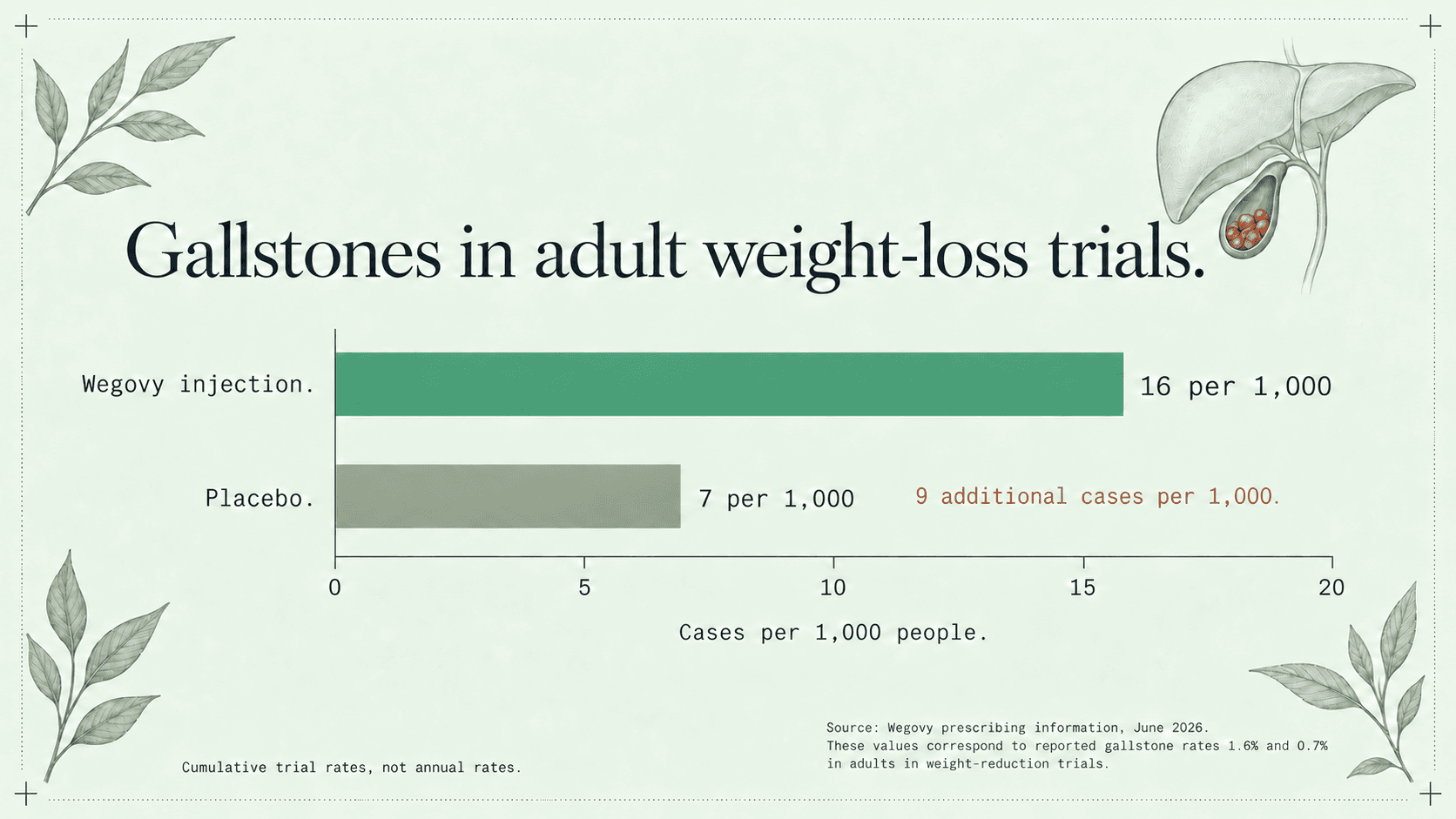
The product labels give the most concrete numbers for the specific drugs people take for weight loss. These are cumulative percentages from separate trial programs, not standardized annual rates.
| Product and trial pool | Outcome | Drug | Placebo | Extra cases per 1,000 |
|---|---|---|---|---|
| Wegovy injection, adult weight loss | Gallstones | 1.6% | 0.7% | About 9 |
| Wegovy injection, adult weight loss | Cholecystitis | 0.6% | 0.2% | About 4 |
| Wegovy tablet, adult weight loss | Gallstones | 2.5% | 1% | About 15 |
| Zepbound, adult weight loss | Gallstones | 1.1% | 1% | About 1 |
| Zepbound, adult weight loss | Cholecystitis | 0.7% | 0.2% | About 5 |
| Zepbound, adult weight loss | Gallbladder removal | 0.2% | 0% | About 2 |
Sources are the current Wegovy and Zepbound prescribing information.34 The Wegovy label also reports gallstones in 3.8 percent of adolescents on the injection versus none on placebo.3
Do not read across the rows to rank the drugs. These numbers come from different trials with different populations, durations, and definitions of a gallbladder event. A 1.1 percent gallstone rate on Zepbound and a 1.6 percent rate on Wegovy injection tell you nothing reliable about which drug is safer for you.
The 2026 BMJ network meta-analysis by Nong and colleagues added a larger comparative evidence set. It searched the literature through November 2025 and included 262 trials with 99,791 participants. Its gallbladder analysis covered 55 trials, 46,513 participants, and 899 events.2 The certainty of evidence was moderate for some treatments and lower for others. Network meta-analysis compares drugs indirectly through their shared placebo arms, and follow-up ranged from 12 to 172 weeks. It gives no head-to-head proof that one GLP-1 is safer for your gallbladder than another.
03Rapid loss and long fasts are the eating patterns to watch
The evidence on fast weight loss and fasting comes from general dieting research. No GLP-1 trial has tested it.
NIDDK's guidance on dieting and gallstones suggests a first goal of losing 5 to 10 percent of starting weight over six months.5 That guidance is general weight-management advice, last reviewed in 2017. It does not set an individual rate limit for GLP-1 treatment. Use a pace agreed with your prescriber, and do not add aggressive restriction on top of medication-driven loss. No trial has shown that a specific rate change prevents gallstones during GLP-1 treatment.
Three habits push the rate higher without anyone choosing to.
- Going most of the day without food because appetite is gone, day after day.
- Stacking a very-low-calorie diet or extended fasting protocol on top of the medication.
- Eating one small meal a day for weeks because it feels easier than eating at all.
NIDDK links long periods without eating to impaired gallbladder emptying, but its guidance does not test meal timing during GLP-1 treatment.5 Keep the practical recommendation narrow. Avoid adding extended fasting or a very-low-calorie diet without guidance from your prescriber. The available evidence does not define an ideal meal schedule or amount of dietary fat for preventing gallstones during GLP-1 use.
Keep your rate of loss inside the plan you agreed with your prescriber, and eat at regular intervals even when hunger is low. How Fast You Should Lose Fat covers weekly rate targets in more depth, and the GLP-1 dose titration guide explains how rate-of-loss trends fit into dose conversations.
04Avoid the prevention claims the evidence does not support
Zero-fat eating. No GLP-1 trial has tested a zero-fat diet as gallstone prevention. Do not treat it as a prevention protocol. If a clinician recommends lower-fat meals for symptom tolerance after a diagnosis, use that plan for comfort. It does not dissolve stones or replace clinical care. The Low-Fat Diet guide covers meal structure for that situation.
Routine ursodiol. NIDDK notes that ursodiol can help prevent gallstones in people losing weight rapidly on very-low-calorie diets or after weight-loss surgery.5 The Wegovy label does not mention it.3 Whether it helps people on GLP-1 medication has not been established. Only your prescriber should decide whether it fits your situation.
Routine ultrasound. The current Wegovy and Zepbound labels call for gallbladder studies when gallstones or cholecystitis are suspected. They do not specify a routine screening schedule for people without symptoms.34
Stopping or lowering your dose on your own. A dose change is a clinical decision. If you are worried about your gallbladder, bring that worry to the prescriber instead of skipping injections.
05Warning signs that need care
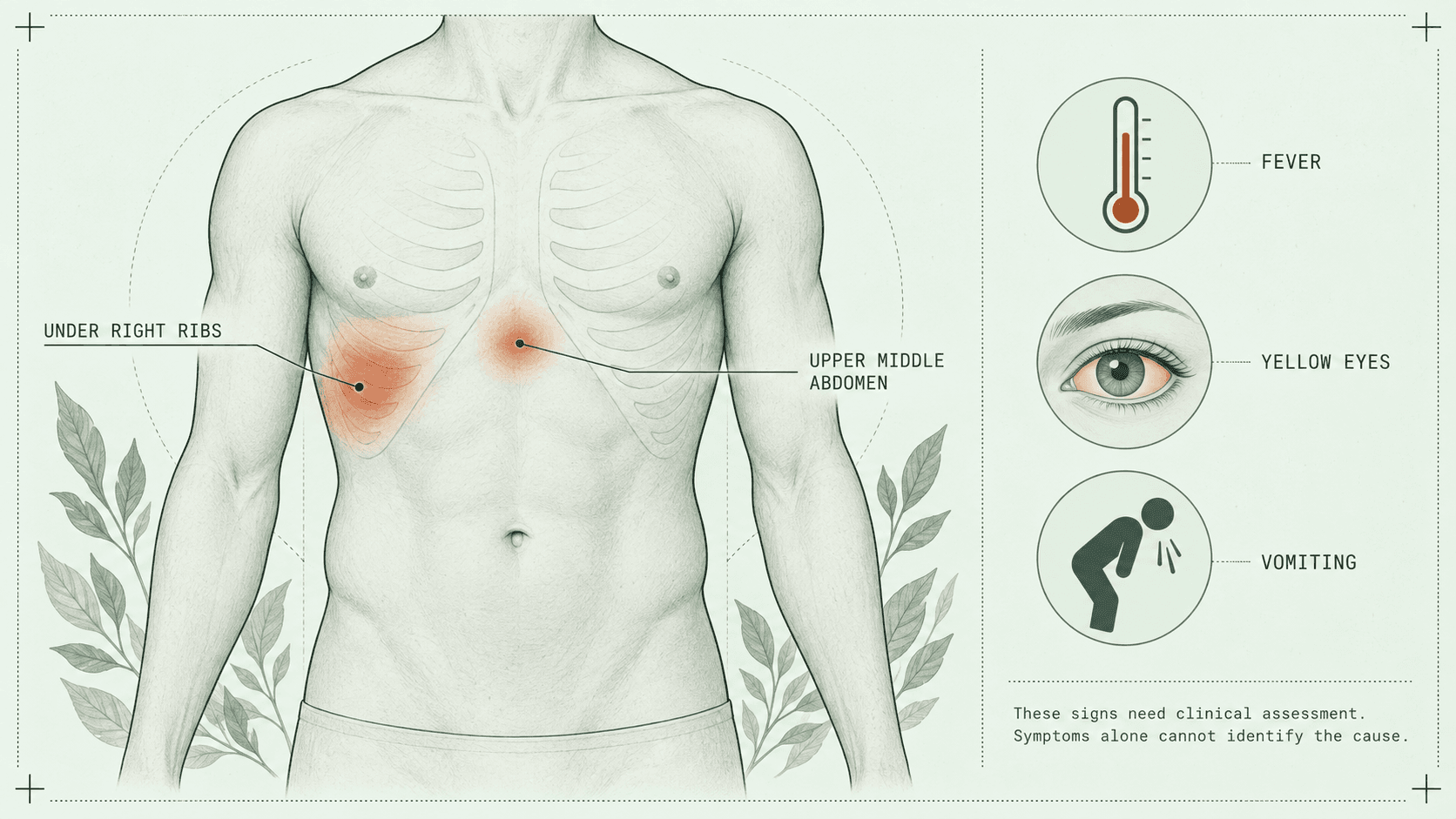
The hard part is that a gallbladder attack and ordinary GLP-1 side effects share symptoms. Both can cause nausea, vomiting, and abdominal discomfort. Symptoms alone cannot tell you the cause. Pancreatitis, which is also listed on these labels, can look similar too. The pattern of the pain is the most useful clue for deciding how fast to act.
NIDDK describes a gallbladder attack as pain in the upper right abdomen, sometimes lasting several hours, often after heavy meals and often in the evening or at night.6 The NHS describes pain that may be constant and severe, lasting longer than 30 minutes and up to several hours, in the middle of the abdomen or just under the right ribs.7
| What you notice | What to do |
|---|---|
| Mild nausea after an injection or dose increase without focal pain or other warning signs | Follow your prescriber's tolerability plan and mention it at your next appointment34 |
| Upper right or central abdominal pain lasting longer than 30 minutes | Contact your prescriber or an urgent care service the same day |
| Repeated episodes of that pain, especially after meals or at night | Contact your prescriber promptly, even if each episode resolves |
| Pain lasting several hours, with nausea or vomiting | Seek care right away |
| Fever, even low-grade, or chills with abdominal pain | Seek care right away |
| Yellow skin or eyes, tea-colored urine, or pale stools | Seek care right away |
| Sudden severe abdominal pain, or pain spreading to the back with vomiting | Call 911 in the US, or 999 in the UK, or go to an emergency room |
The pain-duration and urgent-care thresholds reflect NIDDK and NHS guidance.67 The first row describes common medication-label symptoms, not a gallbladder diagnosis.34 Use the table to judge urgency. Finding the cause takes a clinical exam and often imaging. The NHS thresholds reflect UK care routing, so use the equivalent service where you live.
06Two situations that get mistaken for something else
Injection-day pain that keeps coming back. Someone six months into semaglutide notices a dull ache under the right ribs after their weekly shot. Nausea on injection days has happened since the start, so they dismiss it. Then the ache repeats for two weeks and lasts two hours each time. A recurring, localized pain pattern is different from isolated injection-day nausea. It calls for a prescriber contact, not another week of ginger or small meals. The GLP-1 side effects guide describes routine dose-related symptoms.
The low-fat question. Someone with diagnosed gallstones asks whether lower-fat meals will help. A clinician may suggest a tolerance plan, but lower-fat eating does not dissolve stones or replace treatment. Monitoring, medication, or surgery are clinical decisions.
07Notes worth bringing to your clinician
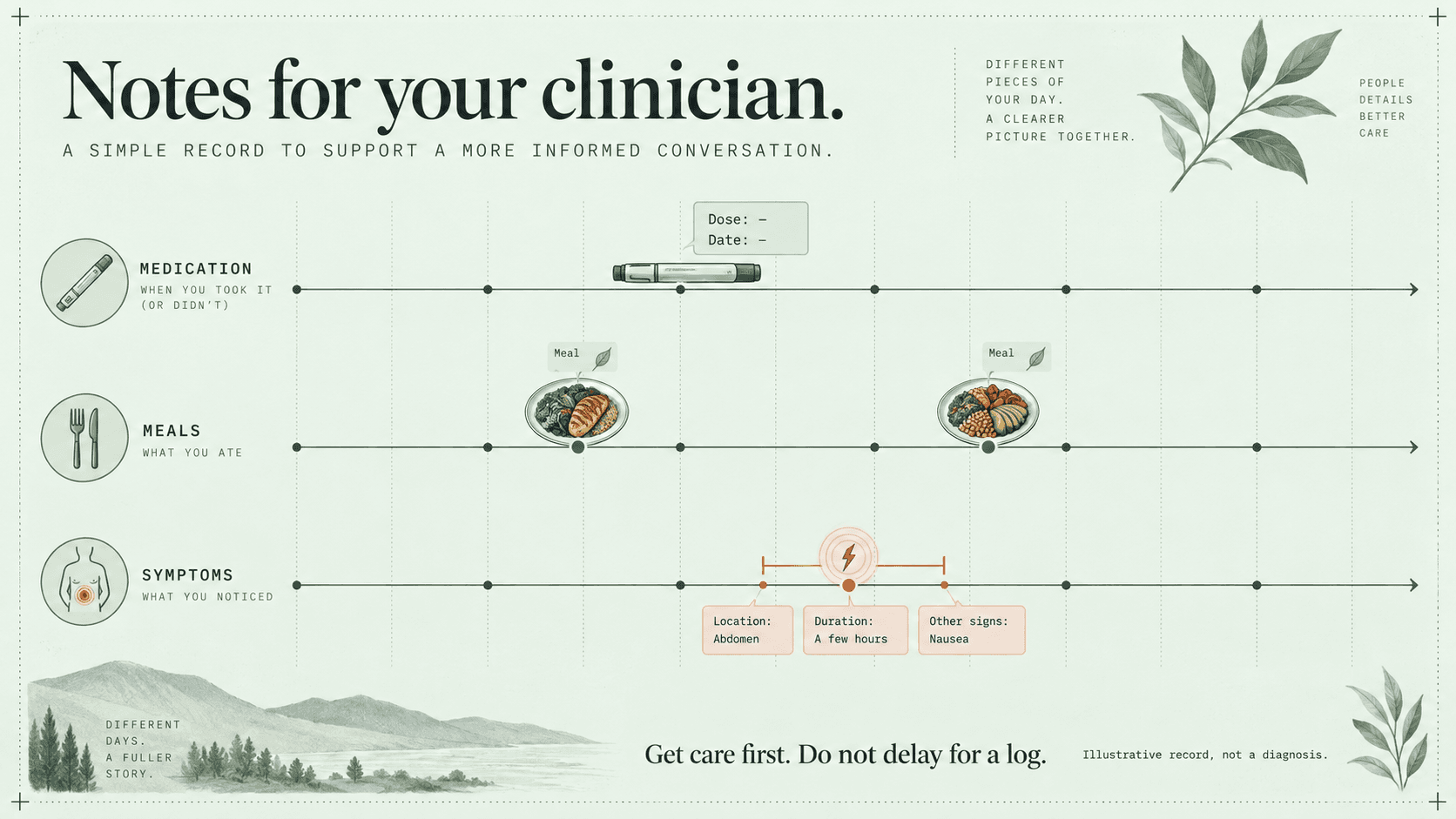
If you have symptoms, get care first. Do not delay for a log. These details can help your clinician assess the pattern.
| Detail | Why it helps |
|---|---|
| Medication, dose, and start date | Risk in the JAMA analysis rose with higher doses and longer treatment1 |
| Date of your last dose increase | Helps your clinician assess whether pain followed a dose change |
| Weight trend over recent months | Shows how fast you have been losing |
| When the pain started and how long it lasts | Pain lasting past 30 minutes calls for same-day care |
| Where the pain sits and whether it spreads | Pain under the right ribs and pain spreading to the back need different workups |
| What and when you ate before episodes | Shows whether attacks follow meals or come at night |
| Fever, skin color, urine, or stool changes | These signs raise urgency |
| Past gallstones or gallbladder surgery | Changes what your clinician will look for |
If you already log food and weight, you have most of this. Do not wait to collect a week of data before calling about pain that matches the warning signs.
08Keep the medication decision with your prescriber
Take recurring pain, dose changes, weight trend, and symptom timing to the clinician managing your medication. They can decide whether to continue, pause, or change treatment. The GLP-1 Diet guide covers meal structure and nutrition at each dose. If you and your prescriber decide to stop, The Nutrition and Muscle Plan for Stopping a GLP-1 covers how to approach the next phase.
Footnotes
He L, Wang J, Ping F, et al. Association of glucagon-like peptide-1 receptor agonist use with risk of gallbladder and biliary diseases: a systematic review and meta-analysis of randomized clinical trials. JAMA Intern Med. 2022, 182(5), 513-519. JAMA Network. PubMed
Back to textBack to text 2Back to text 3Back to text 4Back to text 5Nong et al. Comparative effects of drugs for adults with overweight or obesity: systematic review and network meta-analysis. BMJ. 2026, 394:e372161. BMJ. PubMed
Back to textWEGOVY (semaglutide) injection and tablets prescribing information, section 5, Acute Gallbladder Disease. Revised June 2026. DailyMed
Back to textBack to text 2Back to text 3Back to text 4Back to text 5Back to text 6Back to text 7Back to text 8Back to text 9ZEPBOUND (tirzepatide) prescribing information, section 5.4, Acute Gallbladder Disease. Revised August 2026. DailyMed
Back to textBack to text 2Back to text 3Back to text 4Back to text 5Back to text 6Back to text 7National Institute of Diabetes and Digestive and Kidney Diseases. Dieting and Gallstones. NIDDK
Back to textBack to text 2Back to text 3Back to text 4Back to text 5Back to text 6Back to text 7National Institute of Diabetes and Digestive and Kidney Diseases. Symptoms and Causes of Gallstones. NIDDK
Back to textBack to text 2Back to text 3NHS. Gallstones. NHS
Back to textBack to text 2Back to text 3