A 2025 meta-analysis of 488 people found ashwagandha lowered cortisol by 1.16 µg/dL and did not significantly change Perceived Stress Scale scores.1 You can lower morning cortisol and still have the same week.
01Cortisol falls more than felt stress
Albalawi's 2025 systematic review searched from 2012 through February 2024 and kept randomized trials of at least 2 weeks at oral doses of 250 mg per day or more. Seven trials reported cortisol. Six reported Perceived Stress Scale scores. Across 488 people, cortisol fell by a mean of 1.16 µg/dL (95% CI −1.64 to −0.69, P<0.001). The Perceived Stress Scale pooled effect was SMD −0.355 (95% CI −1.188 to 0.47, P=0.40). The abstract reports I² = 50.9% without separate values for cortisol and perceived stress. That single figure cannot establish how consistently each outcome responded across trials. Between-study variation limits how confidently a pooled average predicts an individual response, and the wide perceived-stress confidence interval leaves that benefit uncertain.1
A 1.16 µg/dL drop is a change in a single biomarker. The Perceived Stress Scale is closer to the week you actually live. That outcome did not clear statistical significance when the 2012 result was pooled with later trials.1
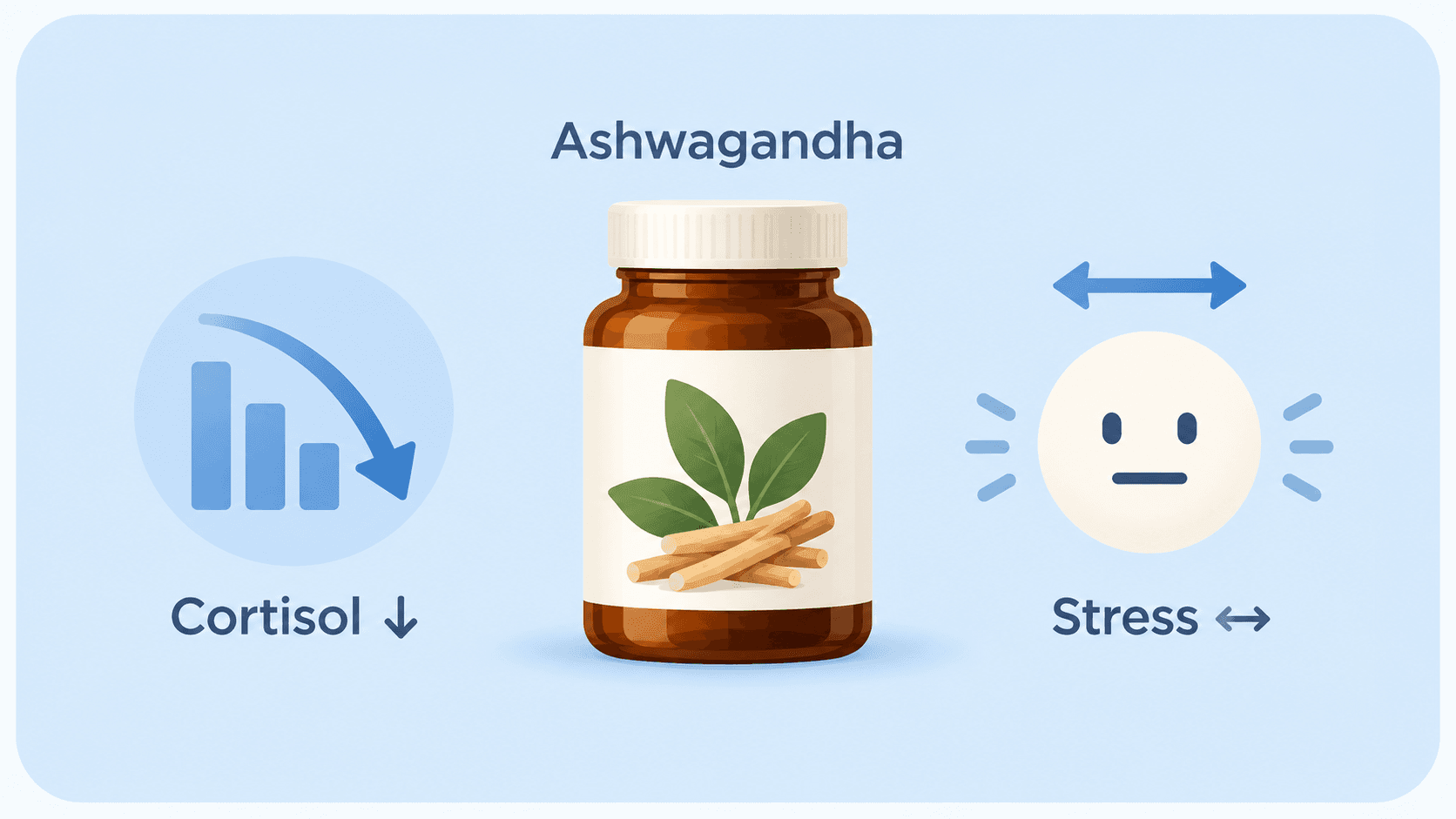
The confidence interval on the stress-scale result runs from a large benefit to harm approaching moderate size. A nonsignificant pool with that width does not establish that the 2012 drop failed to replicate. It remains compatible with benefit, no effect, or harm.1
Chandrasekhar 2012 is the trial the cortisol ads cite. Sixty-four adults with chronic stress took KSM-66 300 mg twice daily or placebo for 60 days. Serum cortisol fell 27.9% on the extract versus 7.9% on placebo. Perceived Stress Scale scores fell 44% versus 5.5%. Ixoreal Biomed supplied the extract.2 Those percentages are large, and they belong to that sample and that product.
Smith, Lopresti, and Fairchild tested the same question in 2023 with Witholytin 200 mg twice daily for 12 weeks in 120 overweight adults aged 40 to 75. Perceived Stress Scale scores fell in both arms. The between-group p-value was 0.867. Fatigue improved versus placebo as a secondary outcome.3 If your primary question is whether the week feels lighter, start with Smith.3
| Study | Extract | Cortisol | Perceived Stress Scale |
|---|---|---|---|
| Albalawi 2025 pool, 488 people | Mixed extracts, ≥250 mg/day | MD −1.16 µg/dL | SMD −0.355, not significant 1 |
| Chandrasekhar 2012, n=64 | KSM-66 300 mg twice daily, 60 days | −27.9% vs −7.9% placebo | −44% vs −5.5% placebo 2 |
| Smith 2023 | Witholytin 200 mg twice daily, 12 weeks | not reported | no difference vs placebo, p=0.867 3 |
Industry involvement recurs in the cited trials. Ixoreal supplied KSM-66 in the cited trials, and Arjuna supplied Shoden in the cited trials. Treat a sponsored trial as one data point.257910
02Sleep gains are real and small
Cheah and colleagues pooled 5 randomized trials in 400 adults in 2021. Ashwagandha extract improved overall sleep versus placebo at SMD −0.59 (95% CI −0.75 to −0.42, I²=62%). The paper calls that a small effect. The signal was stronger in people with insomnia, at 600 mg per day or more, and at 8 weeks or longer.4
Deshpande 2020 is the 120 mg Shoden trial in 150 adults with nonrestorative sleep, 144 of whom completed 6 weeks. Self-reported sleep quality rose 72% on Shoden versus 29% on placebo. Actigraphy improved sleep efficiency, total sleep time, sleep onset latency, and wake after sleep onset versus placebo.5 The actigraphy measures provide a complementary objective check alongside self-report.5 Arjuna supplied the extract.5
Langade 2019 is a separate insomnia study. Sixty adults with insomnia took KSM-66 300 mg twice daily or placebo for 10 weeks, with actigraphy. Sleep onset latency at week 10 was 29.00 minutes on ashwagandha versus 33.94 minutes on placebo, both down from baselines above 40 minutes.6 A roughly 5-minute gap favoring ashwagandha in 60 people is the observed difference, not a reliable expected effect for all users.6
The sleep studies summarized here enrolled adults with nonrestorative sleep or insomnia and anxiety. They do not establish benefit for every mild stress-linked sleep problem.456 Start with sleep hygiene before treating a supplement trial as a useful test. Do the sleep work in Sleep and Fat Loss first. If the gap is intake, Magnesium for Sleep, Cramps, and Recovery has a clearer repletion story.
03Testosterone claims belong to specific groups
Wankhede 2015 randomized 57 men with little resistance-training experience to KSM-66 300 mg twice daily or placebo for 8 weeks while they started lifting. Fifty completed. Serum testosterone rose from 630.45 to 726.64 ng/dL in the ashwagandha group, a +96.19 ng/dL change, versus +18.00 ng/dL on placebo. Both means stayed inside a normal male range.7
Bench-press 1RM rose 46.0 kg versus 26.4 kg. Ashwagandha-group baseline bench was about 33 kg, while placebo baseline was 31.35 kg. Novices on a first program gain. Ixoreal supplied the extract. A 96 ng/dL change in this novice sample does not establish a treatment for hypogonadism.7
Ambiye 2013 studied oligospermic men on 675 mg per day of a full-spectrum root extract for 90 days. Serum testosterone rose 17% from 4.45 to 5.22 ng/mL.8 That finding lives in infertility, not in a well-fed athlete chasing a number.
Lopresti, Drummond, and Smith ran a 16-week crossover in overweight men aged 40 to 70 with mild fatigue, using Shoden beads that delivered 21 mg of withanolide glycosides a day. Salivary testosterone rose 14.7% more than placebo. Salivary DHEA-S rose 18% more. Fatigue, vigor, and sexual well-being did not differ statistically from placebo.9 A hormone moved. The symptoms that would make you care did not.
Those numbers are not TRT or evidence that ashwagandha treats hypogonadism. If testosterone is the reason you want the bottle, the evidence is population- and preparation-specific, and these studies did not test hypogonadism.789 The cited ashwagandha trials do not establish a general benefit for men with normal testosterone.789
04Strength evidence is thin and industry-heavy
Wankhede is still the paper people mean when they say ashwagandha builds strength. Untrained men, one 8-week novice block, manufacturer-supplied KSM-66, and a bench jump that looks dramatic until you see the 33 kg start. The cited strength trial involved untrained men, so this article does not establish benefit in trained athletes.7
The Andrew Huberman Supplement List (2026) parks ashwagandha in the lower-confidence add-on group with rhodiola and the NAD precursors. That ranking matches the evidence. Strength work, protein, sleep, and energy availability move output. This extract does not earn a place ahead of those.
05Thyroid markers can shift
Sharma, Basu, and Singh randomized 50 adults with subclinical hypothyroidism (TSH 4.5 to 10 mIU/L) to KSM-66 300 mg twice daily or placebo for 8 weeks. In the ashwagandha group, TSH fell 17.4%, T3 rose 41.5%, and T4 rose 19.6%. Ixoreal supplied the extract.10
Treat Sharma as evidence that thyroid markers can shift in this specific sample.10 NCCIH advises people with thyroid disorders and those taking thyroid hormone medications to avoid ashwagandha.16 If you have thyroid disease or take thyroid medication, avoid it and ask a clinician about alternatives.16
06Liver injury is rare and documented
LiverTox gives ashwagandha a likelihood score of B, a likely cause of clinically apparent liver injury.11 Björnsson and colleagues reported 5 cases from Iceland and the US Drug-Induced Liver Injury Network. Latency was 2 to 12 weeks. The pattern was cholestatic or mixed. Everyone developed jaundice. Itch and high bilirubin lasted weeks. Liver tests normalized within 1 to 5 months in the 4 patients with follow-up. No one progressed to liver failure in that series.12
Philips 2023 reported 8 single-ingredient cases from India. Five people already had chronic liver disease. Three presented with acute-on-chronic liver failure, and all 3 died.13 Those deaths were in people with underlying chronic liver disease. There is no incidence rate to quote. Avoid ashwagandha if you have cirrhosis or advanced chronic liver disease. If you have any liver condition, consult a clinician before use.1113 Stop and seek medical care if you develop jaundice, itching, abdominal discomfort, or unusual fatigue.111213
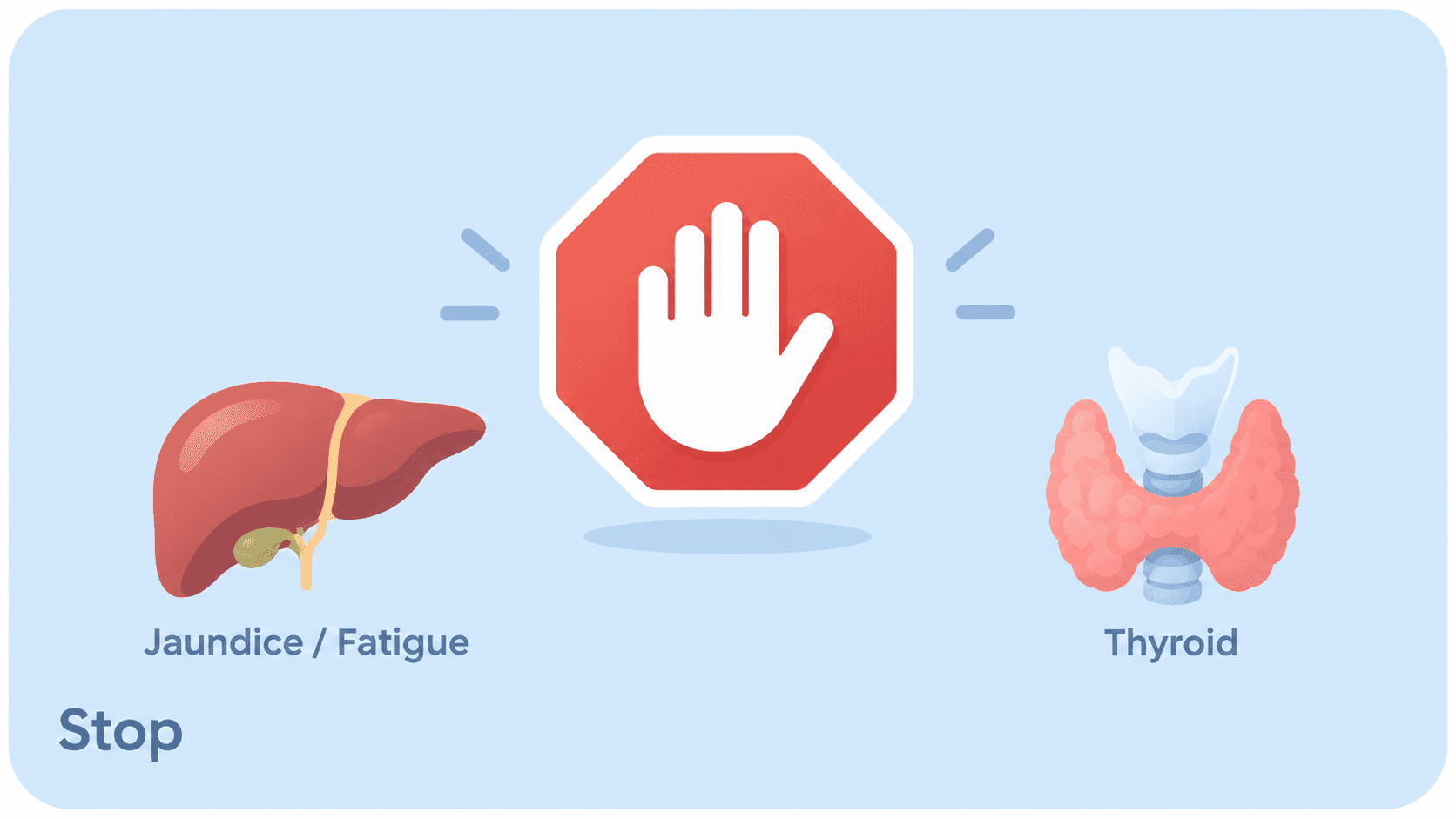
NCCIH also advises against ashwagandha in pregnancy and while breastfeeding, before surgery, and in autoimmune disease. Interactions are listed with diabetes medications, blood-pressure medications, immunosuppressants, sedatives, anticonvulsants, and thyroid hormone.16 Check the full stack before you add another bottle.16
07Named extracts and trial doses
Supplements only match the trials if the bottle matches the extract. Root-only KSM-66 and root-and-leaf Shoden are the named extracts used in the cited trials.2579 The NIH Office of Dietary Supplements notes that root and leaf chemistry differ.15 If you want the Chandrasekhar or Wankhede protocol, match the root-only KSM-66 extract used in those studies rather than a product with an unspecified leaf blend.27
In ConsumerLab's selected 2024 sample, 8 of 13 products contained 7.8% to 83% of the withanolides their labels implied. Three of those eight failures used the same branded extract.14 A brand name on the label did not guarantee the withanolide dose in that sample.14
| Extract | What it is | Trial dose range | Who funded or supplied it |
|---|---|---|---|
| KSM-66 | Root extract used in cited trials | 300 mg twice daily (600 mg/day) | Ixoreal Biomed 27 |
| Shoden | Root-and-leaf extract used in cited trials | Deshpande used 120 mg/day. Lopresti 2019 used 600 mg/day of beads delivering 21 mg/day of withanolide glycosides | Arjuna Natural 59 |
| Unlabeled generic | Root powder, leaf blends, or unverified withanolide claims | No cited trial dose | Evidence for the exact product is unavailable from the cited trials 1415 |
The cited trials use fixed durations and do not establish an 8-weeks-on, 2-weeks-off cycle.45678910 The sleep trials summarized here last 6 to 12 weeks. The other cited trials extend to 16 weeks and 90 days. The NIH Office of Dietary Supplements and NCCIH describe short-term use as up to about 3 months. Long-term safety is unknown.1516
If a 6 to 8 week trial helps, that does not establish safety for year-long use. Pick an end date before you open the bottle because longer-term safety is unknown.1516
08Run a 6 to 8 week trial or skip it
- Skip the bottle or consult a clinician first if you are pregnant or breastfeeding, have thyroid disease or take thyroid medication, have cirrhosis or advanced chronic liver disease, have an autoimmune condition, have surgery coming, or take interacting drugs.111316 If testosterone is the goal, the cited evidence is population-specific and does not test hypogonadism.789
- Keep the target narrow. The cited sleep studies enrolled adults with nonrestorative sleep or insomnia and anxiety. They do not establish general benefits for mild stress-linked sleep, fat loss, or hormone optimization.1456789 Start with sleep hygiene before treating a supplement trial as a useful test.
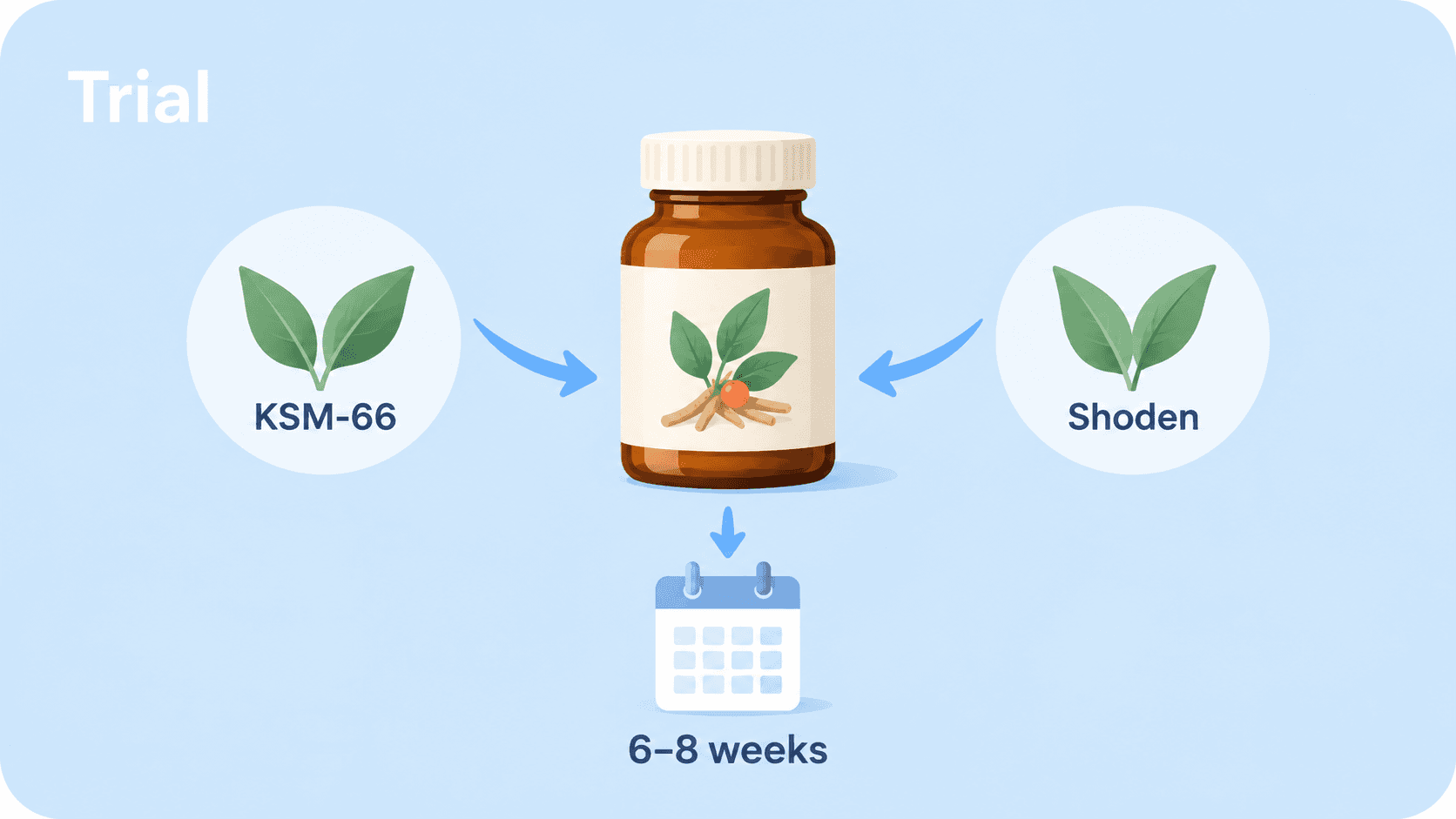
- Match a named extract. KSM-66 300 mg twice daily, Deshpande's Shoden 120 mg/day extract, or Lopresti's 600 mg/day of Shoden beads delivering 21 mg/day of withanolide glycosides.2579 If the label cannot name the extract, you cannot verify that the product matches these trials.1415
- Run 6 to 8 weeks and stop on a calendar. The cited trials do not establish an 8-weeks-on, 2-weeks-off cycle.45678910
- Stop immediately for jaundice, itching, abdominal discomfort, or unusual fatigue.111213
- Stop if the week did not change. If sleep and perceived stress stayed the same, the lower cortisol number is not a reason to keep taking it.1456
Footnotes
Albalawi AA. Dual impact of Ashwagandha. Significant cortisol reduction but no effects on perceived stress. A systematic review and meta-analysis. Nutrition and Health. 2025. PubMed
Back to textBack to text 2Back to text 3Back to text 4Back to text 5Back to text 6Back to text 7Back to text 8Chandrasekhar K, Kapoor J, Anishetty S. A prospective, randomized double-blind, placebo-controlled study of safety and efficacy of a high-concentration full-spectrum extract of ashwagandha root in reducing stress and anxiety in adults. Indian J Psychol Med. 2012. PubMed PMC
Back to textBack to text 2Back to text 3Back to text 4Back to text 5Back to text 6Back to text 7Back to text 8Smith SJ, Lopresti AL, Fairchild TJ. Exploring the efficacy and safety of a novel standardized ashwagandha (Withania somnifera) root extract (Witholytin) in adults experiencing high stress and fatigue in a randomized, double-blind, placebo-controlled trial. J Psychopharmacol. 2023. PubMed
Back to textBack to text 2Back to text 3Back to text 4Cheah KL, Norhayati MN, Husniati Yaacob L, Abdul Rahman R. Effect of Ashwagandha (Withania somnifera) extract on sleep: A systematic review and meta-analysis. PLoS One. 2021. PubMed
Back to textBack to text 2Back to text 3Back to text 4Back to text 5Back to text 6Back to text 7Back to text 8Deshpande A, Irani N, Balkrishnan R, Benny IR. A randomized, double blind, placebo controlled study to evaluate the effects of ashwagandha (Withania somnifera) extract on sleep quality in healthy adults. Sleep Med. 2020. PubMed
Back to textBack to text 2Back to text 3Back to text 4Back to text 5Back to text 6Back to text 7Back to text 8Back to text 9Back to text 10Back to text 11Back to text 12Back to text 13Back to text 14Langade D, Kanchi S, Salve J, Debnath K, Ambegaokar D. Efficacy and Safety of Ashwagandha (Withania somnifera) Root Extract in Insomnia and Anxiety: A Double-blind, Randomized, Placebo-controlled Study. Cureus. 2019. PubMed PMC
Back to textBack to text 2Back to text 3Back to text 4Back to text 5Back to text 6Back to text 7Back to text 8Back to text 9Wankhede S, Langade D, Joshi K, Sinha SR, Bhattacharyya S. Examining the effect of Withania somnifera supplementation on muscle strength and recovery: a randomized controlled trial. J Int Soc Sports Nutr. 2015. PubMed PMC
Back to textBack to text 2Back to text 3Back to text 4Back to text 5Back to text 6Back to text 7Back to text 8Back to text 9Back to text 10Back to text 11Back to text 12Back to text 13Back to text 14Back to text 15Back to text 16Ambiye VR, Langade D, Dongre S, Aptikar P, Kulkarni M, Dongre A. Clinical Evaluation of the Spermatogenic Activity of the Root Extract of Ashwagandha (Withania somnifera) in Oligospermic Males: A Pilot Study. Evid Based Complement Alternat Med. 2013. PubMed PMC
Back to textBack to text 2Back to text 3Back to text 4Back to text 5Back to text 6Back to text 7Back to text 8Back to text 9Lopresti AL, Drummond PD, Smith SJ. A Randomized, Double-Blind, Placebo-Controlled, Crossover Study Examining the Hormonal and Vitality Effects of Ashwagandha (Withania somnifera) in Aging, Overweight Males. Am J Mens Health. 2019. PubMed PMC
Back to textBack to text 2Back to text 3Back to text 4Back to text 5Back to text 6Back to text 7Back to text 8Back to text 9Back to text 10Back to text 11Back to text 12Back to text 13Sharma AK, Basu I, Singh S. Efficacy and Safety of Ashwagandha Root Extract in Subclinical Hypothyroid Patients: A Double-Blind, Randomized Placebo-Controlled Trial. J Altern Complement Med. 2018. PubMed
Back to textBack to text 2Back to text 3Back to text 4Back to text 5Back to text 6Back to text 7LiverTox. Ashwagandha. In: LiverTox: Clinical and Research Information on Drug-Induced Liver Injury. Bethesda (MD): National Institute of Diabetes and Digestive and Kidney Diseases. NBK548536
Back to textBack to text 2Back to text 3Back to text 4Back to text 5Back to text 6Björnsson HK, Björnsson ES, Avula B, et al. Ashwagandha-induced liver injury: A case series from Iceland and the US Drug-Induced Liver Injury Network. Liver Int. 2020. PubMed
Back to textBack to text 2Back to text 3Philips CA, Valsan A, Theruvath AH, et al. Ashwagandha-induced liver injury. A case series from India and literature review. Hepatol Commun. 2023. PubMed
Back to textBack to text 2Back to text 3Back to text 4Back to text 5Back to text 6ConsumerLab. Little Ashwagandha in Most Ashwagandha Supplements. May 23, 2024. ConsumerLab
Back to textBack to text 2Back to text 3Back to text 4Back to text 5National Institutes of Health Office of Dietary Supplements. Ashwagandha: Is it helpful for stress, anxiety, or sleep? Fact sheet for health professionals. NIH ODS
Back to textBack to text 2Back to text 3Back to text 4Back to text 5Back to text 6National Center for Complementary and Integrative Health. Ashwagandha: Usefulness and Safety. NCCIH
Back to textBack to text 2Back to text 3Back to text 4Back to text 5Back to text 6Back to text 7Back to text 8