Micronutrient targets protect the part of the plan calories cannot see: whether the logged day has enough fiber, minerals, vitamins, and long-chain omega-3 to support repeated training, hunger control, and recovery.
01The difference between macros and micronutrients
Macros and calories are the execution layer. They determine whether energy balance matches the goal.
Micronutrients, water, and caffeine are the quality layer. They influence hunger, performance, and how sustainable the plan feels, even when the calorie target is technically met.
02Where the targets come from
Fuel sets most micronutrient targets by age and sex from the Dietary Reference Intakes issued by the National Academies Food and Nutrition Board. That is why targets can change across life stage instead of acting like one universal checklist.
Different rows have different authority labels. RDA means the target is designed to cover nearly all healthy people in that group. AI is used when there is not enough evidence to set an RDA. CDRR is a risk-reduction intake, used for sodium. Pattern-level limits draw from the Dietary Guidelines for Americans, caffeine uses FDA adult guidance, and EPA + DHA uses a combined long-chain omega-3 reference target.
| Label | How Fuel uses it |
|---|---|
| RDA | Daily target for nutrients with a recommended allowance |
| AI | Daily target where an adequate intake is the best standard |
| CDRR | Risk-reduction limit, such as sodium |
| FDA | Adult caffeine guidance |
| AHA | Added-sugar guidance |
| EFSA/AHA | EPA + DHA long-chain omega-3 reference target |
03Omega-3 EPA and DHA
EPA + DHA is not the same as generic omega-3. Fuel tracks the combined EPA + DHA row separately from plant omega-3 sources because the app is measuring long-chain omega-3 intake, not estimating conversion from ALA.
Fuel credits EPA and DHA from direct sources such as salmon, sardines, tuna, shellfish, fish oil, algal oil, or foods explicitly fortified with EPA and DHA. Flax, chia, walnuts, and plant oils can still be useful foods, but Fuel does not convert their ALA into EPA + DHA for the target.
04Micronutrient rows wait for trustworthy data
Micronutrient data has to be trustworthy before Fuel treats it as a real signal. If a log only contains calories and macros, or an imported record does not include usable micronutrients, Fuel can mark the micronutrient payload as not authoritative yet.
That behavior keeps Today, widgets, watch surfaces, Health Grade, reports, shortcuts, and coaching from overstating partial data. When micronutrient availability is missing, Health Grade neutralizes micronutrient coverage and limit pressure instead of punishing the day for data Fuel cannot see.
05Switch amounts and percentages
Open the Micronutrients detail from Today. Tap the Watch limits, Omegas, or All nutrients section to switch its main rows between amounts against targets and percentages. Separate EPA and DHA rows keep their amounts.
Fuel also tracks Choline as a nutrient-coverage row, with an age- and sex-based Adequate Intake target. Its presence in the list does not guarantee every food log contains choline data; missing detail stays unknown.
06Review 30-day Nutrient Insights
Today's detail answers what is covered so far. Nutrient Insights reviews the previous 30 completed days to identify repeated food-coverage gaps.
From today's Micronutrients detail, tap 30-day nutrient insights, or open Nutrient Insights on You. This Pro feature needs at least 10 logged food days and enough nutrient detail to assess a pattern. It separates Below target, On target from food, and No data, with food options for supported gaps.
The 30-day rows already show percentages. Tapping one expands its average, on-target days, and daily coverage rather than switching amount formats.
07Treat micronutrients as a weekly pattern
Micronutrients are not a daily perfection game. Treat them as a weekly signal.
If you miss a target today, the relevant question is whether the pattern is repeated across the week. That is the point where the plan needs a structural change such as a different breakfast template, more fruit and vegetables, or a different set of repeat meals.
08Logging requirements
Micronutrient targets only work when food logs contain enough detail. AI logging and recipes are the fastest way to build a structured record without manual database work.
Use Food Logging and AI Food Logging to make the record dense enough that micronutrient totals reflect what you ate, not what the database guessed.
09Power food suggestions
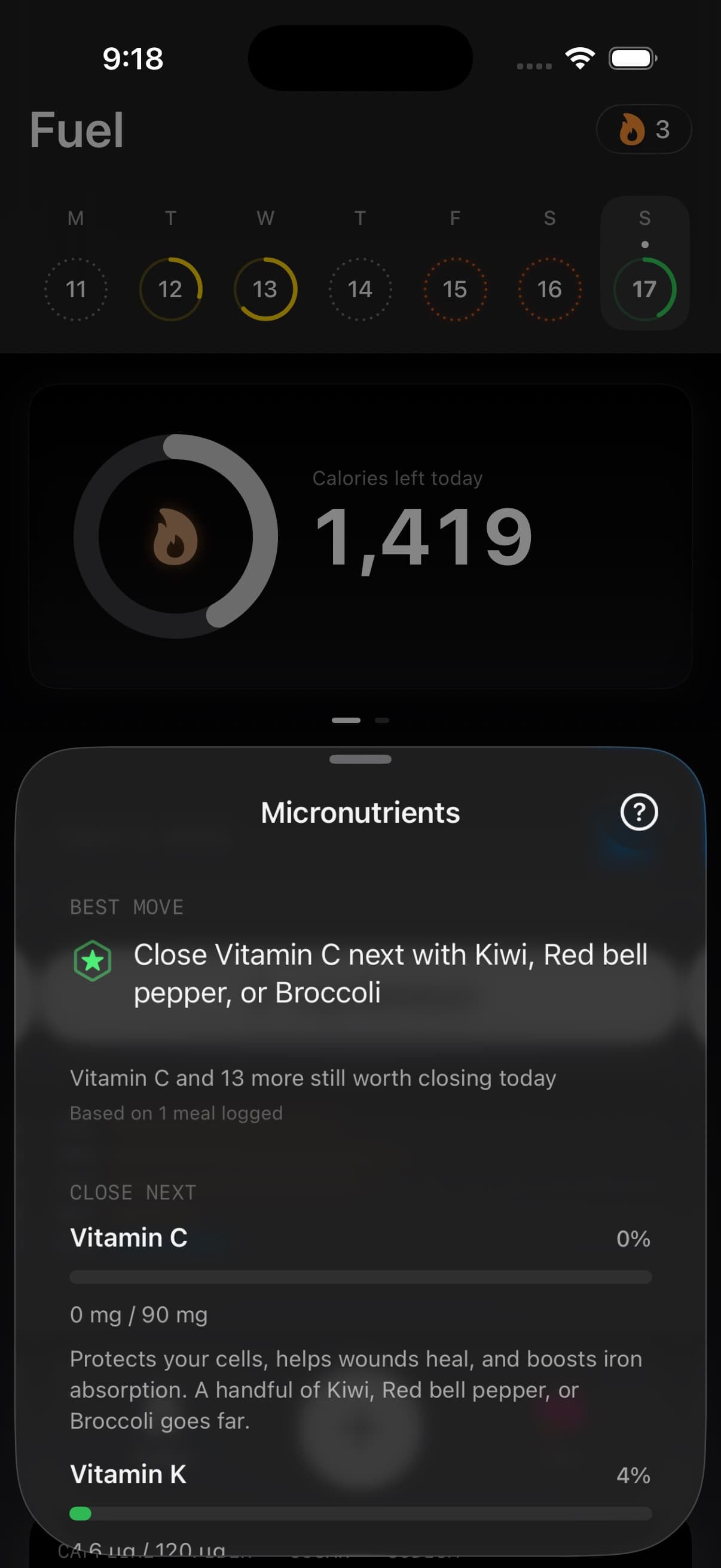
The micronutrient detail view turns open gaps into food guidance. On the current day, Best move highlights the top actionable gap and shows concrete foods that can move it. Historical days keep the gap list and food suggestions so you can see what would have helped without treating yesterday like an open task.
These are deterministic whole-food suggestions, not a supplement engine. The catalog favors familiar foods that are easy to log: beans and lentils for fiber and minerals, leafy greens for vitamin K and folate, yogurt and milk for calcium, potatoes and bananas for potassium, peppers and citrus for vitamin C, and fatty fish or algae-based sources for EPA + DHA.
Use power foods as repeatable meal edits. A recurring magnesium gap probably needs a better default snack or side dish. A recurring EPA + DHA gap probably needs a fish, seafood, or algal-oil pattern, not a random one-day correction.
10Use micronutrient gaps to change default meals
Use micronutrient widgets as prompts, not as judgments. A widget that stays low should trigger a plan change you can repeat, not a single day patch with random supplements or last minute food choices.