The nutrition app market in 2026 is large, fragmented, and poorly differentiated. Dozens of products compete for the same user, and most of them do the same thing: record what you ate, compare it to a number, and leave you to figure out the rest. Understanding where each product actually sits requires looking past marketing labels and evaluating what each tool does after the food is logged.
01Nutrition tracker market segments
| Segment | Primary focus | Representative products |
|---|---|---|
| Log-first trackers | Database depth and manual accuracy | MyFitnessPal, Cronometer, MacroFactor |
| Photo-first AI loggers | Speed of capture through image recognition | Cal AI, SnapCalorie, Foodvisor |
| Coaching-integrated platforms | Behavior change curriculum and human or AI coaching | Noom, Welling, Fitia |
| Performance-specific platforms | Training-calendar integration and adaptive targets | Fuelin, MAVR |
Each segment solves a real problem. The question is whether the problem it solves is the one that matters most for your goals.
02Log-First Trackers
| Product | Strength | Key limitation | Notable data point |
|---|---|---|---|
| MyFitnessPal | Largest food database, highest name recognition | User-generated entries are inconsistent. Search for "chicken tikka masala" and find 30 to 50 entries ranging from 250 to 700 cal/serving. No curation layer flags obviously incorrect entries. | Barcode scanning paywalled at $19.99/mo. Fitbit integration double-counts workout calories by adding logged sessions on top of step-based calorie adjustments from the same activity window. |
| Cronometer | Lab-verified database covering 84+ nutrients. Strongest micronutrient tracking in the category. | Late to AI capture (photo logging added September 2025). Historically serves a more technical user base. | Best option for users tracking specific micronutrients due to medical conditions or performance goals. |
| MacroFactor | Most analytically sophisticated tracker. Adaptive expenditure algorithm infers actual energy balance from logged intake and observed weight change rather than relying on static formulas. | Steep learning curve. Demands significant user investment. Does not bridge the gap for users who need the system to tell them what to do next. | EU barcode coverage is incomplete. European users often resort to manual entry for packaged foods that scan instantly in competing apps. |
03Photo-First AI Loggers
| Product | Capture method | Accuracy | Key limitation |
|---|---|---|---|
| SnapCalorie | Single-image estimation | 16% mean error rate, validated through CVPR-published study on 5,000-dish weighed dataset | No coaching layer, no weekly synthesis, no adaptive targets. Speed without interpretation. |
| Cal AI | Photo and barcode | 20% calorie underestimation in independent testing. User reviews report dish misidentification, macro splits that do not match actual food composition, and basic arithmetic errors where gram values double or macro totals do not add up. | Barcode scans return values that diverge from package labels on fiber and sugar. Corrections do not persist between scans. The same wrong value appears every time you scan the same product. |
| Foodvisor | Photo estimation | Comparable segment accuracy | Limited coaching features. No adaptive target system. |
The structural issue with photo-first logging is that a per-meal calorie estimate, even when accurate, is a data point without context. It does not know whether you trained today, whether your weekly average is trending in the right direction, or whether your protein distribution across meals is supporting recovery.
04Coaching-Integrated Platforms
| Product | Approach | Price | Key limitation |
|---|---|---|---|
| Noom | Cognitive behavioral curriculum with access to human coaches. Clinical literature behind the behavioral approach is more developed than most competitors. | Approximately $70/mo | App frequently fails to load. Most common fix is uninstall and reinstall, which resets all preferences. No barcode scanning, no photo logging, no voice input. Cannot copy meals from previous days. Manual food additions do not register correctly, leading to inaccurate calorie totals. Customer service described as unreachable across user reviews. |
| Welling / Fitia | Conversational AI nutrition coaching with adaptive calorie guidance through chat interface | Mid-range pricing | Absence of training-context awareness and macro-level target precision. Coaching intelligence layer remains shallow for performance-oriented users. |
05Tracker feature comparison matrix
| Feature | MyFitnessPal | Cronometer | MacroFactor | Cal AI | Noom |
|---|---|---|---|---|---|
| Database quality | User-generated, inconsistent | Lab-verified, 84+ nutrients | Curated, North America focused | AI-estimated | Manual search only |
| Barcode scanning | Paywall ($19.99/mo) | Included | Included (regional gaps) | Included | None |
| Photo logging | Limited | Added Sept 2025 | None | Core feature | None |
| Adaptive targets | No | No | Yes (expenditure algorithm) | No | No |
| Training integration | No | No | No | No | No |
| Weekly coaching synthesis | No | No | No | No | Behavioral curriculum |
| Price range | Free / $19.99/mo | Free / $9.99/mo | $11.99/mo | Free download, hard paywall during onboarding ($19.99 to $29.99/year) | Approximately $70/mo |
06Patterns across tracker categories
The pattern across every segment is consistent. Each product solves one problem well and leaves the user to absorb the cost of everything it does not solve. MyFitnessPal has the database but no intelligence. Cronometer has the accuracy but no coaching. MacroFactor has the algorithm but demands the user do the interpretation. Cal AI has the speed but not the accuracy. Noom has the psychology but cannot log a meal reliably.
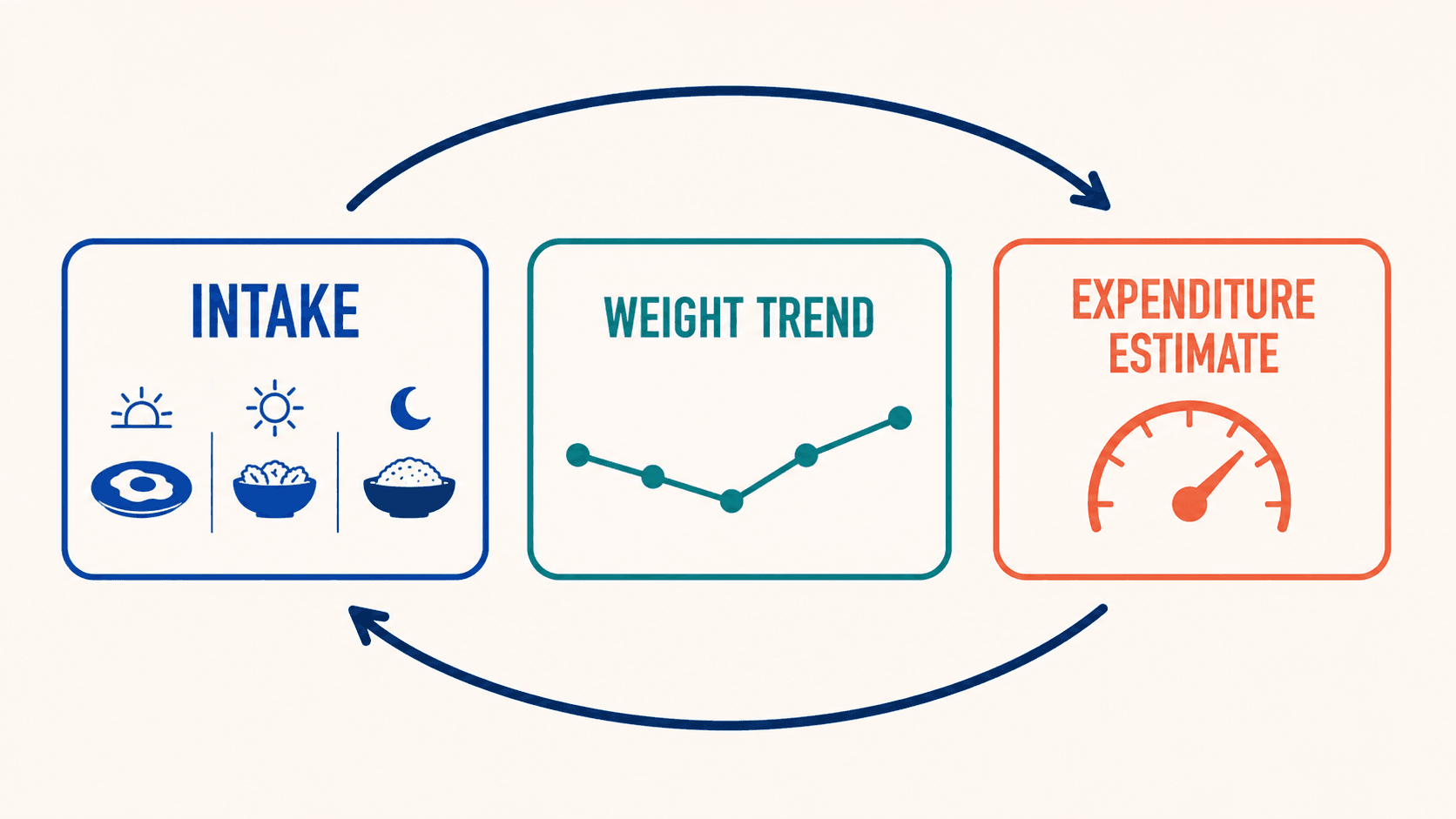
What a complete system needs to deliver is structured food capture, adaptive targets, pattern detection, and a closed feedback loop. Most products in 2026 are still building one layer and hoping users will supply the rest themselves.